All species › Kingfishers, bee-eaters and rollers › Bee-eaters › Swallow-Tailed Bee-Eater
Swallow-Tailed Bee-Eater | Merops hirundineus
Zwaluwstaartbijeneter | Abejaruco Golondrina
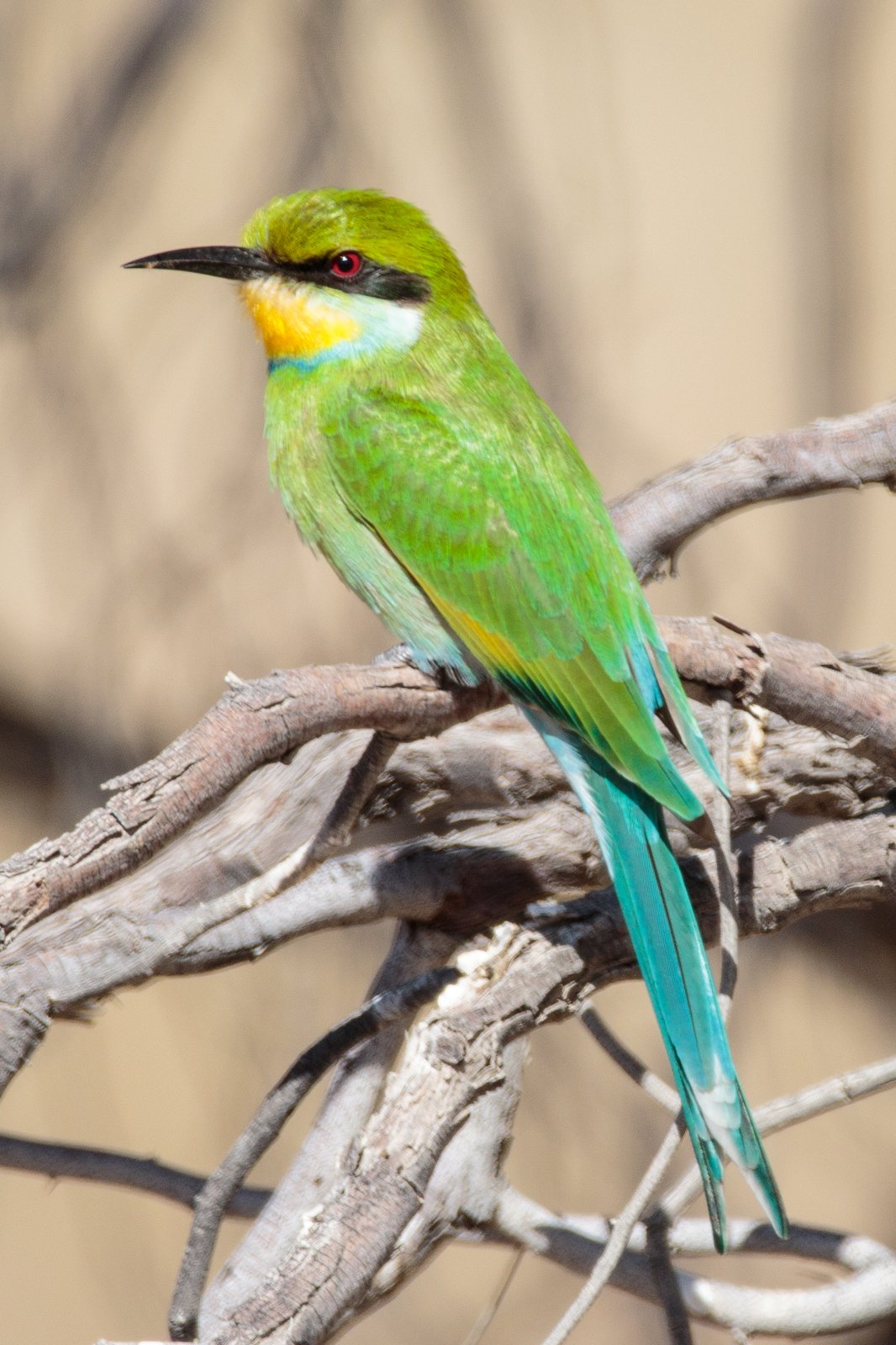
The Swallow-Tailed Bee-Eater is the only bee-eater in the region with a deeply forked tail. It is a bee-eater of dry woodland and Kalahari thornveld that can live far from water and often sits in pairs or small groups on low branches.
Voice
A soft, clear twitter, kwit-kwit or tsip-tsip, and a fuller trilling kwiirr, mainly on take-off and between members of a group. Not loud, but carries well on still mornings on the Kalahari sands.
Recording: Keith Blomerley — CC BY-NC-SA 4.0 · converted to mono · xeno-canto
Identification
About 21 cm, including the forked tail. Upperparts grass-green with a golden sheen, throat bright yellow above a narrow blue collar. Breast green, shading to a blue-green belly and pale blue undertail coverts. A black mask, sometimes with a thin blue line above it. The tail is blue, deeply forked, with black tips and a white fringe; in flight the cinnamon flight feathers with a black trailing edge show. The sexes are alike. Juveniles lack the yellow throat and blue collar, are plainer green and have a shallower fork.
Confusion species
Little Bee-Eater (Merops pusillus) is smaller, with a black rather than blue collar, an ochre-brown breast and a square rufous tail. Böhm's Bee-Eater (Merops boehmi) has a rufous crown and throat and long thin streamers instead of a fork. European Bee-Eater (Merops apiaster) is much larger, with a chestnut crown and mantle and short streamers.
Habitat
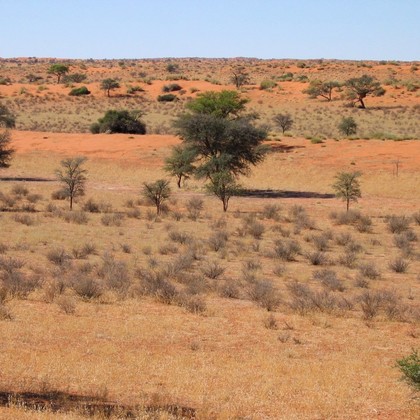
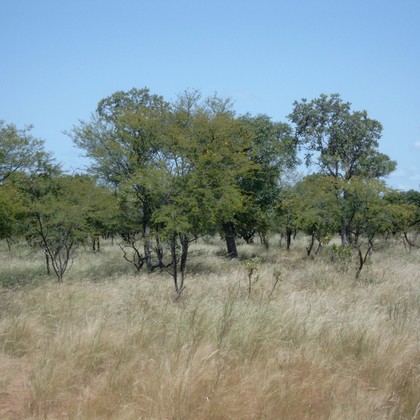
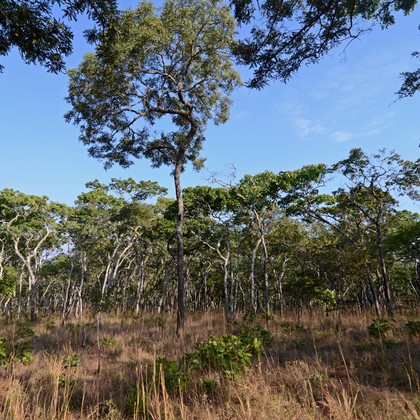
Dry open woodland, Kalahari thornveld with scattered trees on sand, miombo and mopane, also dry riverbeds and bushy dune country. Less tied to water than other bee-eaters. It hunts from a perch for bees, wasps and other flying insects. It nests in a tunnel in flat sand or a low sandbank.
Where the bird is most at home, classified by the vegetation units of southern Africa.
Range and movements
Mainly in the west and centre of the region: Namibia (except the Namib coast), Botswana, the northern Northern Cape and western Limpopo and North West in South Africa, western Zimbabwe, Zambia, Angola, Malawi and central and northern Mozambique. Beyond the region in a belt through the Sahel from Senegal to Sudan and in East Africa to Tanzania.
- Resident
- Summer visitor (c. Oct–Mar)
- Winter visitor (c. Apr–Sep)
- Passage (Mar–Apr, Oct–Nov)
- dark = core range, pale = thinly spread
How and when to look
Kgalagadi Transfrontier Park and the Central Kalahari are reliable: the birds sit low in thorn bushes along the dry beds of the Auob and Nossob. In Namibia often along sand roads through thornveld. Watch for the forked tail on take-off, which gives the species away at once.
Conservation status
Not threatened and widespread, although numbers fall locally where woodland is converted to cropland. In many areas it is scarcer than Little Bee-Eater, but in its core range on the Kalahari sands it is common.
Scientific name
Merops hirundineus | Lichtenstein, 1793
Lichtenstein described the species in 1793 and placed it straight away in the genus where it still stands. The genus Merops was introduced in 1758 by Linnaeus. Merops is Greek and means 'bee-eater'. hirundineus is Latin for 'swallow-like', from hirundo, 'swallow' — for the deeply forked tail. The specimen the first description was based on came from Orange River, South Africa.