All species › Kingfishers, bee-eaters and rollers › Bee-eaters › Little Bee-Eater
Little Bee-Eater | Merops pusillus
Dwergbijeneter | Abejaruco Chico
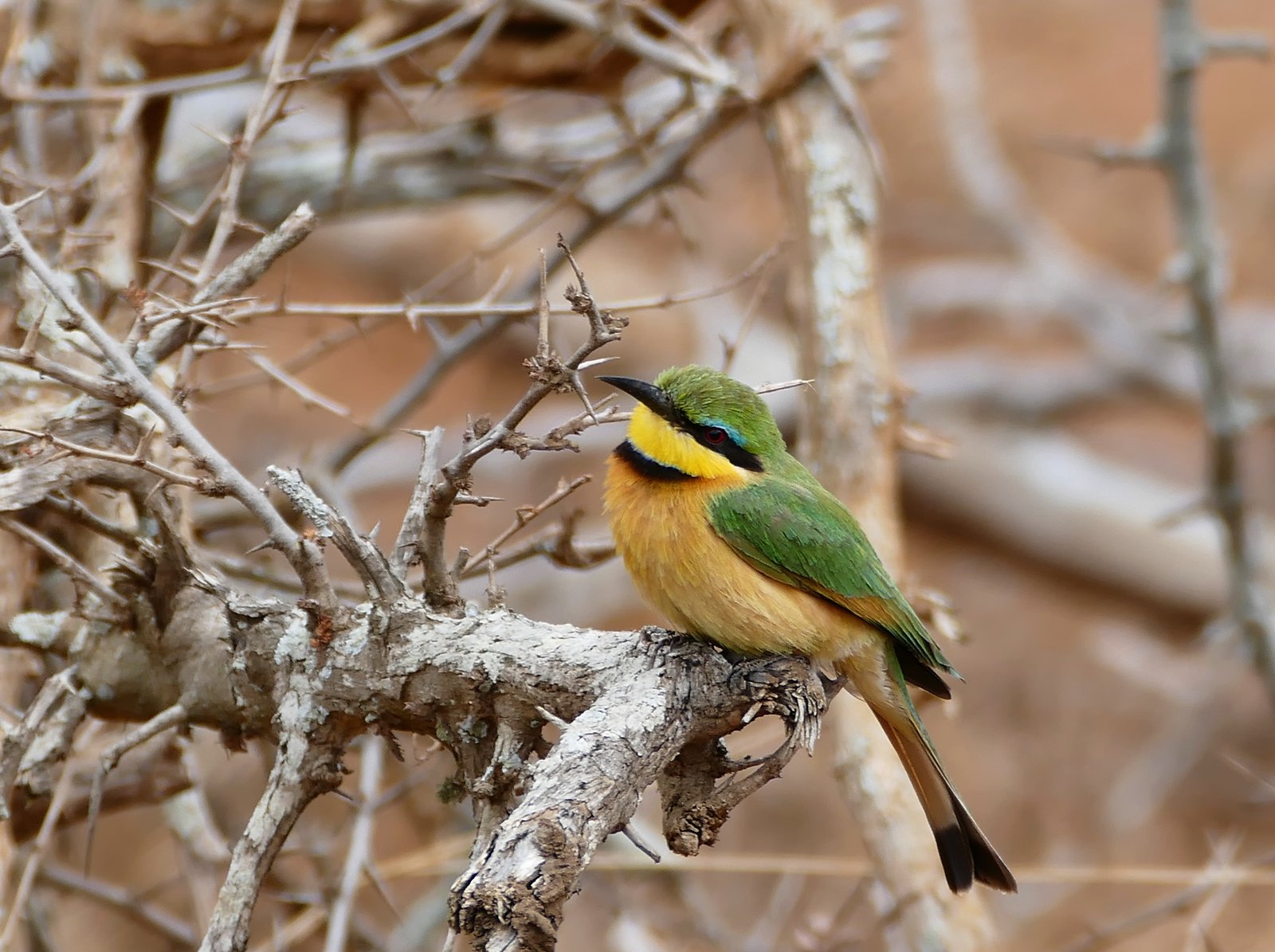
The Little Bee-Eater is the smallest and most widespread bee-eater of the region: a grass-green bird with a yellow throat that hunts low over grass and bushes. Pairs and family parties often sit pressed together on a low branch.
Voice
A soft, high, short sip or tsip-tsip, sometimes run into a quick soft twitter, siddle-iddle-ip, mainly among groups perched together. Unobtrusive and often overlooked.
Recording: GABRIEL LEITE — CC BY-NC-SA 4.0 · converted to mono · xeno-canto
Identification
About 16 cm, with a square, slightly notched tail lacking streamers. Upperparts grass-green, throat bright yellow above a black gorget; the breast is warm ochre-brown, shading to a paler buff belly. A black mask, in many birds with a thin blue line above it. In flight the wings are cinnamon with a black trailing edge, and the tail is rufous with a black terminal band and green central feathers. The sexes are alike. Juveniles lack the black gorget and are greener on the breast.
Confusion species
Swallow-Tailed Bee-Eater (Merops hirundineus) is larger, with a blue rather than black collar, a blue-green belly and a deeply forked blue tail. Blue-Breasted Bee-Eater (Merops variegatus), in Zambia and Angola, is larger, with a white cheek patch and a blue-black breast band. Böhm's Bee-Eater (Merops boehmi) has a rufous crown, green underparts and long streamers.
Habitat
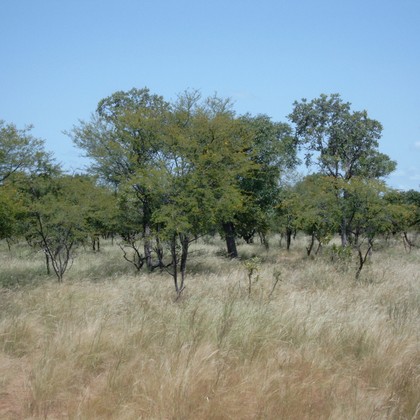
The edges of savanna and woodland with tall grass and scrub, riverside growth, reed fringes at vleis and dams, and rank ground by fields and road verges. It hunts from a low perch, often no more than a metre above the ground, for small flying insects. It nests in a tunnel in a low bank, a ditch wall or an aardvark burrow.
Where the bird is most at home, classified by the vegetation units of southern Africa.


Range and movements
Across the north and east of the region: almost all of Zambia, Malawi, Mozambique and Angola, Zimbabwe, northern and eastern Botswana, northern Namibia, Eswatini and northern and eastern South Africa south to KwaZulu-Natal and the Eastern Cape. Absent from the arid west and the Cape. Beyond the region across almost all of sub-Saharan Africa, from Senegal to Ethiopia.
- Resident
- Summer visitor (c. Oct–Mar)
- Winter visitor (c. Apr–Sep)
- Passage (Mar–Apr, Oct–Nov)
- dark = core range, pale = thinly spread
How and when to look
All year along rivers and vleis in the lowveld, the Okavango and Chobe area and the Zambezi valley. Scan the low branches above tall grass: the birds make short sallies and keep returning to the same twig. In the early morning up to five or six may sit in a row pressed against each other.
Conservation status
Not threatened and common throughout its range. It tolerates disturbed ground well and locally benefits from road verges and rank field margins.
Scientific name
Merops pusillus | Müller, 1776
Müller described the species in 1776 and placed it straight away in the genus where it still stands. The genus Merops was introduced in 1758 by Linnaeus. Merops is Greek and means 'bee-eater'. pusillus is Latin for 'very small' — it is the smallest African bee-eater. The specimen the first description was based on came from Senegal.