All species › Woodpeckers and allies › Woodpeckers › Olive Woodpecker
Olive Woodpecker | Dendropicos griseocephalus
Olijfspecht | Pito Oliváceo
The Olive Woodpecker is the woodpecker of evergreen forest: an unmarked, golden-olive bird with a grey head and a red rump. It is heard more often than seen, high in the canopy of montane and coastal forest.

Voice
A loud, high weet-weet-weet or yeh-yeh-yeh and a fast rattling chrrrrr; also a sharp single chik. It drums briefly and strongly.
Recording: Lynette Rudman — CC BY-NC-SA 4.0 · shortened to the first 60 s, mono · xeno-canto
Identification
About 19 cm. Head and neck are plain grey; the male has a red crown, the female a grey crown. Back and wings are golden olive-green without markings, the rump and uppertail coverts bright red, the tail dark. In the south the underparts are plain greyish olive; in the northern form (in Angola, Zambia and Malawi) the belly shows a red patch. The bill is dark grey, the eye reddish-brown. Juveniles are duller, with a greyer back.
Confusion species
No other woodpecker in the region is so unmarked: Knysna Woodpecker (Campethera notata), Golden-Tailed Woodpecker (Campethera abingoni) and Cardinal Woodpecker (Dendropicos fuscescens) all have spots, streaks or bars below or on the back. In north-western Angola Elliot's Woodpecker (Dendropicos elliotii) is also plain olive above, but has a pale buffy face, a streaked belly and no red rump.
Habitat
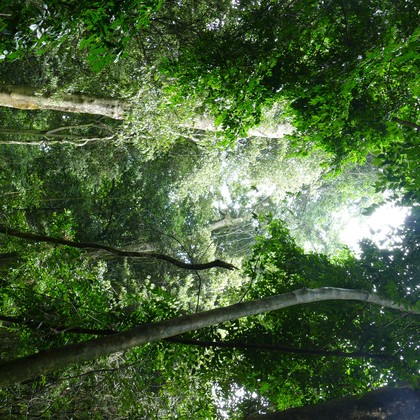
Afromontane forest, Podocarpus mountain forest, coastal and dune forest, and in the north also gallery forest and forest edges; locally in adjacent plantations, gardens and dense woodland. It forages mainly in the middle and upper storeys, on trunks, branches and among epiphytes, often in mixed flocks.
Where the bird is most at home, classified by the vegetation units of southern Africa.

Range and movements
In South Africa in a band from the south coast at Knysna and George through the Eastern Cape and KwaZulu-Natal to Mpumalanga and Limpopo, and in Eswatini; further in the eastern highlands of Zimbabwe and adjacent Mozambique, the montane forests of Malawi, northern Zambia and the interior of Angola. Beyond the region to eastern DR Congo, Rwanda, Uganda and Tanzania.
- Resident
- Summer visitor (c. Oct–Mar)
- Winter visitor (c. Apr–Sep)
- Passage (Mar–Apr, Oct–Nov)
- dark = core range, pale = thinly spread
How and when to look
The high weet-weet gives the bird away in forests such as those of the Garden Route, Karkloof, Magoebaskloof and the Vumba. Look high in the canopy; the red rump is the best feature on a bird flying off. Pair members keep in touch with soft calls.
Conservation status
Not threatened and locally common in suitable forest. Dependent on evergreen forest, so fragmentation and logging of montane forest reduce numbers locally; elsewhere it benefits from old plantations.
Scientific name
Dendropicos griseocephalus | (Boddaert, 1783)
Boddaert described the species in 1783 as Picus griseocephalus; because it was later moved to another genus, the author and year stand in brackets. The genus Dendropicos was introduced in 1849 by Malherbe. Dendropicos combines the Greek dendron, 'tree', with the Latin picus, 'woodpecker': a 'tree woodpecker'. griseocephalus means 'grey-headed', from the Medieval Latin griseus, 'grey', and the Greek kephalē, 'head' — for the plain grey head. The specimen the first description was based on came from Cape of Good Hope.