All species › Woodpeckers and allies › Woodpeckers › Elliot's Woodpecker
Elliot's Woodpecker | Dendropicos elliotii
Elliots specht | Pito de Elliot
Elliot's Woodpecker is a Central African forest woodpecker that reaches the region only in the far north-west of Angola. It is an inconspicuous, plain olive woodpecker with a long bill and a pale face, found mainly in mixed flocks high in the forest.

Voice
Little known and not noisy. A high kee-kee-kee and a dry rattling chrrr. It drums briefly and rarely.
Recording: Magnus Wadstein — CC BY-NC-SA 4.0 · converted to mono · xeno-canto
Identification
About 20 cm, with a fairly long, straight bill. The upperparts are plain olive-green without bars or spots. Face and throat are pale buffy-yellow, without a distinct moustachial stripe. The underparts are yellowish olive with dark streaking on breast and flanks. The male has a black forecrown and a red hind crown; in the female the whole crown is black. The tail is dark olive-brown.
Confusion species
Olive Woodpecker (Dendropicos griseocephalus) has a grey head, a red rump and an unstreaked belly. Brown-Eared Woodpecker (Campethera caroli) has a dark brown ear-patch and a spotted breast. Buff-Spotted Woodpecker (Campethera nivosa) is smaller, with a short bill and densely spotted underparts. Yellow-Crested Woodpecker (Chloropicus xantholophus) is larger, with a golden-yellow crown and a white stripe across the face.
Habitat
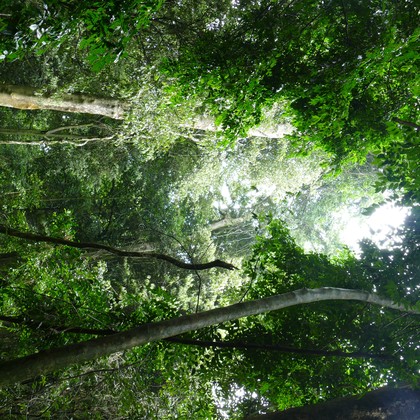
Humid lowland forest, submontane forest and gallery forest, also old secondary growth and forest edges. It forages in the middle and upper storeys on thin branches and lianas, usually in pairs and often in mixed-species flocks, taking ants, beetles and their larvae.
Where the bird is most at home, classified by the vegetation units of southern Africa.

Range and movements
Within the region only in north-western Angola, in Cabinda and on the forested slopes of the northern interior. Beyond the region from south-eastern Nigeria and Cameroon through Gabon, Congo and DR Congo to western Uganda.
How and when to look
A species for those searching the forests of north-western Angola; follow mixed flocks of bulbuls, drongos and flycatchers in the canopy and watch for an olive woodpecker working slowly along thin branches. The pale, almost unmarked face is the best clue.
Conservation status
Not threatened and widespread in the Central African forest block. In Angola it is confined to a small forest area threatened by deforestation, so it is vulnerable there to logging and conversion to farmland.
Scientific name
Dendropicos elliotii | (Cassin, 1863)
Cassin described the species in 1863 as Polipicus Elliotii; because it was later moved to another genus, the author and year stand in brackets. The genus Dendropicos was introduced in 1849 by Malherbe. Dendropicos combines the Greek dendron, 'tree', with the Latin picus, 'woodpecker': a 'tree woodpecker'. elliotii honours the American ornithologist Daniel Giraud Elliot (1835–1915). The specimen the first description was based on came from Muni River, Gabon.