All species › Woodpeckers and allies › Woodpeckers › Cardinal Woodpecker
Cardinal Woodpecker | Dendropicos fuscescens
Kardinaalspecht | Pito Cardenal
The Cardinal Woodpecker is the smallest and most widespread woodpecker in the region, found in almost every type of woodland and scrub. It works restlessly over thin twigs and is often the first member of a mixed flock to attract attention.

Voice
A high, dry rattling krrrrrr-rr or chirrrr and a sharp chik. It drums often, softly and rapidly, on thin dead twigs.
Recording: isaac kilusu — CC BY-NC-SA 4.0 · converted to mono · xeno-canto
Identification
About 15 cm, with a short, straight bill. Forehead and forecrown are brown; the male has a red hind crown and nape, the female a black hind crown. The face is white with a black moustachial stripe. The back is olive-brown with regular pale bars, the wings are spotted and the tail barred. The underparts are white to pale buff with distinct black streaking. Juveniles of both sexes show some red on the crown.
Confusion species
Bearded Woodpecker (Chloropicus namaquus) is much larger, with a bold black-and-white face and finely barred underparts. Golden-Tailed Woodpecker (Campethera abingoni) is larger, with a spotted rather than barred back and, in the male, an all-red crown. Stierling's Woodpecker (Dendropicos stierlingi) in Malawi and Mozambique has a plain brown back and a scaled breast. The brown forehead with the black moustachial stripe and the barred back are diagnostic together.
Habitat
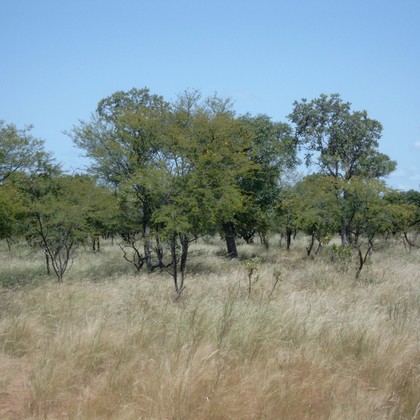
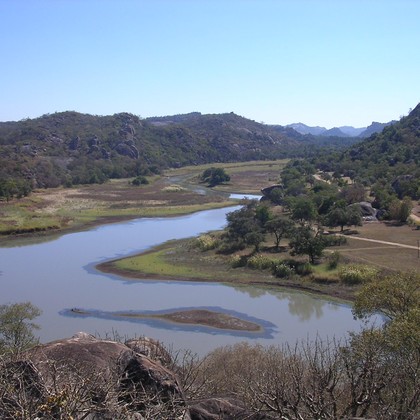
Almost any wooded habitat: acacia savanna, miombo, mopane, mixed woodland, riverine forest, forest edges, scrub in the Karoo and along dry rivers, plantations and gardens. It is absent only from closed montane forest and from completely treeless country. It forages low to high on thin twigs, stems and even maize stalks, singly or in pairs, taking small insects and their larvae.
Where the bird is most at home, classified by the vegetation units of southern Africa.

Range and movements
Distributed across almost the whole region, from Angola and Zambia to the Cape; scarce or absent only in the barren Namib and in the treeless parts of the Karoo and the Highveld. Beyond the region across almost all of sub-Saharan Africa.
- Resident
- Summer visitor (c. Oct–Mar)
- Winter visitor (c. Apr–Sep)
- Passage (Mar–Apr, Oct–Nov)
- dark = core range, pale = thinly spread
How and when to look
In any bushveld listen for a soft, rapid drumming or a high rattle in a mixed flock; the woodpecker is so small that it may first suggest a large tit. The brown forehead is usually visible even on a bird seen from behind.
Conservation status
Not threatened and common to very common. With its modest demands on woodland, the species copes well with disturbed and man-altered landscapes.
Scientific name
Dendropicos fuscescens | (Vieillot, 1818)
Vieillot described the species in 1818 as Picus fuscescens; because it was later moved to another genus, the author and year stand in brackets. The genus Dendropicos was introduced in 1849 by Malherbe. Dendropicos combines the Greek dendron, 'tree', with the Latin picus, 'woodpecker': a 'tree woodpecker'. fuscescens is Latin for 'brownish, darkish', from fuscus, 'dusky brown'. The specimen the first description was based on came from Grootvadersbosch near Swellendam, Western Cape, South Africa.