All species › Woodpeckers and allies › Woodpeckers › Ground Woodpecker
Ground Woodpecker | Geocolaptes olivaceus
Kaapse grondspecht | Pito Terrestre
The Ground Woodpecker is the only woodpecker in the region that hardly ever uses trees. In small family groups it hops over rocky mountain slopes, digging ants out of the soil and from under stones, and it breeds in a tunnel it excavates in an earth bank.
Voice
A loud, harsh, rasping chik-ree chik-ree or pee-aargh, often given from a boulder; group members call to one another. It almost never drums.
Recording: Lynette Rudman — CC BY-NC-SA 4.0 · converted to mono · xeno-canto
Identification
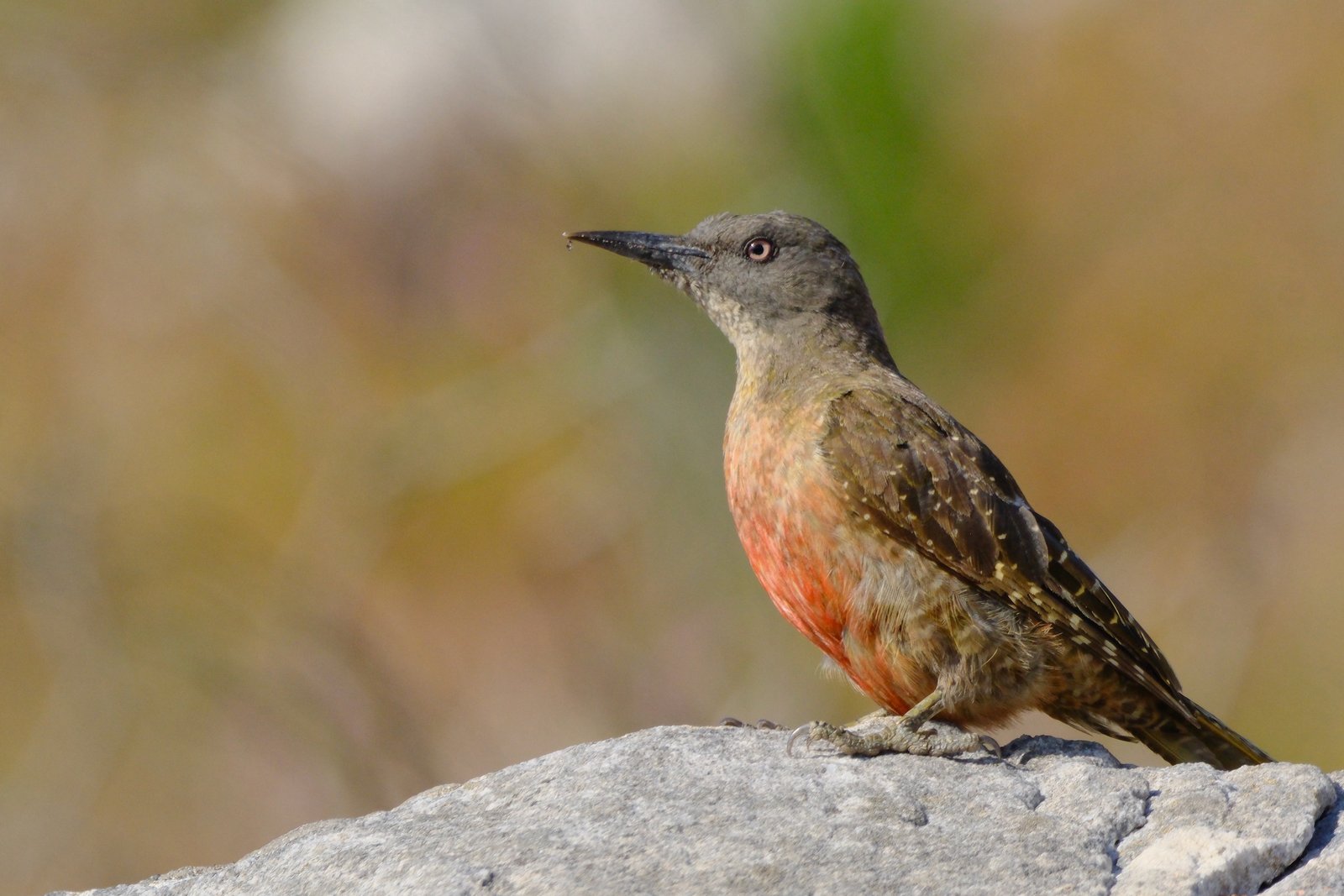
About 25 cm, a large, stocky woodpecker with a long, slightly curved bill. Head and upperparts are greyish olive-brown, the back and wings finely barred and spotted pale; the rump is red. The eye is strikingly pale, white to pink, set in a grey face. Throat pale, breast and belly pink to rosy red, flanks grey-brown. The male has a red moustachial stripe, which is grey in the female. In flight the red rump and barred wings stand out. Juveniles are duller and less pink.
Confusion species
Hardly confusable in its rocky habitat. Olive Woodpecker (Dendropicos griseocephalus) has a grey head, olive-green back and dark eye and lives in forest. Red-Throated Wryneck (Jynx ruficollis) is smaller and slimmer, with a rufous throat and cryptic grey-brown plumage, and usually sits in trees or on posts.
Habitat
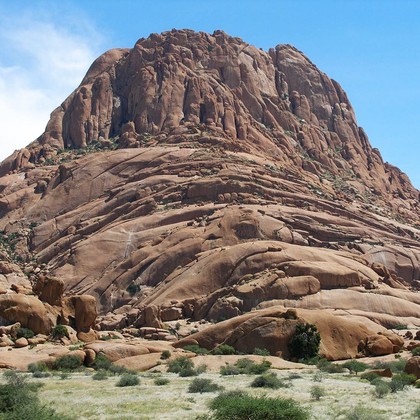
Rocky slopes, cliffs and boulder fields in mountain fynbos, montane grassland and on the Karoo margins, usually above 1000 m inland but down to sea level in the Western Cape. It lives in groups of three to five on the ground and feeds mainly on ant larvae and pupae. It digs a tunnel up to a metre long in a sandy or loamy bank.
Where the bird is most at home, classified by the vegetation units of southern Africa.


Range and movements
Endemic to southern Africa: the mountains of the Western, Eastern and Northern Cape, the Drakensberg, Lesotho, western Eswatini and the eastern escarpments of KwaZulu-Natal and Mpumalanga, north to southern Limpopo. It does not occur outside South Africa, Lesotho and Eswatini.
- Resident
- Summer visitor (c. Oct–Mar)
- Winter visitor (c. Apr–Sep)
- dark = core range, pale = thinly spread
How and when to look
In early morning scan boulders on mountain slopes, for example on the passes around Cape Town, in the Cederberg or in the Drakensberg, for a grey bird sitting upright. The raucous call often gives the group away hundreds of metres off; when approached they fly off low and land on another boulder.
Conservation status
Near Threatened. The species is declining in parts of its range, especially in the Western Cape, which has been linked to rising temperatures, more frequent fynbos fires, overgrazing and the spread of plantations and alien trees on mountain slopes.
Scientific name
Geocolaptes olivaceus | (Gmelin, 1788)
Gmelin described the species in 1788 as Picus olivaceus; because it was later moved to another genus, the author and year stand in brackets. The genus Geocolaptes was introduced in 1832 by Swainson. Geocolaptes comes from the Greek gē, 'earth', and the genus Colaptes (flickers) — for this woodpecker that forages on the ground among rocks. olivaceus is Latin for 'olive-green', from oliva, 'olive' — for the olive upperparts. The specimen the first description was based on came from Cape of Good Hope.