All species › Passerines › Waxbills › Orange-Breasted Waxbill
Orange-Breasted Waxbill | Amandava subflava
Goudbuikje | Bengalí Cebra
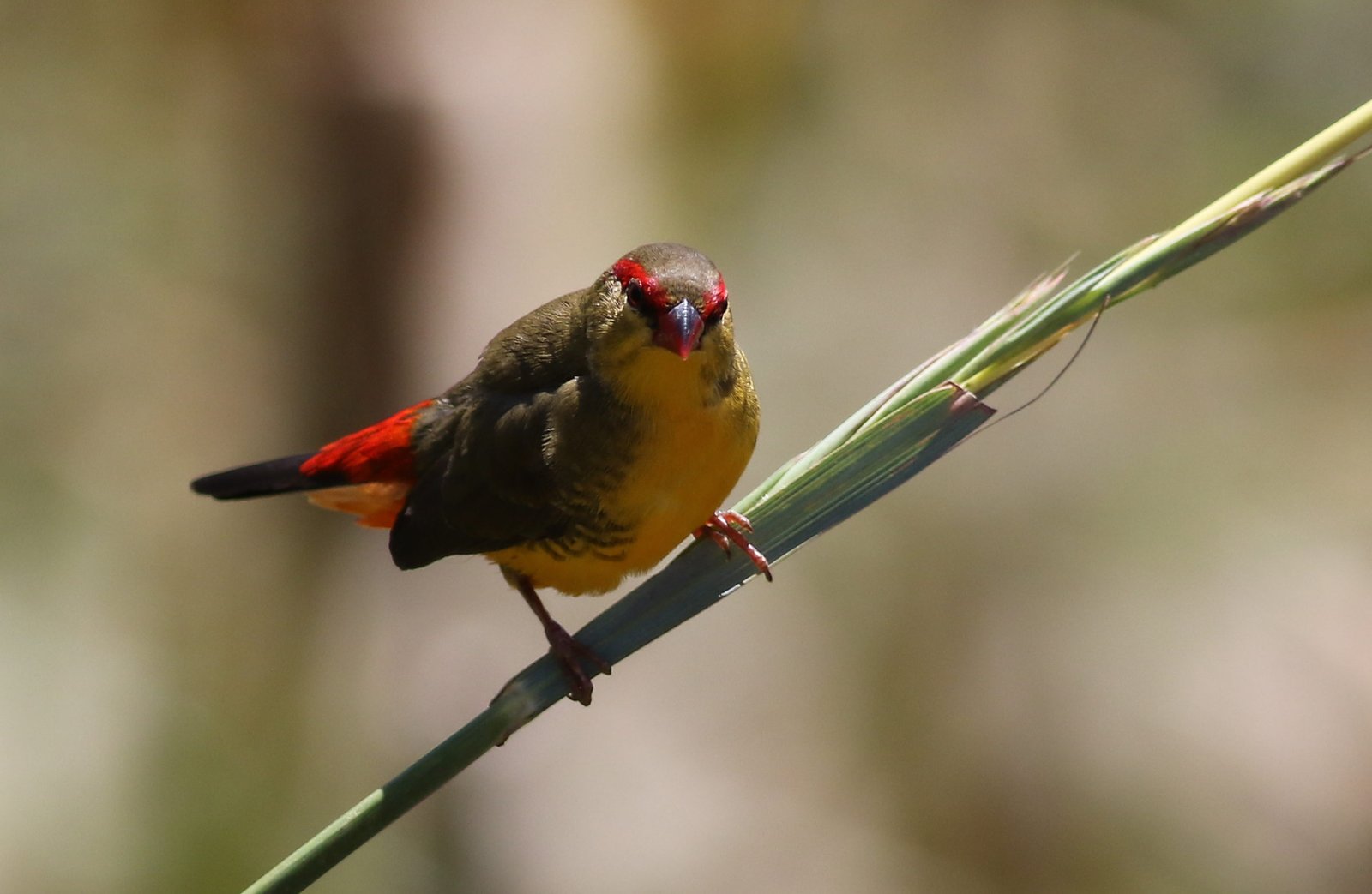
The Orange-Breasted Waxbill is the smallest estrildid of the region: an olive-green and golden-yellow bird of rank grass near water, which whirrs away low over the grass in fast little flocks, flashing its red rump.
Voice
A soft, metallic tsip or zink, from flushing flocks a tinkling chorus; the song is a monotonous series of soft, high notes, tsi-tsi-tsi-tseep.
Recording: Dries Van de Loock — CC BY-NC-SA 4.0 · converted to mono · xeno-canto
Identification
9–10 cm. Upperparts olive-brown to olive-green, rump and uppertail coverts scarlet, tail blackish. The male has a red supercilium, golden-yellow underparts with an orange breast and orange-red undertail coverts, and olive-green and yellow barred flanks. The bill is red with a dark culmen line. The female lacks the red supercilium and is paler yellow below without orange on the breast, but also has the red rump and barred flanks. Juveniles are plain yellowish-brown with a black bill and a duller rump.
Confusion species
The Common Waxbill (Estrilda astrild) is larger and brown, finely barred, with a red eye-stripe and red belly patch but no red rump. The Swee Waxbill (Coccopygia melanotis) also has a red rump and green back, but a grey head (the male with a black face) and pale underparts without flank barring; it is a bird of forest edges and gardens. The Locust Finch (Paludipasser locustella) shares the wet grassland, but the male has a red face and blackish underparts, and both sexes show orange in the wing. The Quailfinch (Ortygospiza atricollis) is a barred ground bird without a red rump, with black and white on the face.
Habitat
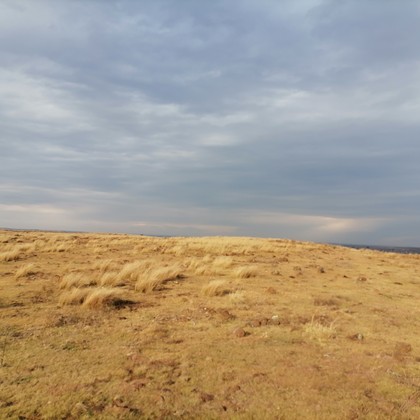
Rank, tall grass and reedy margins at vleis, rivers and dams, flooded grassland and damp fields, also overgrown sugarcane and rice fields. It feeds in small flocks on grass stems and on the ground on small grass seeds. It often breeds in old nests of weavers or bishops, which it lines with grass and feathers.
Where the bird is most at home, classified by the vegetation units of southern Africa.

Range and movements
Widespread in the north and east of the region: Angola, Zambia, Malawi, Mozambique, Zimbabwe, northern Botswana (Okavango Delta, Chobe), north-eastern Namibia, and in South Africa from Limpopo, Mpumalanga and Gauteng through the eastern Free State and KwaZulu-Natal to the east of the Eastern Cape; also Eswatini, and scarce in Lesotho. Beyond the region across much of sub-Saharan Africa, from Senegal to Ethiopia and East Africa.
- Resident
- Summer visitor (c. Oct–Mar)
- Winter visitor (c. Apr–Sep)
- Passage (Mar–Apr, Oct–Nov)
- dark = core range, pale = thinly spread
How and when to look
Walk the edge of a vlei or dam with tall grass and listen for the tinkling contact call: small flocks flush just ahead, land further on and then climb up grass stems, where males show well. The female is best identified by the combination of red rump and barred yellow flanks.
Conservation status
Not threatened. Common, but often overlooked because of its secretive habits. It benefits locally from dams and irrigation, but loses habitat where vleis are drained or overgrazed.
Scientific name
Amandava subflava | (Vieillot, 1819)
Vieillot described the species in 1819 as Fringilla subflava; because it was later moved to another genus, the author and year stand in brackets. The genus Amandava was introduced in 1836 by Blyth. Amandava is a corruption of Ahmedabad in Gujarat, the Indian city from which the first specimens of the Red Avadavat came. subflava is Latin for 'yellowish', from sub, 'somewhat', and flavus, 'yellow' — for the yellow to orange underparts. The specimen the first description was based on came from Senegal.