All species › Passerines › Starlings › Pale-Winged Starling
Pale-Winged Starling | Onychognathus nabouroup
Vaalvleugelspreeuw | Estornino Naburup
Pale-Winged Starling is a large, glossy black starling of the arid rocky country of western southern Africa. With its orange eye and the pale, almost white patch in the wing, which lights up like a bright window in flight, it is the western counterpart of Red-Winged Starling.

Voice
A loud, clear whistle, preeoo or cheep-cheeoo, often in flight; also a harsh, grating cherrr in alarm and a soft, chattering song of whistles and scratchy notes given from a boulder.
Recording: Filippo Ceccolini — CC BY-NC-SA 4.0 · converted to mono · xeno-canto
Identification
26–28 cm, with a fairly long, slightly graduated tail. The sexes are alike: wholly black with a blue to greenish gloss on the head, body and wings. The primaries are largely pale cream to whitish, with a rusty wash at the base and dark tips; on the perched bird this shows as a narrow pale panel, in flight as a large pale wing patch. The eye is bright orange, the bill and legs black. Juveniles are duller, with a browner eye. It lives in pairs and small groups that fly noisily back and forth along cliff faces.
Confusion species
Red-Winged Starling Onychognathus morio has rufous, not pale, primaries and a dark red eye, and the female has a grey head; where the ranges meet, in the eastern Karoo and southern Namibia, wing colour in flight is the best feature. Cape Starling Lamprotornis nitens is smaller, bright blue-green glossed, with a yellow eye and no pale wing panel. The voice differs too: the whistle of Pale-Winged Starling sounds thinner and less full than that of Red-Winged Starling.
Habitat
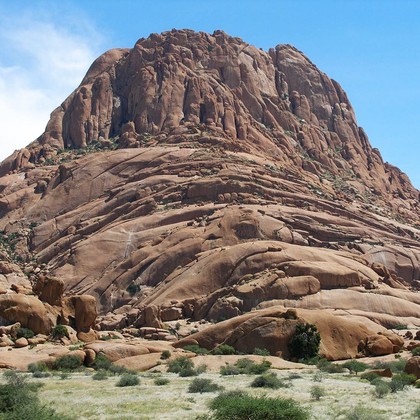
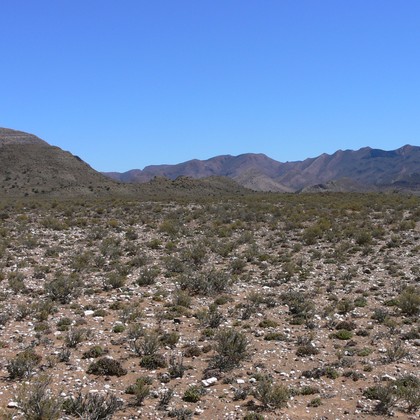
Gorges, cliffs, koppies and rocky hills in semi-desert, Karoo and dry savanna, to the edge of the Namib Desert; also around farms, dams and villages in rocky terrain. It eats figs, berries of Lycium and mistletoe among others, aloe nectar and insects. It nests in rock crevices and sometimes in buildings.
Where the bird is most at home, classified by the vegetation units of southern Africa.

Range and movements
In the west of the region: south-western Angola (Namibe, Huíla), virtually all of Namibia except the north-east, locally the extreme south-west of Botswana, and in South Africa the Northern Cape and the western and central Karoo. It does not occur outside the region.
- Resident
- Winter visitor (c. Apr–Sep)
- dark = core range, pale = thinly spread
How and when to look
Year-round. Good sites are Spitzkoppe, the Naukluft, Fish River Canyon, Augrabies and the Richtersveld; search cliff faces and listen for the whistle. In flight the pale wing patch shows from afar. Where the range meets that of Red-Winged Starling it pays to check every passing Onychognathus for wing colour and eye colour.
Conservation status
Not threatened; fairly common and stable within its limited, largely arid range. It benefits locally from farms, gardens and orchards, where it also takes fruit.
Scientific name
Onychognathus nabouroup | (Daudin, 1800)
Daudin described the species in 1800 as Sturnus nabouroup; because it was later moved to another genus, the author and year stand in brackets. The genus Onychognathus was introduced in 1849 by Hartlaub. Onychognathus combines the Greek onyx 'nail, claw' and gnathos 'jaw'. nabouroup is the Namaqua name for this starling; Levaillant (1801) wrote that he kept the name by which the Namaqua called the bird. The specimen the first description was based on came from Kamiesberg, Namaqualand, Northern Cape, South Africa.