All species › Nightjars › Nightjars › Pennant-Winged Nightjar
Pennant-Winged Nightjar | Caprimulgus vexillarius
Wimpelnachtzwaluw | Chotacabras Cuelgacintas
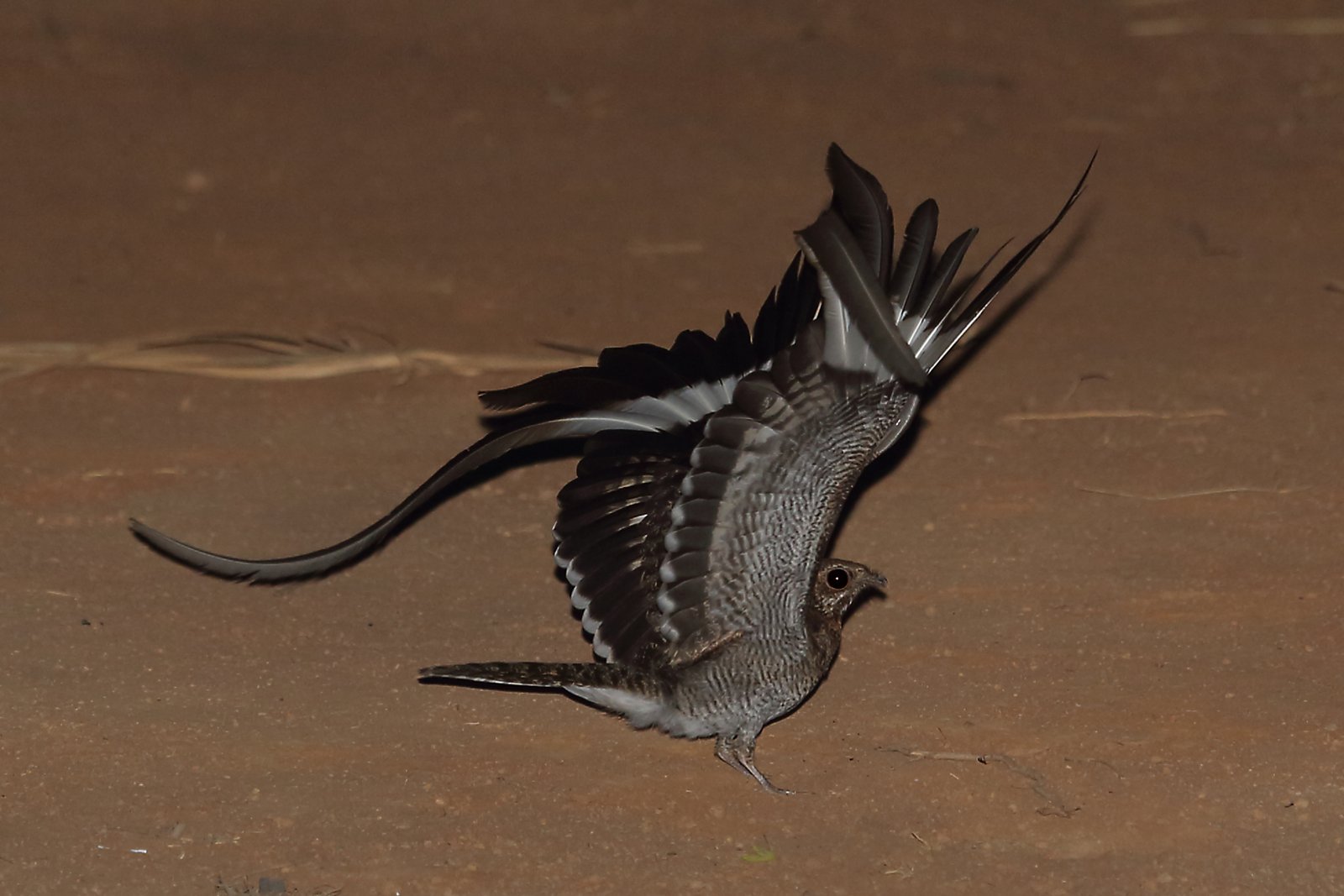
The Pennant-Winged Nightjar is a nightjar of southern Africa. In the breeding season the male carries a greatly elongated primary in each wing that trails behind him as a long, pale pennant, so that a bird flying at dusk can look like three or four birds at once.
Voice
A very high, thin, insect-like twittering and squeaking, tsip-tsip-tsiiip, often so faint that many people cannot hear it. The male gives it during display, circling the female on slow wingbeats with the pennants raised.
Recording: Dries Van de Loock — CC BY-NC-SA 4.0 · converted to mono · xeno-canto
Identification
25–28 cm without the pennants; with pennants the male reaches about 70 cm. A large, warm brown nightjar with fine dark markings and a rufous hind collar. The breeding male has a broad white band across the black primaries, and the elongated primaries step up in length to the pennant, which is dark at the base and largely white beyond. After breeding the pennants are broken off or shed. The female is large, plain brown and lacks any white in wing or tail; the primaries are barred rufous. Young males resemble the female.
Confusion species
A male with pennants is unmistakable. A male without pennants is told by the broad white wing band and absence of white in the tail. The female is larger than the Fiery-Necked Nightjar (Caprimulgus pectoralis) and the Square-Tailed Nightjar (Caprimulgus fossii) and lacks the white or pale tail corners and wing spots of those species; the rufous-barred primaries are the best feature. The European Nightjar (Caprimulgus europaeus) is greyer and longer-winged.
Habitat
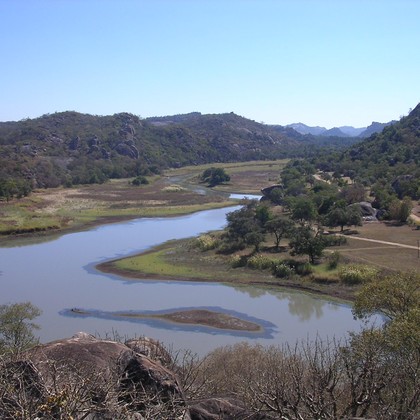
Miombo and other broad-leaved woodland, often on stony slopes, rocky ridges and in clearings with low growth. It hunts moths and beetles at dusk in a slow, floating flight above the treetops or along woodland edges. The two eggs are laid on bare ground among leaf litter.
Where the bird is most at home, classified by the vegetation units of southern Africa.

Range and movements
Breeds in the north and east of the region: Angola, Zambia, Malawi, Mozambique and Zimbabwe, as well as northern Botswana, north-eastern Namibia (Kavango and Zambezi Region) and sparsely in north-eastern South Africa (Limpopo and Mpumalanga). After breeding it moves to Africa just north of the equator, from Nigeria and Cameroon to South Sudan and Uganda.
- Summer visitor (c. Oct–Mar)
- Passage (Mar–Apr, Oct–Nov)
- dark = core range, pale = thinly spread
How and when to look
From October to December in miombo, at nightfall. Drive or walk slowly along a clearing or sandy track in the woodland and look against the still-light sky: the pennants of a hunting male show from hundreds of metres. Females also sit on sandy tracks, their eyes shining in the headlights.
Conservation status
Not threatened. It is locally fairly common in miombo, though scarce in the south of the region. Large-scale clearance of miombo for agriculture and charcoal is the main long-term threat; road kills on sandy tracks are regular.
Scientific name
Caprimulgus vexillarius | (Gould, 1838)
Gould described the species in 1838 as Semeïophorus (Macrodypteryx?) vexillarius; because it was later moved to another genus, the author and year stand in brackets. The genus Caprimulgus was introduced in 1758 by Linnaeus. Caprimulgus is Latin, from capra 'nanny goat' and mulgere 'to milk', after the old belief that nightjars suckled goats at night. vexillarius is Latin for 'standard-bearer' — for the greatly elongated inner primaries the breeding male trails like pennants. The specimen the first description was based on came from Sierra Leone (original locality in error).