All species › Nightjars › Nightjars › European Nightjar
European Nightjar | Caprimulgus europaeus
Nachtzwaluw | Chotacabras Europeo
The European Nightjar that churrs over heaths and open woods in Europe spends the northern winter in the woodlands of eastern and southern Africa. Here it is silent and almost impossible to find by day, so it is far more common than the number of records suggests.
Voice
Mostly silent in Africa. A flushed bird sometimes gives a short quick or chuck. The familiar sustained churring of the breeding grounds is rarely heard here, at most shortly before departure.
Recording: Benjamin Drillat — CC BY-NC-SA 4.0 · converted to mono · xeno-canto
Identification
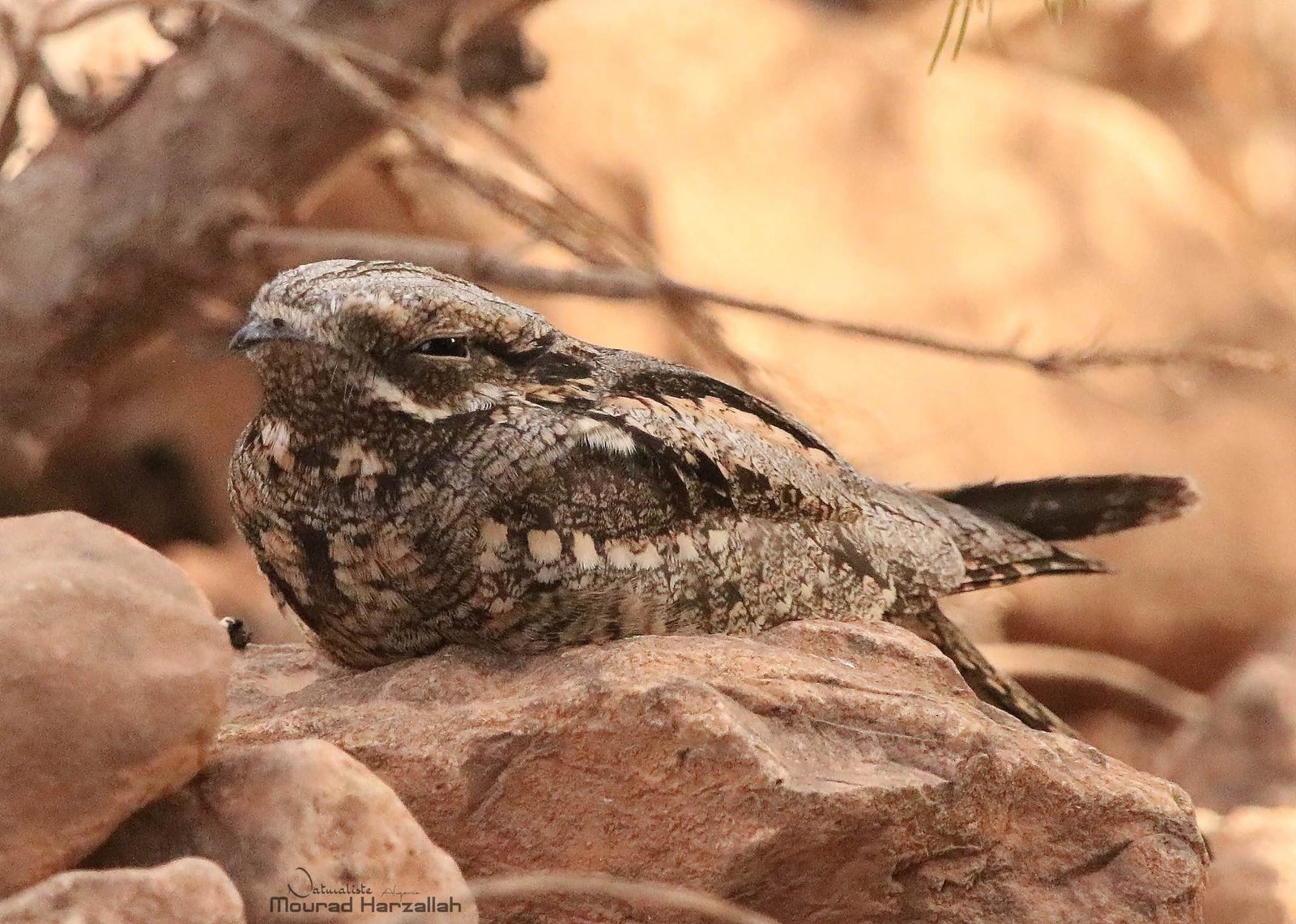
25–28 cm, wingspan 52–59 cm. A large, long and slender nightjar with long pointed wings and a long tail. The plumage is grey-brown with fine vermiculation and black streaks on crown and mantle, a pale stripe below the eye and a row of pale spots along the scapulars. There is no rufous hind collar. The male has white spots on the three outer primaries and white tail corners; females and first-year birds lack that white. Birds of eastern subspecies are paler and greyer. It roosts by day lengthwise along a horizontal branch, rarely on the ground.
Confusion species
The Fiery-Necked Nightjar (Caprimulgus pectoralis) and the Rufous-Cheeked Nightjar (Caprimulgus rufigena) are smaller and shorter-winged, with an obvious rufous hind collar. The female Pennant-Winged Nightjar (Caprimulgus vexillarius) is warmer brown with rufous-barred primaries. The longer, pointed wings, overall grey tone and habit of roosting along a branch point to this species.
Habitat
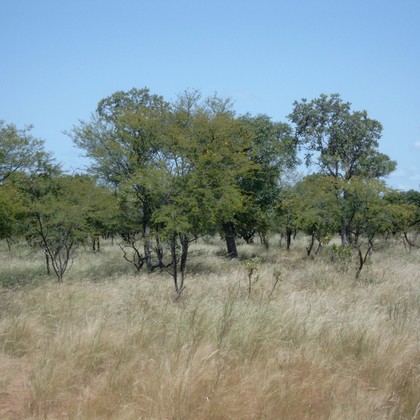
Woodland of all kinds, from miombo and mixed broadleaf woodland to acacia savanna, as well as plantations and woodland edges near farmland. It hunts moths, beetles and flying termites at dusk and by moonlight, often high above the treetops. By day it roosts on a branch in shade.
Where the bird is most at home, classified by the vegetation units of southern Africa.


Range and movements
Mainly in the east of the region: Zimbabwe, Zambia, Malawi, Mozambique and north-eastern South Africa, scarcer in northern Botswana and Namibia and in Angola; south to KwaZulu-Natal and the Eastern Cape, and scarce to absent in the arid west. It breeds from north-west Africa and Europe to Central Asia and Mongolia and winters in sub-Saharan Africa.
- Resident
- Summer visitor (c. Oct–Mar)
- Passage (Mar–Apr, Oct–Nov)
- dark = core range, pale = thinly spread
How and when to look
December to March. By day it is found only by chance, when a bird flushes from a branch; then note the long pointed wings and the lack of a rufous collar. In the evening nightjars often hunt around lights at camps and lodges, and in March and April small groups sometimes appear on passage.
Conservation status
Not threatened. In parts of the European breeding range it has declined through loss of heath and open woodland and a decrease in large insects. No clear threats are known in the African wintering areas, though road kills are regular.
Scientific name
Caprimulgus europaeus | Linnaeus, 1758
Linnaeus described the species in 1758 and placed it straight away in the genus where it still stands. He introduced the genus Caprimulgus in that same work. Caprimulgus is Latin, from capra 'nanny goat' and mulgere 'to milk', after the old belief that nightjars suckled goats at night. europaeus is Latin for 'European'. The specimen the first description was based on came from Sweden.