All species › Nightjars › Nightjars › Rufous-Cheeked Nightjar
Rufous-Cheeked Nightjar | Caprimulgus rufigena
Roodwangnachtzwaluw | Chotacabras Carirrojo
The Rufous-Cheeked Nightjar is the nightjar of the arid west. Its long, mechanical churring, like a distant two-stroke engine, is one of the typical sounds of summer nights in the Kalahari and the Karoo.

Voice
A long, sustained, even churring trrrrrrrrrrr that sometimes lasts for minutes, often introduced or ended with a few dull chuk-chuk notes. Given from the ground or a low branch, mainly in the first hours after sunset and by moonlight.
Recording: Bram Vogels — CC BY-NC-SA 4.0 · converted to mono · xeno-canto
Identification
22–24 cm. A medium-sized, rather pale and grey nightjar with fine vermiculation, black streaks on the crown and an orange-buff to creamy hind collar. The name refers to the rufous cheek, which is inconspicuous in the field. The throat has a white patch and the scapulars a pale edge. The male has white spots on the four outer primaries and white tail corners; in the female the wing spots are smaller and paler and the white tail corners are largely absent.
Confusion species
The Fiery-Necked Nightjar (Caprimulgus pectoralis) is warmer and darker, with rufous throat and breast and a more obvious orange-rufous collar; its whistled song is entirely different. The Square-Tailed Nightjar (Caprimulgus fossii) has more white along the whole outer edge of the tail and a pale band on the wing coverts, and lives mainly in the east. The Freckled Nightjar (Caprimulgus tristigma) is darker and sits on rocks. Silent birds remain difficult.
Habitat
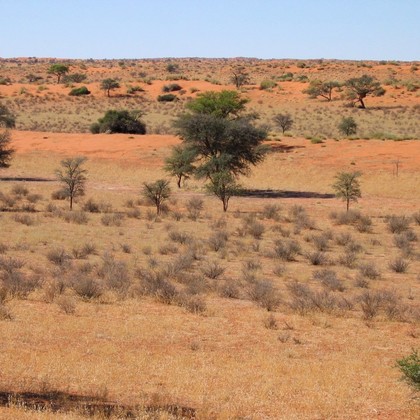
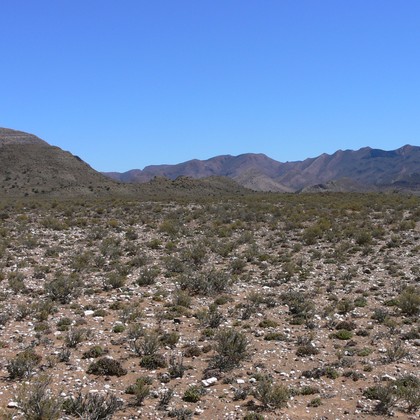
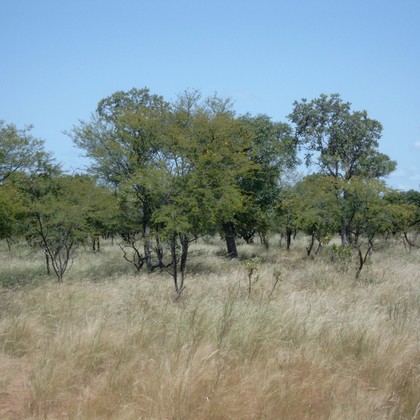
Arid savanna, Kalahari thornveld, Karoo scrub and open, stony plains with scattered bushes. It roosts by day on the ground, often on bare sand or among stones, and hunts moths and beetles from the ground or in short sallies.
Where the bird is most at home, classified by the vegetation units of southern Africa.
Range and movements
Breeds in the west and centre of the region: Namibia, Botswana, western Zimbabwe, southern Angola and, in South Africa, the Northern Cape, the Karoo, the Free State and western North West and Limpopo, scarcer eastwards. After breeding it migrates to the savannas of West and Central Africa, from Cameroon and Chad to South Sudan.
- Resident
- Summer visitor (c. Oct–Mar)
- Passage (Mar–Apr, Oct–Nov)
- dark = core range, pale = thinly spread
How and when to look
October to February on a warm, still evening in the Kalahari or the Karoo. Stop by a sandy track and listen: the churring carries far. With a torch the calling bird can often be found on the ground or on a post; on sandy roads red eyeshine gives away resting birds.
Conservation status
Not threatened and widespread in the arid west. There is no evidence of major declines. Road kills on gravel roads are locally frequent.
Scientific name
Caprimulgus rufigena | Smith, 1845
Smith described the species in 1845 and placed it straight away in the genus where it still stands. The genus Caprimulgus was introduced in 1758 by Linnaeus. Caprimulgus is Latin, from capra 'nanny goat' and mulgere 'to milk', after the old belief that nightjars suckled goats at night. rufigena comes from the Latin rufus, 'rufous', and gena, 'cheek' — for the rusty cheeks. The specimen the first description was based on came from eastern Cape Province, South Africa.