All species › Passerines › Bushshrikes › Pink-Footed Puffback
Pink-Footed Puffback | Dryoscopus angolensis
Gabonpoederdonsklauwier | Cubla Patirrosada
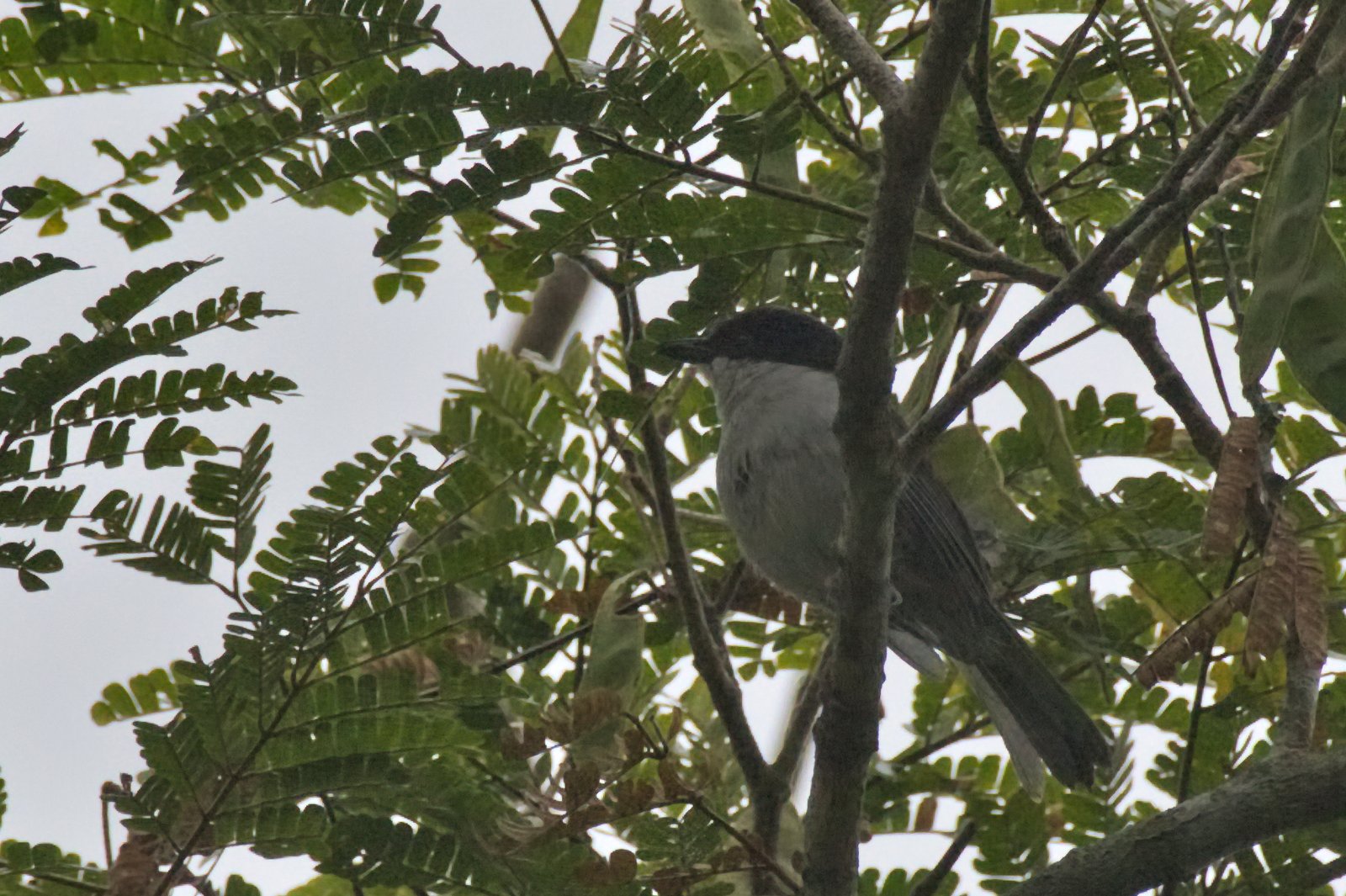
The Pink-Footed Puffback is a small grey bushshrike of the rainforests of Central Africa, which within the region occurs only in the north and west of Angola. It has the loose, fluffy rump plumage of the puffbacks but lacks the contrasting black and white of the common species, and is best picked out by its pink legs.
Voice
Less vocal than Black-Backed Puffback. A repeated hard chek or chik as a contact call, a strident rattling chrrr-chrrr in alarm and a soft whistled series from the male. Wing-snapping is heard in display.
Recording: Paulina Meller — CC BY-NC-SA 4.0 · converted to mono · xeno-canto
Identification
16–17 cm. The male is slate-grey above with a darker grey crown and nape, blackish wings and tail without white edges, and white to pale grey below with grey flanks. The rump feathers are long and grey and are fluffed out in display. The bill is black and hooked, the eye red-brown and the legs strikingly pink or flesh-coloured. The female has a grey head, an olive-brown back and a warm rufous to ochre throat and breast. Juveniles resemble the female but are duller and finely barred.
Confusion species
Black-Backed Puffback Dryoscopus cubla has a glossy black cap and back, white edges to the wing feathers, a bright red eye and blue-grey legs; its female is whitish below with a white supercilium. Bocage's Bushshrike Chlorophoneus bocagei has a black crown and eye mask and a white forehead. Brubru Nilaus afer has a broad white supercilium and a chestnut flank stripe and lives in open woodland.
Habitat
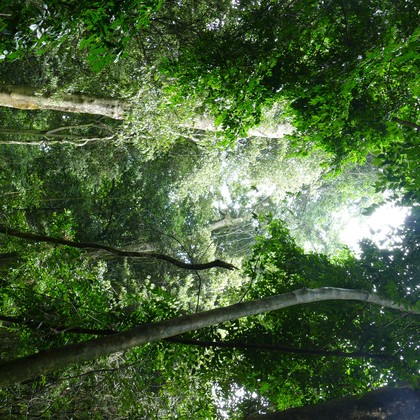
Moist evergreen forest in hills and mountains, especially the canopy and mid-storey of forest edges, clearings and old secondary growth, and also gallery forest. It gleans like a tit among leaves and creepers for insects and larvae, often in mixed foraging flocks.
Where the bird is most at home, classified by the vegetation units of southern Africa.

Range and movements
Within the region only in Angola: in the moist forests of the western escarpment and in forest in the north of the country. Elsewhere in the forests of Cameroon and Gabon east through Congo and the Democratic Republic of the Congo to the Albertine Rift, Uganda and western Kenya.
- Resident
- dark = core range, pale = thinly spread
How and when to look
In Angola, search the escarpment forests, such as around Kumbira and in the Amboim area, in mixed flocks moving through the canopy. Look for a grey shrike with pink legs hanging from leaves like a tit; with her rufous breast the female is often noticed before the male.
Conservation status
Not threatened across its range. In Angola its habitat is small and fragmented, and the escarpment forests are under pressure from clearance for farming and coffee growing; there the species is locally vulnerable.
Scientific name
Dryoscopus angolensis | Hartlaub, 1860
Hartlaub described the species in 1860 and placed it straight away in the genus where it still stands. The genus Dryoscopus was introduced in 1826 by Boie. Dryoscopus comes from the Greek drus, 'tree', and skopos, 'watcher': 'tree-watcher'. angolensis means 'of Angola', where the first specimen was collected. The specimen the first description was based on came from Bembe, northern Angola.