All species › Passerines › Bushshrikes › Black-Crowned Tchagra
Black-Crowned Tchagra | Tchagra senegalus
Zwartkruintsjagra | Chagra del Senegal
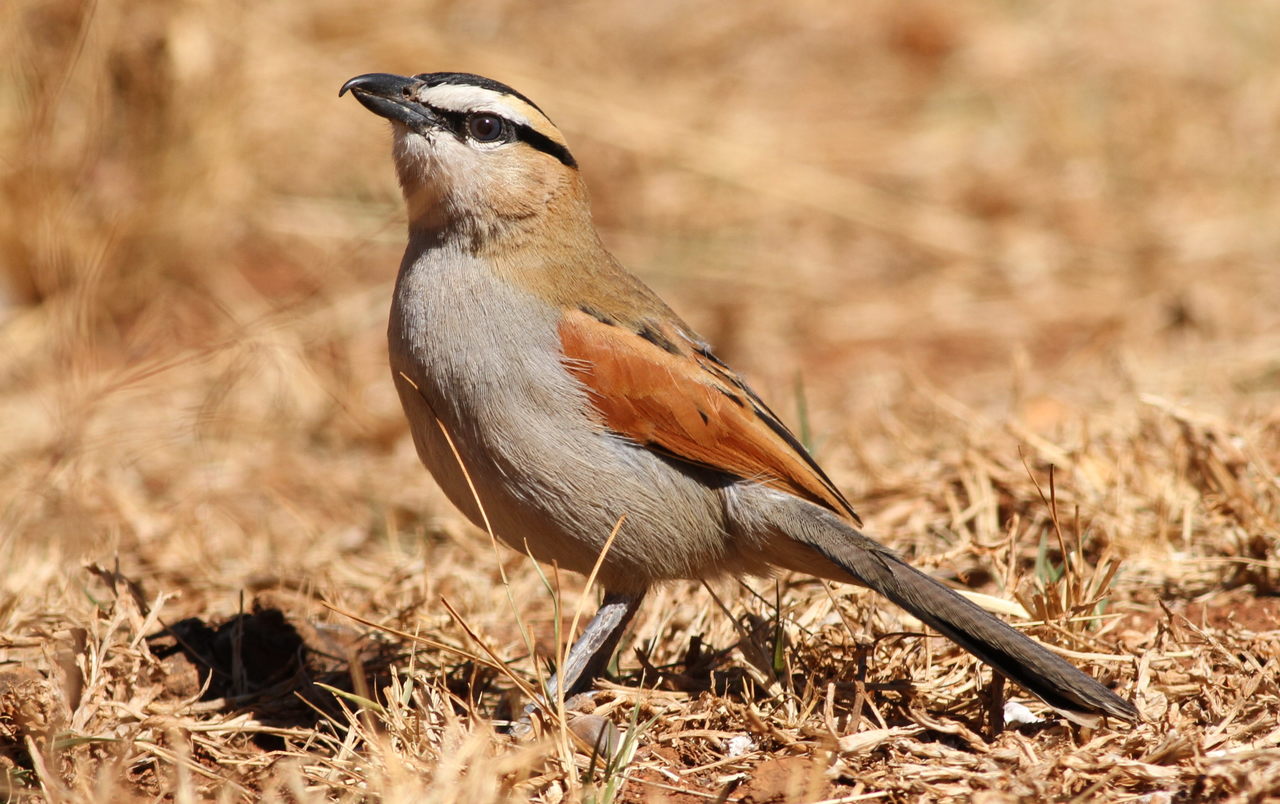
The Black-Crowned Tchagra is the largest and most conspicuous tchagra of the region, with a black crown above a broad white supercilium and rufous wings. Its melodious, descending whistled song is one of the characteristic sounds of the bushveld in the rainy season.
Voice
A loud, liquid, descending whistled song, cheer-tcharee, tcharoo, cheeroo-cheeroo-cheeroo, often from a perch or in display flight on rattling wings. Pairs also sing in duet, the female adding a whirring chrrrrr. When alarmed, loud harsh calls.
Recording: Étienne Leroy — CC BY-NC-SA 4.0 · converted to mono · xeno-canto
Identification
21–23 cm. The crown is black from forehead to nape, with a broad whitish to pale buff supercilium below it and a black eye-stripe. The back is grey-brown and the wing bright rufous. The underparts are pale grey with a pale buff wash. The tail is black with broad white tips, well visible in flight. The bill is heavy and black and the eye dark. The sexes are alike. Juveniles have a brownish crown and a horn-coloured bill. It forages much on the ground and then dashes low into cover.
Confusion species
Brown-Crowned Tchagra Tchagra australis is smaller, with a brown crown separated from the white supercilium by a narrow black line. Southern Tchagra Tchagra tchagra also has a brown crown, a longer bill and a less contrasting head. Marsh Tchagra Bocagia minuta has a black cap without a white supercilium and a rufous-brown back.
Habitat
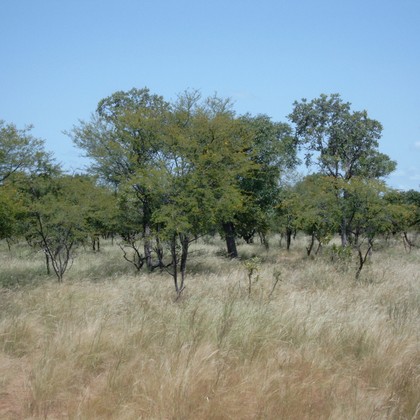
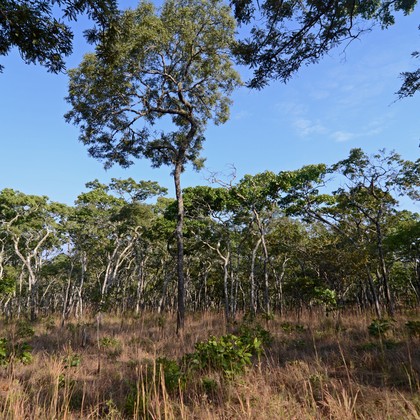
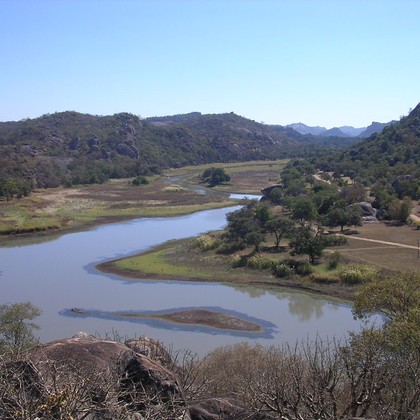
Open woodland and savanna with an understorey of grass and shrubs: acacia savanna, miombo, mopane and mixed woodland, as well as overgrown old fields, forest edge and thickets along rivers. It forages on the ground and in low shrubs for insects, especially grasshoppers, beetles and caterpillars, and sometimes small lizards.
Where the bird is most at home, classified by the vegetation units of southern Africa.
Range and movements
Widespread in the north and east of the region: Angola, Zambia, Malawi, Mozambique, Zimbabwe, northern and eastern Botswana and northern Namibia, and in South Africa from Limpopo, Mpumalanga and North West through KwaZulu-Natal to the Eastern Cape; also in Eswatini. Absent from the arid west, the Karoo, Lesotho and the Western Cape. Beyond the region it occurs over almost all of sub-Saharan Africa, and also in north-west Africa and south-western Arabia.
- Resident
- Summer visitor (c. Oct–Mar)
- Winter visitor (c. Apr–Sep)
- Passage (Mar–Apr, Oct–Nov)
- dark = core range, pale = thinly spread
How and when to look
Year-round; most conspicuous in spring and the rainy season (September–February), when it sings and displays. Listen at sunrise for the descending whistled song and look for a bird that flies up from a bush, rises singing above the vegetation and drops back with its tail spread.
Conservation status
Not threatened; common over a very large range and tolerant of moderately disturbed woodland and old fields. No large-scale threats are known.
Scientific name
Tchagra senegalus | (Linnaeus, 1766)
Linnaeus described the species in 1766 as Lanius senegalus; because it was later moved to another genus, the author and year stand in brackets. The genus Tchagra was introduced in 1831 by Lesson. Tchagra goes back to Levaillant's 'Tchagra' (1800), an imitation of the Southern Tchagra's incessant 'tch tcha tcha gra' calls. senegalus means 'from Senegal', after the region the first described birds came from. The specimen the first description was based on came from Senegal.