All species › Passerines › African Warblers › Pulitzer's Longbill
Pulitzer's Longbill | Macrosphenus pulitzeri
Angolalangsnavelzanger | Picolargo de Pulitzer
Pulitzer’s Longbill is one of the sought-after endemics of the Angolan escarpment. This inconspicuous, grey-brown warbler with a long bill lives in dense, dry forest and thicket on the western slope of the plateau and was only found again with some regularity in the 1990s.

Voice
A loud, clear and rapid series of whistles that swells and then fades, and a dry, rattling contact call. The song is often the only way to find the bird in dense thicket.
Recording: Derek Engelbrecht — CC BY-NC-SA 4.0 · converted to mono · xeno-canto
Identification
12 cm. Longer-tailed than the other longbills, with a long, straight, dark bill. The upperparts are olive-grey to grey-brown, the head greyer. The throat is whitish, the breast and flanks pale grey, with a buff to yellowish wash on the flanks and undertail coverts. The eye is pale brown to reddish-brown. It is plainly marked; the long bill and longer tail are the best features.
Confusion species
Hartert’s Camaroptera Camaroptera harterti, which shares the same thicket, has a shorter bill, a green wing and a frequently cocked tail, and gives a bleating alarm call. Long-Billed Crombec Sylvietta rufescens is almost tailless and lives in open woodland. Pale-Olive Greenbul Phyllastrephus fulviventris is larger, olive-brown with a rufous belly and a shorter, thicker bill. Yellow Longbill Macrosphenus flavicans of northern Angola is yellow below and short-tailed.
Habitat
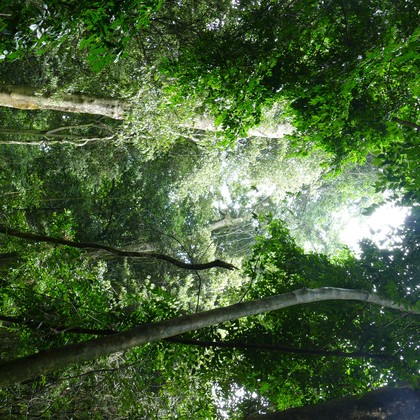
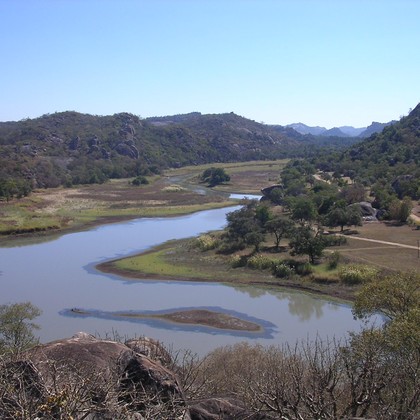
Dense, dry to semi-humid forest and thicket with many lianas on the slopes of the escarpment, especially forest edge and secondary growth, mostly between about 700 and 1200 m. It forages low to mid-level among lianas.
Where the bird is most at home, classified by the vegetation units of southern Africa.
Range and movements
Endemic to Angola. Known from the western escarpment in Cuanza Sul, including around Gabela, Conda (Kumbira Forest) and Seles, and south into inland Benguela. Found nowhere else in the world.
- Resident
- dark = core range, pale = thinly spread
How and when to look
Year-round. Kumbira Forest near Conda is the standard site on Angola tours, together with the other escarpment endemics. Wait near a liana tangle at a forest edge for the loud song and be prepared for brief views.
Conservation status
Endangered (EN). The range is small and fragmented, and escarpment forest is being cleared for cultivation, charcoal and the expansion of unshaded coffee. None of the known sites is formally protected.
Scientific name
Macrosphenus pulitzeri | Boulton, 1931
Boulton described the species in 1931 and placed it straight away in the genus where it still stands. The genus Macrosphenus was introduced in 1859 by Cassin. Macrosphenus comes from the Greek makros, 'long', and sphēn, 'wedge' — for the long, tapering bill. pulitzeri honours the American publisher Ralph Pulitzer (1879–1939), who sponsored the expedition to Angola on which the species was discovered. The specimen the first description was based on came from Chingoroi, Benguela Province, Angola.