All species › Falcons › Falcons › Pygmy Falcon
Pygmy Falcon | Polihierax semitorquatus
Afrikaanse dwergvalk | Halconcito Africano
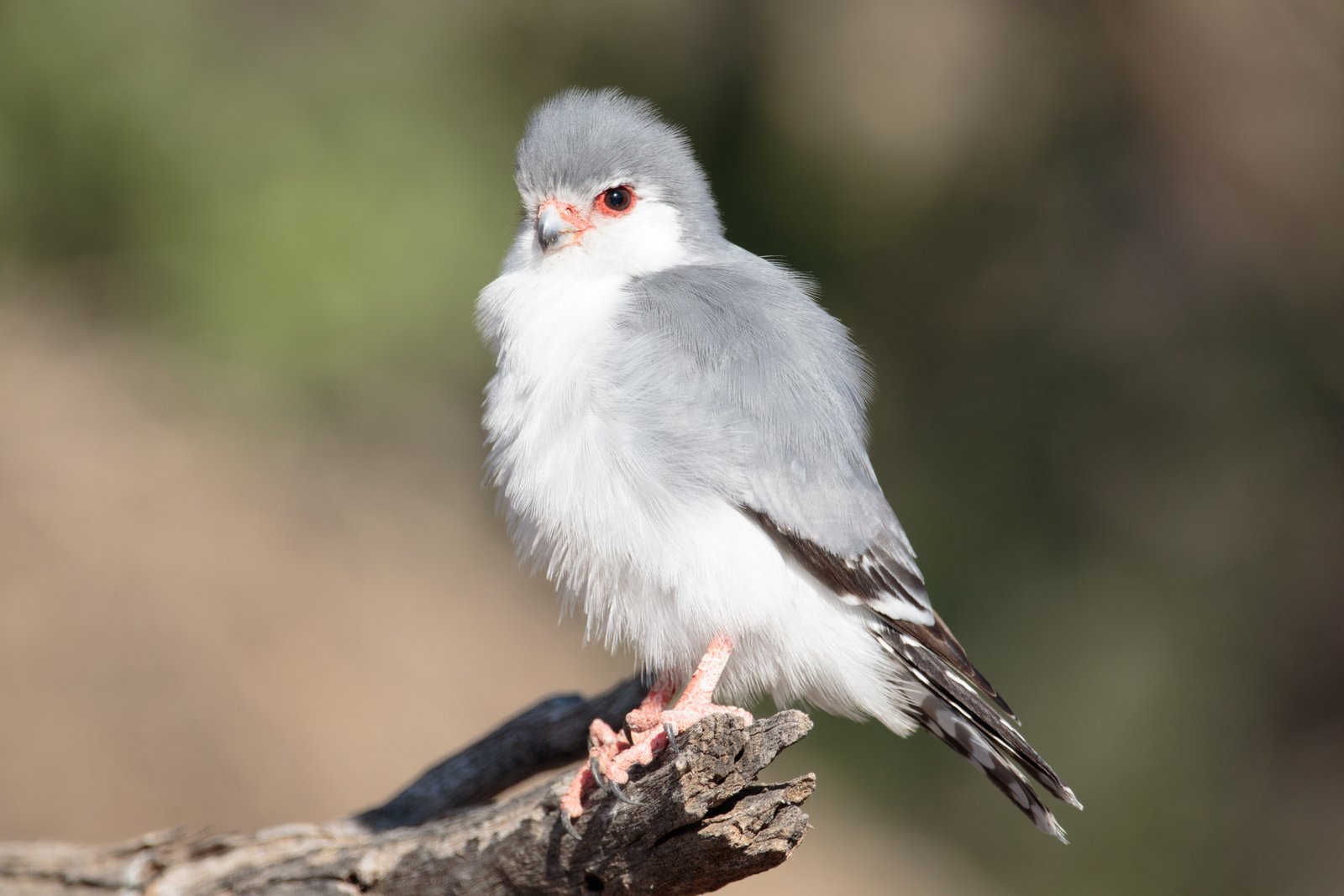
The Pygmy Falcon is Africa's smallest raptor, barely larger than a shrike. In southern Africa it lives almost exclusively in colonies of Sociable Weaver, breeding and roosting in their giant nests.
Voice
A high chip-chip or kee-kee-kee, and a fast twittering twee-twee-twee at the colony. Pairs call to each other a great deal, especially at the nest.
Recording: Rick Nuttall — CC BY-NC-SA 4.0 · shortened to the first 60 s, mono · xeno-canto
Identification
About 19 cm, compact, with a short hooked bill and a fairly long tail. The male is pale grey above and pure white below, with a white hind collar and forehead. The female has a chestnut mantle. Flight feathers and tail are black with rows of white spots, giving a chequered pattern in flight; the rump is white. Cere, eye-ring and legs are orange-red. Juveniles have a browner back and a cream-washed breast.
Confusion species
In size and colour more shrike than falcon: Lesser Grey Shrike (Lanius minor) and Southern Fiscal (Lanius collaris) have a black mask and black-and-white wings without rows of white spots. Black-Winged Kite (Elanus caeruleus) is much larger, with black shoulders and red eyes. Dickinson's Kestrel (Falco dickinsoni) is larger and dark grey, with no white below.
Habitat
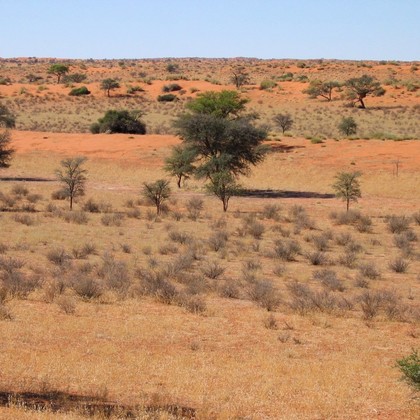
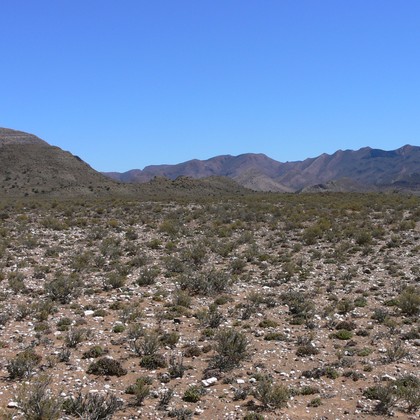
Dry savanna, Kalahari thornveld and the eastern edge of the Nama Karoo, wherever Sociable Weaver colonies hang in camel thorns or on poles. It hunts from a lookout on a treetop or wire, dropping onto beetles, grasshoppers, lizards and at times small birds; its flight is undulating like a woodpecker or shrike.
Where the bird is most at home, classified by the vegetation units of southern Africa.
Range and movements
Within the region in the dry west: most of Namibia, southern and western Botswana, the Northern Cape and the west of North West Province in South Africa, and south-western Angola. A separate population lives in East Africa, from Sudan and Somalia to Tanzania, where it breeds in buffalo-weaver nests.
- Resident
- Summer visitor (c. Oct–Mar)
- Winter visitor (c. Apr–Sep)
- Passage (Mar–Apr, Oct–Nov)
- dark = core range, pale = thinly spread
How and when to look
In the Kgalagadi and the Kalahari check every Sociable Weaver colony: the falcon often perches on a branch or pole right beside the nest. Back colour gives the sex; a pair with a grey male and a chestnut-backed female together is a classic sight at the edge of a colony.
Conservation status
Not threatened and fairly common within its limited range. The species depends entirely on Sociable Weaver; the loss of colonies through felling of old camel thorns or removal of nests from poles also affects the falcon.
Scientific name
Polihierax semitorquatus | (Smith, 1836)
Smith described the species in 1836 as Falco simitorquata; because it was later moved to another genus, the author and year stand in brackets. The genus Polihierax was introduced in 1847 by Kaup. Polihierax comes from the Greek polios, 'grey', and hierax, 'hawk, falcon' — for the grey plumage of these small falcons. semitorquatus is Latin for 'half-collared', from semi, 'half', and torquatus, 'collared' — for the white hind-collar. The specimen the first description was based on came from Kuruman, Northern Cape, South Africa.