All species › Passerines › Monarch flycatchers › Red-Bellied Paradise Flycatcher
Red-Bellied Paradise Flycatcher | Terpsiphone rufiventer
Roodbuikparadijsmonarch | Monarca Ventrirrojo
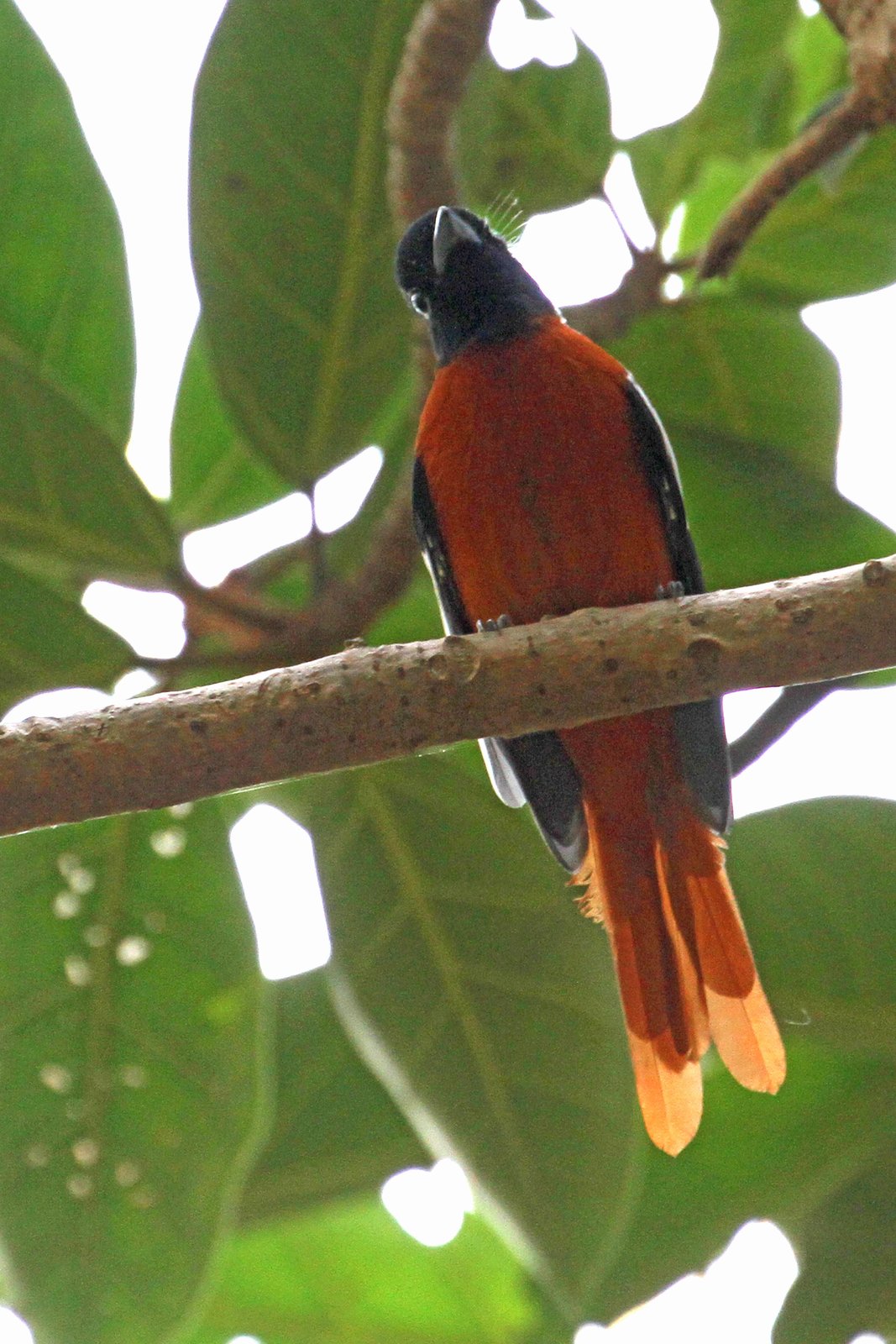
The Red-Bellied Paradise Flycatcher is the orange-red paradise flycatcher of the West and Central African rainforest. With its glossy black head and fiery rufous-orange body it is one of the most colourful birds of the forest understorey; within our region it only reaches northern Angola and north-western Zambia.
Voice
A rasping, nasal scold, zwee-zwerr, and as song a fast series of clear whistles, wee-tee-tee-tee-tee, very like that of African Paradise Flycatcher.
Recording: julien Birard — CC BY-NC-SA 4.0 · shortened to the first 60 s, mono · xeno-canto
Identification
17–18 cm; in the male the central tail feathers can be elongated, but in many populations the tail is short. Head, crest and throat are glossy blue-black, with a narrow cobalt-blue eye-ring and a blue bill. Back, rump, tail and the entire underparts are bright rufous-orange; the wings are dark with rufous edges. The female is duller, with a shorter crest, a greyish throat and a shorter tail. Juveniles are browner and lack the gloss on the head. Where it meets African Paradise Flycatcher, intermediates are not rare.
Confusion species
African Paradise Flycatcher Terpsiphone viridis has a grey breast and belly and a rufous back, or in the white morph is largely white; the male almost always has long tail streamers. Rufous-Vented Paradise Flycatcher Terpsiphone rufocinerea has grey underparts with only the undertail coverts rufous. Hybrids, which occur in Angola and Zambia, are partly grey and partly orange below; such birds cannot be safely identified in the field.
Habitat
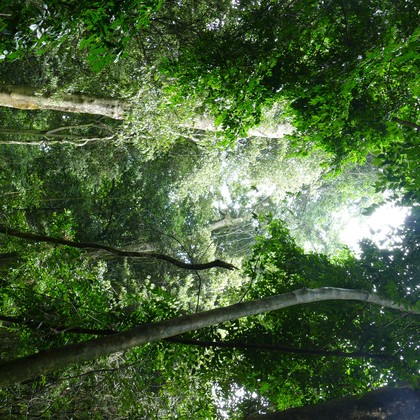
The lower and middle strata of humid lowland forest, secondary forest, gallery forest along rivers and dense growth at forest edges and in swamp forest. It catches insects in short sallies from a perch and gleans foliage; it often joins mixed bird parties.
Where the bird is most at home, classified by the vegetation units of southern Africa.

Range and movements
Within the region in northern Angola, from Cabinda and the north-western interior to the north-east (Lunda), and in north-western Zambia (Mwinilunga), where the subspecies ignea occurs. Outside the region from Senegal east through the West and Central African forest to Uganda and western Tanzania, and on Annobón.
- Resident
- dark = core range, pale = thinly spread
How and when to look
Year-round, for example in the gallery forest of Mwinilunga in Zambia or in the forests of northern Angola. Listen for the nasal scold and look low in the forest for a flash of orange; remember to watch for hybrids with African Paradise Flycatcher.
Conservation status
Not threatened; widespread and fairly common in the Central African rainforest. Within the region the species is confined to gallery and lowland forest on the southern edge of the rainforest, which is under pressure from logging and farming.
Scientific name
Terpsiphone rufiventer | (Swainson, 1837)
Swainson described the species in 1837 as Muscipeta rufiventer; because it was later moved to another genus, the author and year stand in brackets. The genus Terpsiphone was introduced in 1827 by Gloger. Terpsiphone comes from the Greek terpsis, 'delight', and phōnē, 'voice' — for the pleasant song of paradise flycatchers. rufiventer is Latin for 'red-bellied', from rufus, 'red', and venter, 'belly' — for the rufous underparts. The specimen the first description was based on came from West coast of Africa (later restricted to Senegal).