All species › Passerines › Waxbills › Red-Cheeked Cordon-Bleu
Red-Cheeked Cordon-Bleu | Uraeginthus bengalus
Blauwfazantje | Azulito Carirrojo
The Red-Cheeked Cordon-Bleu is the northern counterpart of the Blue Waxbill and reaches the southern limit of its large African range in the far north of the region. The male sports a bright red cheek patch.

Click a thumbnail to switch the photo above.
Voice
A thin, high tsee-tsee or see-see, and a short song of high squeaky and whistled notes, tsi-tsi-tsiieu, similar to that of the Blue Waxbill.
Recording: Bram Piot — CC BY-NC-SA 4.0 · shortened to the first 60 s, mono · xeno-canto
Identification
12–13 cm, with a fairly long tail. The male has a grey-brown crown and back, a sky-blue face, throat, breast, flanks, rump and tail, a pinkish-grey bill and a distinctive crimson patch on the ear coverts. The belly is pale buffy brown. The female lacks the red cheek patch and is paler blue, with the blue more restricted to face and breast and a browner belly. Juveniles are duller still and have a dark bill.
Confusion species
The Blue Waxbill (Uraeginthus angolensis) lacks the red cheek patch in both sexes; the male has more blue, extending well onto flanks and belly. Females often cannot be separated with certainty in the field and are best judged in the company of an identifiable male; in the Red-Cheeked Cordon-Bleu the blue of the underparts is usually more restricted and the belly warmer brown. Isolated reports from Zimbabwe, Botswana and South Africa probably concern escaped cage birds or misidentifications.
Habitat
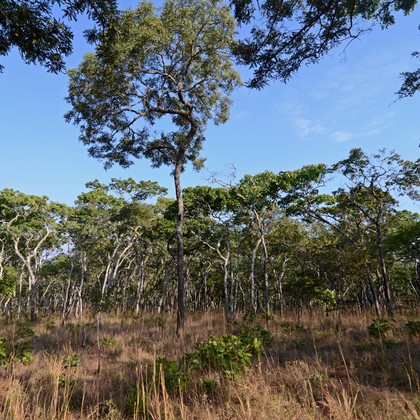
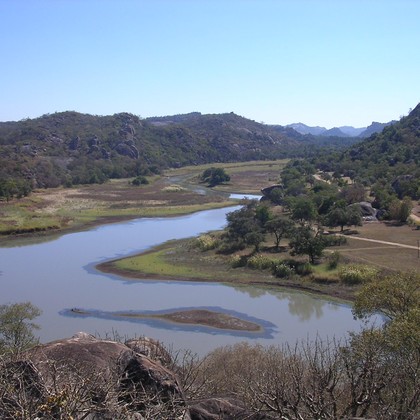
Bushy savanna, the edges of miombo and other woodland, abandoned cultivation, rank vegetation along streams and marshes, and villages and gardens. It feeds on the ground on grass seeds and small insects, in pairs or small groups.
Where the bird is most at home, classified by the vegetation units of southern Africa.
Range and movements
Within the region only in northern Zambia (mainly Northern Province and the surroundings of Lakes Mweru and Tanganyika) and in northern and north-eastern Angola. Beyond the region throughout the savanna belt from Senegal to Ethiopia and south through East Africa to Tanzania and southern DR Congo.
- Resident
- Summer visitor (c. Oct–Mar)
- Passage (Mar–Apr, Oct–Nov)
- dark = core range, pale = thinly spread
How and when to look
Search northern Zambia, for example around Mbala, Kasama and along Lake Mweru, for pairs along village paths and field edges. Where both species occur together, first find a male with a red cheek and only then try to name the females.
Conservation status
Not threatened. Common and widespread in Africa; within the region confined to the far northern edge. Popular as a cage bird, which explains reports far outside its range.
Scientific name
Uraeginthus bengalus | (Linnaeus, 1766)
Linnaeus described the species in 1766 as Fringilla bengalus; because it was later moved to another genus, the author and year stand in brackets. The genus Uraeginthus was introduced in 1851 by Cabanis. Uraeginthus combines the Greek oura, 'tail', with aiginthos, an unidentified bird of antiquity, perhaps a finch — for the long tail of these waxbills. bengalus means 'from Bengal' — an error, since the species occurs only in Africa; the type locality was later corrected to Senegal. The specimen the first description was based on came from Senegal (originally given in error as 'Bengal').