All species › Gannets and cormorants › Gannets and boobies › Red-Footed Booby
Red-Footed Booby | Sula sula
Roodpootgent | Piquero Patirrojo
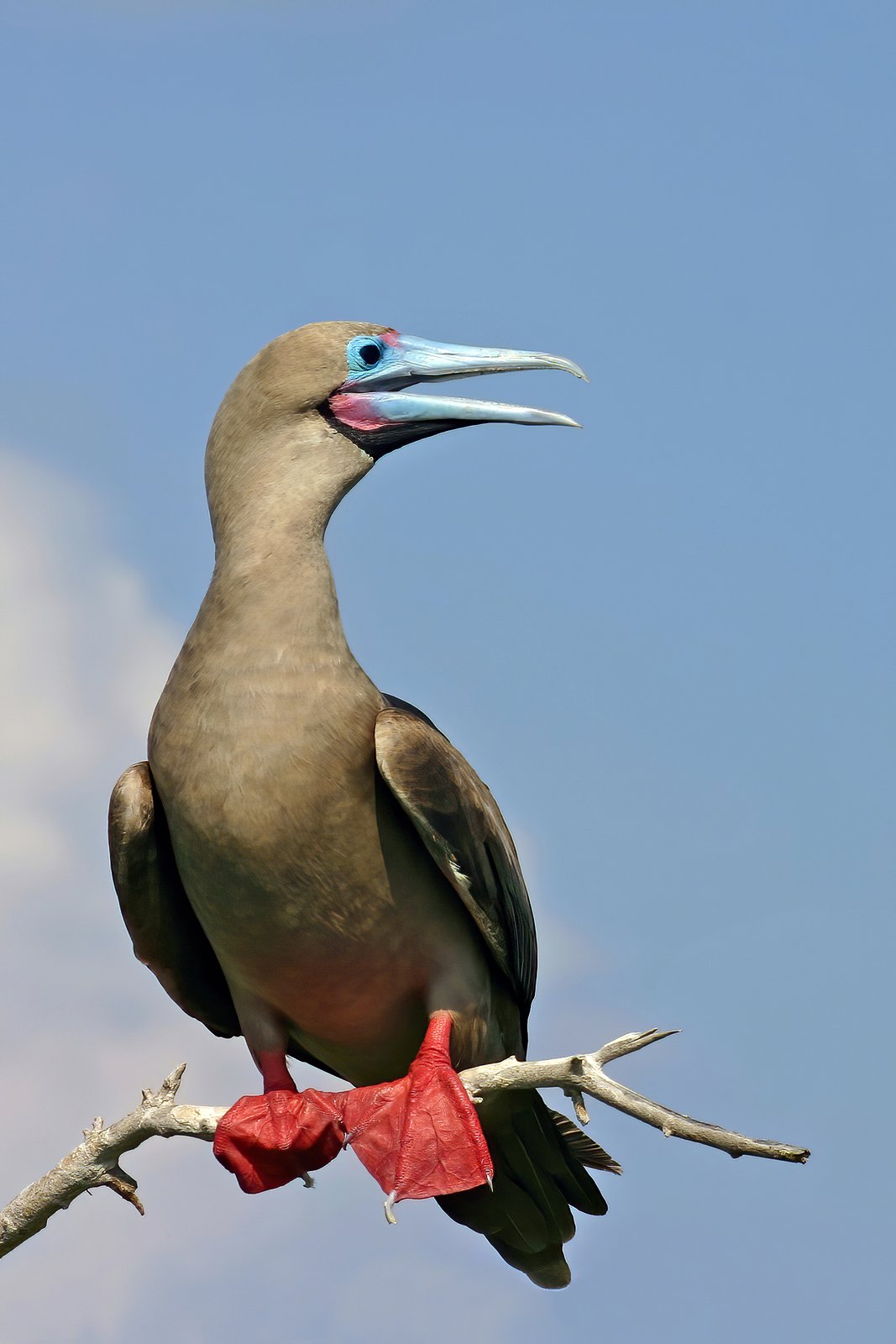
The Red-Footed Booby is the smallest booby, a tropical seabird with bright red feet and the only booby that nests in trees and bushes. In the region it is a rare visitor; the nearest colony is on Europa Island in the Mozambique Channel.
Voice
Silent at sea. At the colony a harsh, rattling karrr-karrr and hoarse squawks.
Recording: Barry Edmonston — CC BY-NC-SA 4.0 · converted to mono · xeno-canto
Identification
66–77 cm long, wingspan 124–142 cm. Slender, with long, narrow wings and a pointed tail. Adults have red feet and a pale blue bill with a pink base and blue around the eye. There are several colour morphs: the white morph is white with black primaries and secondaries and a black carpal patch on the underwing; the brown morph is wholly grey-brown; intermediates have a brown body and white tail. Juveniles are grey-brown with a dark bill and grey to yellowish feet. Flight is light and agile, and it dives into the sea at a shallow angle.
Confusion species
Brown Booby (Sula leucogaster) has a sharply demarcated white belly and a yellowish bill. Cape Gannet (Morus capensis) is much larger and heavier, with a golden head and blue-grey bill. Masked Booby (Sula dactylatra), very rare in the region, is larger with a black facial mask, yellow bill and black tail. Young Red-Footed Boobies are uniformly brown, without the sharp demarcation of Brown Booby.
Habitat
Warm, tropical open ocean, often far offshore. Hunts flying fish and squid in groups, also at night and at dusk. Breeds colonially in bushes and low trees on islands.
Where the bird is most at home, classified by the vegetation units of southern Africa.

Range and movements
Within the region a rare visitor off the coasts of Mozambique and KwaZulu-Natal, sometimes washed up after cyclones; a few birds also off Namibia and the Western Cape, presumably from the Atlantic. Beyond the region it breeds on tropical islands in the Indian Ocean, such as Europa and Aldabra, in the Pacific and in the Atlantic, including Trindade and Fernando de Noronha.
How and when to look
Pelagic trips off southern Mozambique in summer give the best chance. Tired birds sometimes land on boats and are carried into harbours; check masts and buoys. A white booby with red feet and a black carpal patch under the wing is clinched.
Conservation status
Not globally threatened, but the population is declining. On many islands introduced rats and cats, felling of nest trees and the taking of birds and eggs are the main threats.
Scientific name
Sula sula | (Linnaeus, 1766)
Linnaeus described the species in 1766 as Pelecanus Sula; because it was later moved to another genus, the author and year stand in brackets. The genus Sula was introduced in 1760 by Brisson. Sula goes back to súla, the Old Norse and Icelandic word for the gannet; the name passed to the boobies. sula comes from the Old Norse and Icelandic súla, the name for the gannet. The specimen the first description was based on came from Barbados (designated later).