All species › Passerines › Weavers › Red-Headed Malimbe
Red-Headed Malimbe | Malimbus rubricollis
Roodkopprachtwever | Malimbo Cabecirrojo
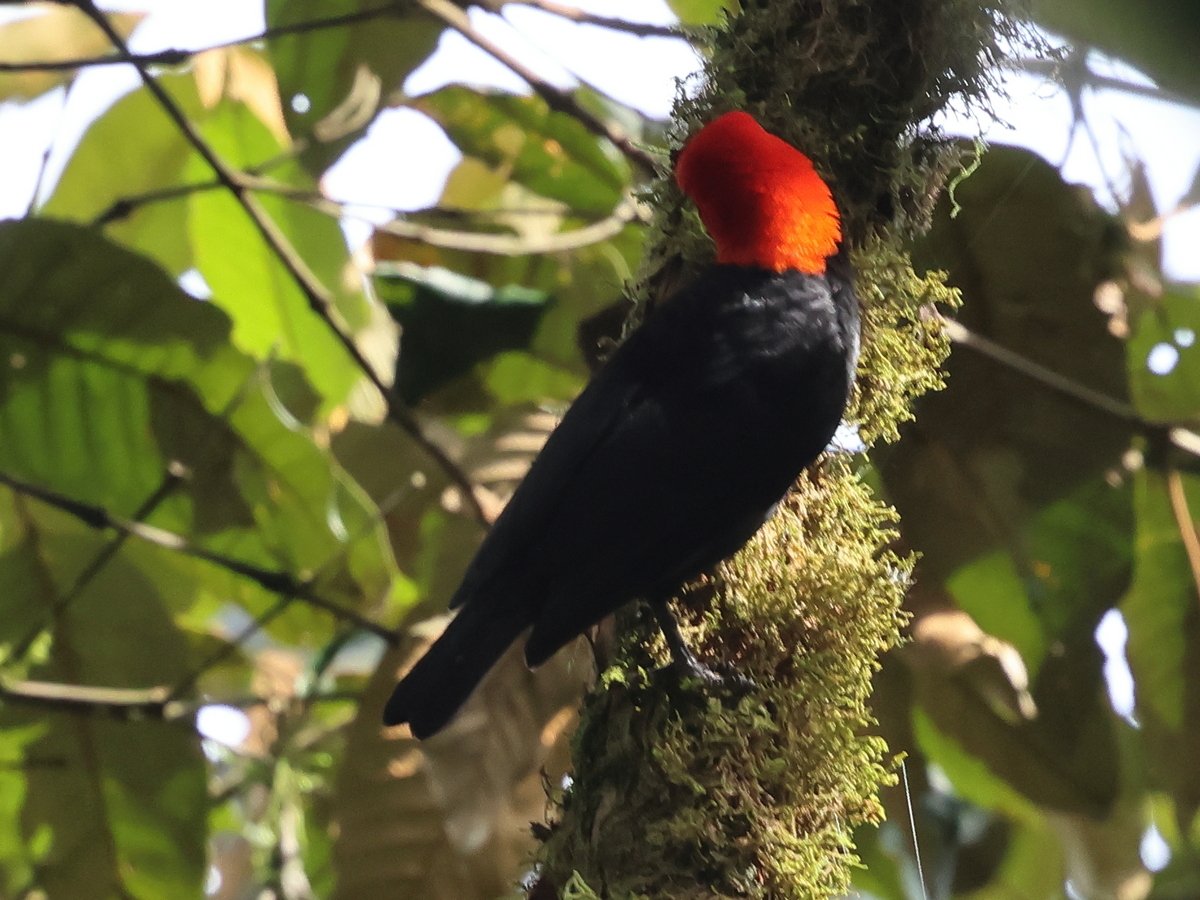
The Red-Headed Malimbe is the largest malimbe: a black forest weaver with a red cap from crown to nape that climbs along thick branches and trunks like a nuthatch. In the region it lives only in the forests of northern and west-central Angola.
Voice
A hoarse, rasping cherr and a dry nasal chatter; the male sings a fast series of scratchy and squeaky notes. Often the first sign of the bird in a mixed flock.
Recording: Étienne Leroy — CC BY-NC-SA 4.0 · converted to mono · xeno-canto
Identification
18–20 cm, bulky, with a long, heavy, pointed black bill. The male is wholly black with a red cap running from the crown over the nape and hindneck onto the sides of the neck; the forehead, face and throat are black. The female is similar, but the red starts further back, so that the forehead and forecrown are black. Juveniles are a duller blackish-brown with an orangey to brownish-red cap.
Confusion species
The Crested Malimbe (Malimbus malimbicus) is smaller and has a red throat and upper breast and a short crest; in the Red-Headed Malimbe the throat and face are black. Vieillot's Black Weaver (Ploceus nigerrimus) has no red and a yellow eye. Its climbing behaviour on thick branches and trunks can suggest a woodpecker or a nuthatch at distance, but the black plumage with the red cap is unmistakable.
Habitat
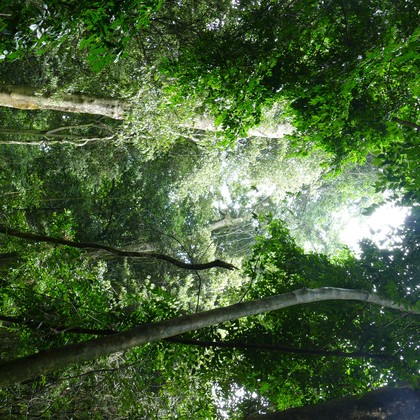
Tall rainforest, forest edges, secondary forest, riverine forest and plantations with tall shade trees or oil palms, also near villages. It lives in the canopy and mid-storey, in pairs or small groups, often in mixed flocks; it climbs along branches and trunks, probing bark, dead branches and epiphytes for insects, and also eats oil-palm fruit. The nest hangs high at the tip of a branch or palm frond, with a long entrance tube.
Where the bird is most at home, classified by the vegetation units of southern Africa.

Range and movements
In the region only in Angola: Cabinda, the forests of Uíge and Cuanza Norte, northern Bengo and Malanje, and south along the escarpment into Cuanza Sul (including around Gabela and Kumbira). Beyond the region from Guinea and Sierra Leone through Ghana, Nigeria and Cameroon to DR Congo, Uganda and western Kenya.
- Resident
- dark = core range, pale = thinly spread
How and when to look
The escarpment forests of Cuanza Sul and the coffee forests of Uíge are the best places. Listen for the hoarse chatter of a mixed flock and scan the thick branches high in the canopy; the bird gives itself away by its climbing behaviour and by the red cap glowing against the dark foliage.
Conservation status
Not threatened and widespread and fairly common in West and Central Africa. In Angola it is confined to fragmented forest remnants that continue to shrink through logging, agriculture and fire, which makes the escarpment population vulnerable.
Scientific name
Malimbus rubricollis | (Swainson, 1838)
Swainson described the species in 1838 as Ploceus rubricollis; because it was later moved to another genus, the author and year stand in brackets. The genus Malimbus was introduced in 1805 by Vieillot. Malimbus is derived from Malimba (Malimbe), a place on the coast of present-day Cabinda (Angola), where the first specimens were collected. rubricollis comes from the Latin ruber, 'red', and collum, 'neck' — for the red head and nape. The specimen the first description was based on came from Malimbe, Cabinda (Angola).