All species › Waders, gulls and terns › Sandpipers and snipes › Red Knot
Red Knot | Calidris canutus
Kanoet | Correlimos Gordo
The Red Knot is a medium-sized, stocky sandpiper with a short neck, short legs and a straight bill about the length of the head. It breeds on the high Arctic tundra of Siberia and in southern Africa winters almost only in a few large lagoons and estuaries on the west coast.
Voice
A low, nasal knut or wut-wut, and a soft twittering in flocks.
Recording: Arend Wassink — CC BY-NC-SA 4.0 · converted to mono · xeno-canto
Identification
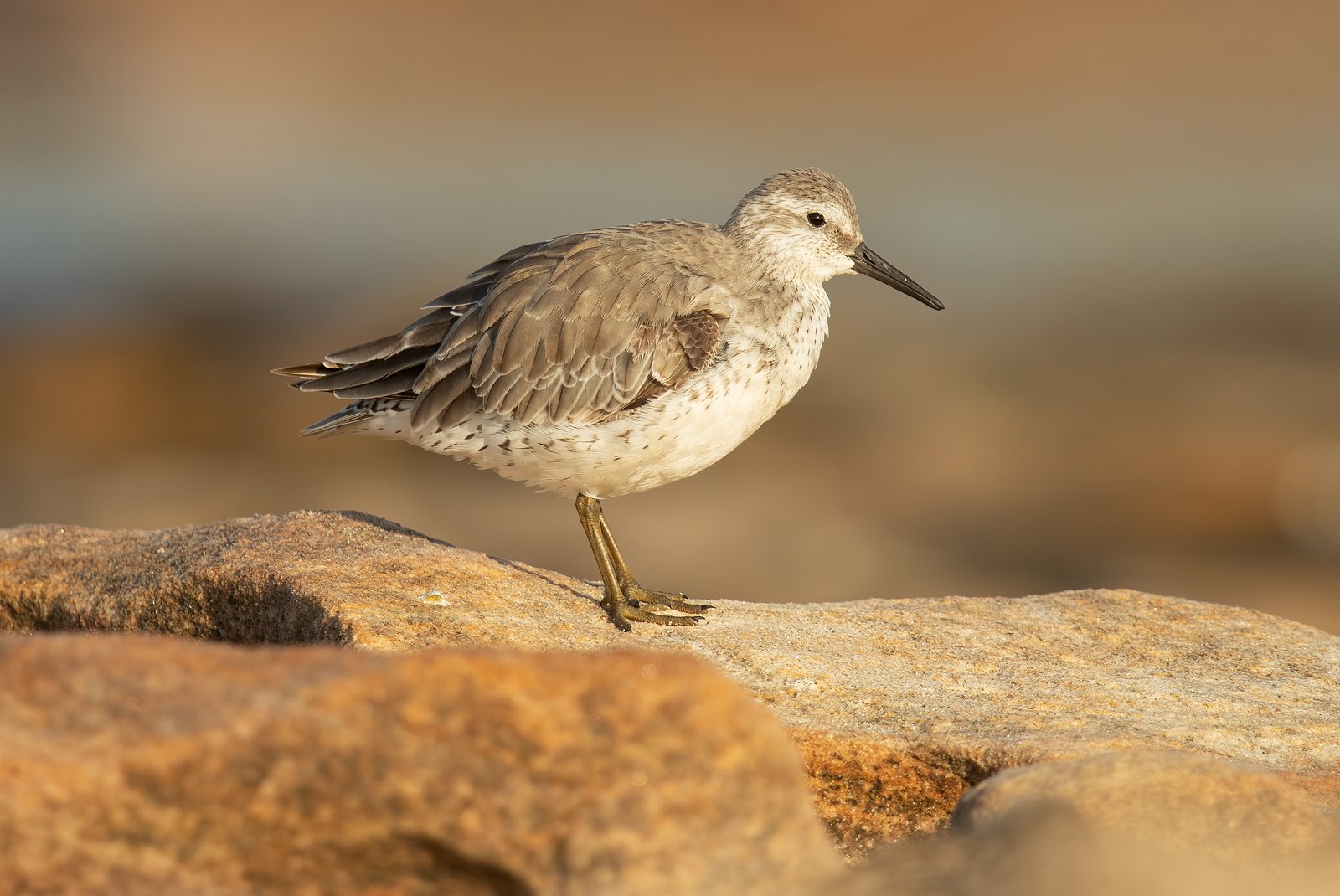
23–25 cm. In non-breeding plumage plain pale grey above with fine pale feather edges, a dull grey, finely streaked breast, white belly and a pale supercilium. Juveniles in their first months have a scaly pattern of dark and pale fringes on the upperparts and a buff wash on the breast. Before departure adults turn brick-red on the head and underparts. The bill is black and straight, the legs are short and greenish-grey. In flight a narrow white wingbar and a pale grey, finely barred rump.
Confusion species
Curlew Sandpiper Calidris ferruginea is smaller and slimmer, with a longer decurved bill, longer black legs and a white rump. Sanderling Calidris alba is smaller and much whiter, with a black leading edge to the wing. Grey Plover Pluvialis squatarola has a short, thick plover bill, a large head and black axillaries.
Habitat
Tidal mudflats and sandbanks in sheltered lagoons and estuaries, rarely on open beaches or in saltworks. It feeds mainly on small bivalves, located with the sensitive bill tip and swallowed whole. At high tide it roosts in dense flocks, often with other waders.
Where the bird is most at home, classified by the vegetation units of southern Africa.

Range and movements
Mainly on the west coast: Walvis Bay and Sandwich Harbour in Namibia and, in South Africa, Langebaan Lagoon and the Berg River estuary; smaller numbers elsewhere along the Western and Eastern Cape. Scarce along the east coast of KwaZulu-Natal and Mozambique and along the coast of Angola; a vagrant inland. Beyond the region it winters in West Africa, Australia, New Zealand, western Europe and South America.
- Summer visitor (c. Oct–Mar)
- Passage (Mar–Apr, Oct–Nov)
- dark = core range, pale = thinly spread
How and when to look
On a rising tide at Langebaan Lagoon or Walvis Bay, search the large flocks of Curlew Sandpipers for a stockier, greyer bird with short legs and a straight bill. A telescope is almost indispensable; at the high-tide roost they often gather together in one corner of the flock.
Conservation status
Near Threatened: the world population is declining steeply through the loss of food-rich intertidal areas along the flyways and changes on the breeding grounds. In southern Africa too numbers have fallen sharply since the 1980s; protection of the few key lagoons is essential for this species.
Scientific name
Calidris canutus | (Linnaeus, 1758)
Linnaeus described the species in 1758 as Tringa Canutus; because it was later moved to another genus, the author and year stand in brackets. The genus Calidris was introduced in 1804 by Merrem. Calidris goes back to Ancient Greek kalidris or skalidris, a name Aristotle used for an unidentified grey waterside bird. canutus is traditionally linked to King Cnut, from the tale of him commanding the tide and the knot's habit of feeding along the tideline, though there is no historical foundation for this. Another explanation is that the name imitates the bird's grunting call. The specimen the first description was based on came from Sweden.