All species › Passerines › Bulbuls › Red-Tailed Bristlebill
Red-Tailed Bristlebill | Bleda syndactylus
Roodstaartblada | Bulbul Bigotudo
The Red-Tailed Bristlebill is a large, shy bulbul of the understorey of the Central African rainforest, with a bright rufous tail, yellow underparts and a small bare bluish patch behind the eye. It often follows driver-ant swarms to catch the insects they flush. In the region it occurs only in northern Angola and the far north-west of Zambia.

Voice
The song is a loud, clear series of melodious whistles that rises and falls again, pee-pee-piew-piew-pew, carrying far through the forest and often the first sign of the bird. The alarm is a harsh, rattling chrrr; also plaintive mewing notes and a dry chatter around ant swarms.
Recording: Étienne Leroy — CC BY-NC-SA 4.0 · converted to mono · xeno-canto
Identification
21–23 cm, bulky and thrush-like, with a heavy, slightly hooked bill and long bristles at the base of the bill, from which the genus gets its name. Head and upperparts are olive-brown to olive-green, and the tail is bright rufous to chestnut, conspicuous when the bird flies off. Throat and the centre of breast and belly are bright yellow, the breast sides and flanks olive. Behind and above the eye is a small patch of bare blue-grey skin. The legs are pink to grey. The sexes are alike; juveniles are duller, with a browner tail and a less obvious bare patch.
Confusion species
Few other birds of the forest floor combine a rufous tail with yellow underparts. White-Throated Greenbul Phyllastrephus albigularis is much smaller and slimmer, with a white throat and a brown tail. Yellow-Throated Nicator Nicator vireo is smaller, has yellow spots on the wing and lives higher in the trees. Yellow-Whiskered Greenbul Eurillas latirostris is smaller and olive-green, with a yellow moustachial stripe and an olive tail. Yellow-Bellied Greenbul Chlorocichla flaviventris lives in thicket and forest edges rather than in the understorey of closed forest, and has an olive-brown tail.
Habitat
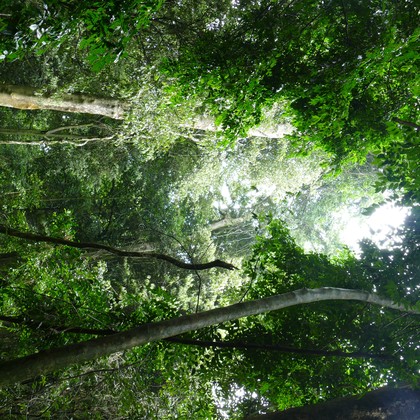
The understorey and floor of moist lowland forest, gallery forest and mature secondary forest with dense undergrowth, often along streams. It forages low, singly or in pairs, and joins driver-ant swarms and mixed understorey flocks.
Where the bird is most at home, classified by the vegetation units of southern Africa.

Range and movements
Within the region in northern Angola (Cabinda, Uíge, Cuanza Norte, Kumbira Forest in Cuanza Sul and the north-east at Dundo) and in the far north-west of Zambia, where it occurs in gallery forest in the Jimbe drainage, around the source of the Zambezi and in a few other forest patches near Mwinilunga. Beyond the region from Sierra Leone east through the forest belt to Uganda, western Kenya and north-western Tanzania.
- Resident
- dark = core range, pale = thinly spread
How and when to look
Year-round. In Zambia the gallery forest at Madman's Crossing in the Jimbe drainage and the forest at the source of the Zambezi are the best-known sites; in Angola Kumbira Forest and the forests around Uíge. Listen for the clear, rising and falling whistled series and for the chatter around ant swarms; then stand still, as the bird often comes into view by itself and gives itself away by the red tail.
Conservation status
Not threatened and fairly common in Central African forest. In the region it is rare and depends on the few large gallery forests of north-western Zambia and the remaining forests of northern Angola; logging, cultivation and the drying out of stream valleys are the main threats.
Scientific name
Bleda syndactylus | (Swainson, 1837)
Swainson described the species in 1837 as Dasycephala syndactyla; because it was later moved to another genus, the author and year stand in brackets. The genus Bleda was introduced in 1857 by Bonaparte. Bleda is named after Bleda, elder brother of Attila and joint ruler of the Huns in the fifth century. syndactylus comes from the Greek sun, 'together', and daktulos, 'toe' — for the partly joined front toes the describer thought he saw. The specimen the first description was based on came from Sierra Leone.