All species › Passerines › Bulbuls › Falkenstein's Greenbul
Falkenstein's Greenbul | Chlorocichla falkensteini
Geelnekbuulbuul | Bulbul de Falkenstein
Falkenstein's Greenbul is a medium-sized greenbul of forest edge, thicket and secondary forest in west-central Africa. In the region it occurs only in north-western Angola, where it is fairly common in the forested escarpment of Cuanza Sul and Cuanza Norte. The bright yellow throat, which extends as a narrow collar onto the sides of the neck, is its hallmark.

Voice
Fairly noisy. A nasal, somewhat plaintive nyeh, often repeated, and a dry chuk. The song is a short, hoarse series of chattering and nasal notes, chuk-chuk-cheerrr, sometimes delivered by two birds together.
Recording: Arnon Dattner — CC BY-NC-SA 4.0 · converted to mono · xeno-canto
Identification
16–17 cm. A compact greenbul with a fairly short, stout bill. The head is greyish olive, the rest of the upperparts olive-green, wings and tail slightly browner. The throat is bright lemon-yellow and continues as a yellow band onto the sides of the neck; it is puffed out when calling. Breast and flanks are washed olive-grey, the belly and undertail-coverts pale yellow. A narrow pale eye-ring. The bill is dark grey with a paler lower mandible, the legs grey. The sexes are alike; juveniles are duller, with a less bright throat.
Confusion species
Yellow-Bellied Greenbul Chlorocichla flaviventris is larger and browner, with entirely yellow underparts, a white half eye-ring and no clear-cut yellow collar. Simple Greenbul Chlorocichla simplex is larger and browner, with a white rather than a yellow throat. Yellow-Whiskered Greenbul Eurillas latirostris has yellow moustachial tufts but a greyish-olive throat and lives in the forest interior. Pale-Throated Greenbul Atimastillas flavigula is much larger and occurs in Angola mainly in the north-east and east.
Habitat
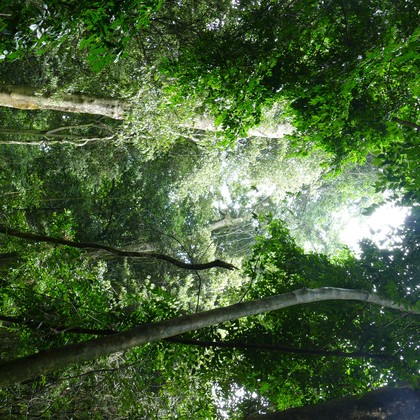
Forest edge, dense thicket, overgrown clearings, secondary forest and shade-coffee plantations, also gallery forest along streams; mostly in the lowlands and middle-altitude hill country. It lives in pairs or small groups in the lower and middle strata, often in creepers and scrub at the forest edge, and eats fruit and insects.
Where the bird is most at home, classified by the vegetation units of southern Africa.

Range and movements
In the region only in north-western Angola: mainly in the forested escarpment of Cuanza Sul (including around Kumbira and Gabela) and in Cuanza Norte, Bengo, Uíge and western Malanje, with a few records further south in Benguela. Beyond the region from southern Cameroon, Gabon and Congo to western DR Congo.
- Resident
- dark = core range, pale = thinly spread
How and when to look
All year. Look for it in the coffee forests and forest edges of the Angolan escarpment at Gabela and Kumbira; it usually gives itself away by its nasal call. Wait for the bird to come into the open: the yellow throat extending onto the sides of the neck is the decisive feature.
Conservation status
Not threatened; fairly common in suitable habitat and tolerant of disturbed forest. Conversion of shade coffee and forest edge into open farmland is a local threat on the Angolan escarpment.
Scientific name
Chlorocichla falkensteini | (Reichenow, 1874)
Reichenow described the species in 1874 as Criniger Falkensteini; because it was later moved to another genus, the author and year stand in brackets. The genus Chlorocichla was introduced in 1882 by Sharpe. Chlorocichla comes from the Greek khlōros, 'green, greenish-yellow', and kikhlē, 'thrush' — for the olive-green and yellow plumage. falkensteini honours the German physician and naturalist Johann Falkenstein (1842–1917), a member of the German Loango Expedition. The specimen the first description was based on came from Chinchoxo, Loango Coast (Cabinda, Angola).