All species › Passerines › Wagtails and pipits › Red-Throated Pipit
Red-Throated Pipit | Anthus cervinus
Roodkeelpieper | Bisbita Gorgirrojo
The Red-Throated Pipit breeds on the tundra from Scandinavia to Alaska and winters as far as East Africa. In southern Africa it is a rare vagrant, with a handful of records scattered across the region. Adults in spring plumage are unmistakable with their brick-red throat; winter birds need careful study.

Voice
The call is a thin, long drawn-out and descending pseeeeh or speeeh, thinner and purer than that of the Tree Pipit; often the first sign of a bird flying over.
Recording: Stanislas Wroza — CC BY-NC-SA 4.0 · shortened to the first 60 s, mono · xeno-canto
Identification
A compact pipit of 14 to 15 cm. The upperparts are dark and contrastingly streaked, with two pale lines on the mantle and a streaked rump. The underparts are buffy-white with heavy black streaks on the breast that continue as broad streaks along the flanks. In spring plumage the throat, face and sometimes upper breast are warm brick-red to pink, more intense in males than in females; in winter plumage the throat is pale, with a sharp black malar stripe and at times a hint of pink. Legs pink, bill with a yellow base. Two pale wing bars; outer tail feathers white.
Confusion species
The Tree Pipit (Anthus trivialis) has finely streaked flanks, a plainer back without pale mantle lines, an unstreaked rump and a hoarse speez call; it seeks out trees. The African Pipit (Anthus cinnamomeus) is larger, longer-legged, less heavily streaked on the flanks and calls differently. When in doubt, the long, thin call is decisive.
Habitat
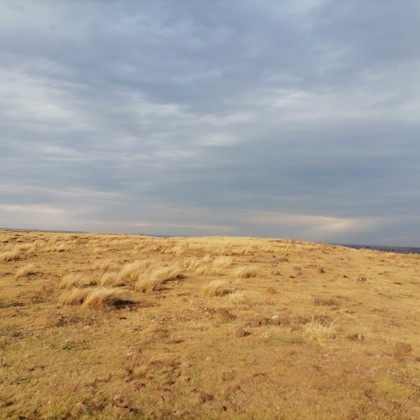
In the wintering areas wet short grassland around lakes, dams, pans and river mouths, preferably with plenty of mud, also wet meadows and fields. It forages by walking through short grass, picking insects from the ground.
Where the bird is most at home, classified by the vegetation units of southern Africa.

Range and movements
Rare vagrant. Records are known from the Swakop River mouth in Namibia, from Chirundu on the Zambezi in Zimbabwe, from the Umvoti River mouth in KwaZulu-Natal and repeatedly from Ndola in Zambia. It breeds on the Arctic tundra from northern Europe to Alaska and winters in the Sahel, East Africa south to Tanzania, and South-East Asia.
How and when to look
The chance of a Red-Throated Pipit is greatest in the north of the region between October and April, on wet short grassland and muddy shores where Western Yellow Wagtails and African Pipits also feed. Listen for the thin, long call of pipits flying over. Document any record with photographs and preferably a sound recording and report it to the national rarities committee.
Conservation status
Not threatened; a numerous species with a very large range. In the area of this guide it has vagrant status only.
Scientific name
Anthus cervinus | (Pallas, 1811)
Pallas described the species in 1811 as Motacilla cervina; because it was later moved to another genus, the author and year stand in brackets. The genus Anthus was introduced in 1805 by Bechstein. Anthus is the Latin word for a small bird of grasslands mentioned by Pliny the Elder. cervinus is Latin for 'stag-coloured', from cervus 'stag', after the rusty red throat of the breeding bird. The specimen the first description was based on came from the Kolyma River, Siberia.