All species › Passerines › Finches › Reichard's Seedeater
Reichard's Seedeater | Crithagra reichardi
Miombokanarie | Serín de Reichard
Reichard's Seedeater is a small brown canary with a white supercilium and a finely streaked breast, living in miombo woodland in the north-east of the region, often on rocky hills. It is quiet and unobtrusive and easily passed off as a Streaky-Headed Seedeater.

Voice
The song is a soft, pleasant warble of quick, clear notes and trills, typically canary-like but less full than that of Cape Canary. The call is a thin, rising tsee-wu, also given in flight.
Recording: isaac kilusu — CC BY-NC-SA 4.0 · converted to mono · xeno-canto
Identification
13 to 14 cm, smaller and more compact than Streaky-Headed Seedeater, with a shorter tail and a slightly finer, horn-coloured conical bill. Crown and mantle are brown with distinct dark streaking. A white supercilium contrasts with dark brown ear-coverts, and the throat is white. The underparts are dirty white to pale brown, with fine dark brown streaks across breast and flanks. Wings and tail are dark brown with pale fringes, without yellow or white. The sexes are alike; juveniles are warmer brown and more heavily streaked.
Confusion species
Streaky-Headed Seedeater (Crithagra gularis) is larger and longer-tailed, with an almost unstreaked grey-brown breast. Black-Eared Seedeater (Crithagra mennelli), which shares the same miombo, has black ear-coverts, a dark crown and coarser breast streaking. Yellow-Browed Seedeater (Crithagra whytii) of the Malawi and Zambia highlands has a yellow supercilium. Black-Throated Canary (Crithagra atrogularis) is greyer, with a black-speckled throat and a yellow rump.
Habitat
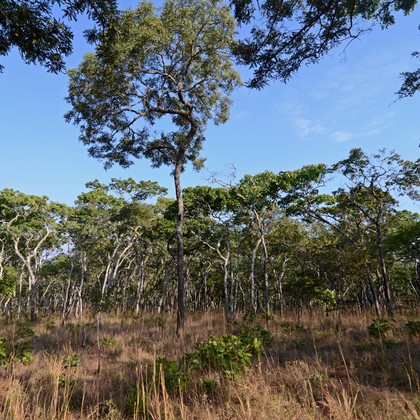
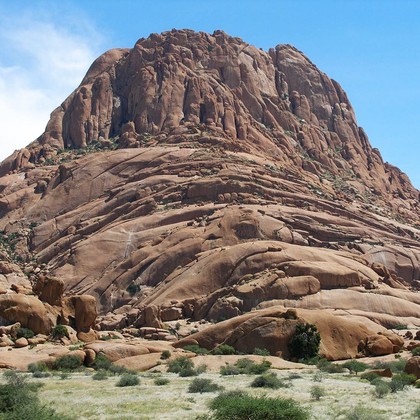
Miombo woodland with Brachystegia and Julbernardia, especially on rocky hills and kopjes, also woodland edges and scrub with tall grass. It lives in pairs or small parties and forages in the canopy and in low shrubs for seeds, buds and insects; it comes to the ground less than most canaries.
Where the bird is most at home, classified by the vegetation units of southern Africa.
Range and movements
Only in the north-east of the region: northern, central and eastern Zambia, almost all of Malawi and northern Mozambique; there are a few uncertain reports from north-eastern Zimbabwe. Beyond the region from south-eastern DR Congo and Tanzania north to Kenya and Ethiopia, the northern birds (striatipectus) sometimes being treated as a separate species.
- Resident
- dark = core range, pale = thinly spread
How and when to look
In hilly miombo, look for pairs feeding quietly in the crowns of low trees; the streaked breast and short tail separate it from Streaky-Headed Seedeater, which occurs in the same woodland in Zambia and Malawi. The song usually gives it away first, especially at the start of the rains. Good areas are the miombo hills of central Zambia and the Malawi plateau.
Conservation status
Not threatened. Locally fairly common, but often overlooked because of its unobtrusive behaviour. Ongoing clearance of miombo for charcoal and farming is reducing its habitat.
Scientific name
Crithagra reichardi | (Reichenow, 1882)
Reichenow described the species in 1882 as Poliospiza reichardi; because it was later moved to another genus, the author and year stand in brackets. The genus Crithagra was introduced in 1827 by Swainson. Crithagra comes from the Greek krithē, 'barley', and agra, 'hunting' — a 'barley hunter', for the seed-eating diet of these canaries and seedeaters. reichardi honours the German explorer Paul Reichard (1854–1938), who travelled in East and Central Africa in the 1880s. The specimen the first description was based on came from Kakoma near Tabora, Tanzania.