All species › Passerines › Finches › Cape Siskin
Cape Siskin | Crithagra totta
Kaapse kanarie | Serín del Cabo
The Cape Siskin is a small, brown-and-yellow canary found only in the mountain fynbos of the south-western and southern Cape. Both sexes have small white tips to the flight feathers and tail feathers, a feature unique within the region.

Voice
The call is a soft, two-part voyp-veeyr, often in flight. The song is a weak but pleasant warble of chirps, trills and whistles, delivered from a bush or boulder, recalling that of Yellow-Fronted Canary.
Recording: Walter Wallner — CC BY-NC-SA 4.0 · shortened to the first 60 s, mono · xeno-canto
Identification
12 to 13 cm, compact, with a short, notched tail and a small, pointed conical bill. The male has an olive-yellow to yellowish-grey head and nape with fine dark streaks, a plain warm brown mantle and rump, and yellow underparts becoming greyer on the belly. Wings and tail are blackish brown; the flight feathers and tail feathers have small white tips, which show as a row of white spots along the wing edge on perched birds and as a white trailing edge in flight. The female is duller and browner, lacks grey on the head and is more streaked on face and breast. Juveniles are streaky brown but already show the white wing and tail tips.
Confusion species
Drakensberg Siskin (Crithagra symonsi) of the Drakensberg and Lesotho lacks the white spots on the flight feathers and instead has white tail sides; the ranges do not overlap. Female Cape Canary (Serinus canicollis) has a streaked, greenish mantle and no white in wing or tail. Protea Canary (Crithagra leucoptera) is larger and grey-brown, with two white wingbars and a heavy bill. Forest Canary (Crithagra scotops) is heavily streaked on its yellow underparts and has a dark face.
Habitat
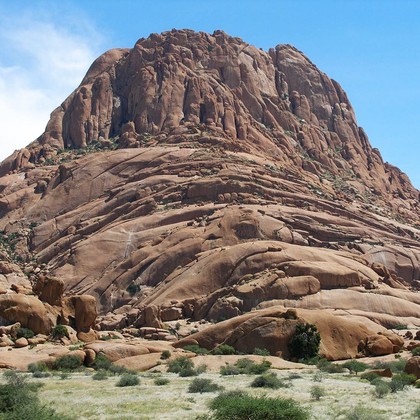
Mountain fynbos, especially on rocky slopes, in sheltered ravines with water and on coastal cliffs, as well as the edges of Afromontane forest, pine plantations, and gardens on the outskirts of Cape Town. It eats seeds of fynbos plants and grasses, buds and small insects, usually in pairs or small parties low in the vegetation or on the ground. Unlike most canaries it nests in cracks and holes in rock, on ledges or among ferns.
Where the bird is most at home, classified by the vegetation units of southern Africa.

Range and movements
Endemic to southern South Africa: from the Cederberg and the Cape Peninsula south and east through the mountains of the Western Cape and along the southern ranges (Langeberg, Outeniqua and Tsitsikamma Mountains) into the western Eastern Cape. Not found outside the region.
- Resident
- Winter visitor (c. Apr–Sep)
- dark = core range, pale = thinly spread
How and when to look
Easy to see at Kirstenbosch and on Table Mountain, around Sir Lowry's Pass and along the coast at Rooi-Els; watch flowering proteas and streams. With every brown canary in fynbos, check for the white spots along the wing edge and the white tail tips on flushed birds. It is one of the fynbos endemics, together with Cape Sugarbird (Promerops cafer) and Orange-Breasted Sunbird (Anthobaphes violacea).
Conservation status
Not threatened. Fairly common within its small range. Too frequent or too hot fires, the spread of invasive alien woody plants and climate change in the fynbos may threaten the species in the longer term.
Scientific name
Crithagra totta | (Sparrman, 1786)
Sparrman described the species in 1786 as Loxia totta; because it was later moved to another genus, the author and year stand in brackets. The genus Crithagra was introduced in 1827 by Swainson. Crithagra comes from the Greek krithē, 'barley', and agra, 'hunting' — a 'barley hunter', for the seed-eating diet of these canaries and seedeaters. totta derives from a dated European name for the Khoekhoe, in whose country at the Cape the species was collected; the term is now considered offensive. The specimen the first description was based on came from Cape Province, South Africa.