All species › Passerines › Finches › Drakensberg Siskin
Drakensberg Siskin | Crithagra symonsi
Basutokanarie | Serín del Drakensberg
The Drakensberg Siskin is the high-mountain counterpart of the Cape Siskin and occurs only in the Drakensberg–Maloti massif of Lesotho and the adjoining escarpment ranges of South Africa. It is one of the characteristic birds of the grassy, rocky slopes and valleys above the treeline.

Voice
The call is a soft schwee, often in flight. The song is a weak warble of short trills and whistles, similar to those of Cape Siskin and Yellow-Fronted Canary.
Recording: Lynette Rudman — CC BY-NC-SA 4.0 · converted to mono · xeno-canto
Identification
13 to 14 cm, slightly larger and longer-tailed than Cape Siskin. The male has a faintly streaked light brown mantle, brown wing coverts, rump and uppertail, a bright yellow throat and yellow underparts duller towards the flanks; the head is olive-yellow with fine streaking. The dark tail has white sides, best seen in flight; white tips to the flight feathers are lacking. The female is duller brown, with no yellow, and buff with much fine dark brown streaking on head and breast. Juveniles resemble the female.
Confusion species
Cape Siskin (Crithagra totta) has white spots on the tips of flight and tail feathers, but occurs only in the fynbos of the Cape. Females of Cape Canary (Serinus canicollis), which lives on the lower Drakensberg slopes, have a greenish, streaked mantle and no white in the tail. Female Yellow Canary (Crithagra flaviventris) has a yellow rump and a pale supercilium and lacks the white tail sides.
Habitat
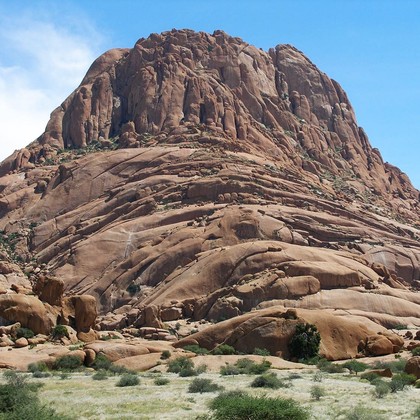
Montane and subalpine grassland with rock sheets, scree slopes and scrub of Leucosidea, Erica and Helichrysum along stream valleys and on slopes, mostly above 1,800 m; also around cattle posts and huts. It forages in pairs or small parties on the ground for seeds of grasses and herbs. The shallow cup nest is placed in cracks and holes in rock, on ledges or among vegetation, often ferns. In severe winters it descends to lower valleys.
Where the bird is most at home, classified by the vegetation units of southern Africa.

Range and movements
Endemic to the region: the highlands of Lesotho and the adjoining Drakensberg escarpment in western KwaZulu-Natal, the eastern Free State and the north-eastern Eastern Cape. Not found outside the region.
- Resident
- Summer visitor (c. Oct–Mar)
- dark = core range, pale = thinly spread
How and when to look
Sani Pass and the Sani Top plateau are the classic site, together with other high-altitude species such as Drakensberg Rockjumper (Chaetops aurantius) and Mountain Pipit (Anthus hoeschi). It can also be found along the mountain roads of Lesotho and in Golden Gate Highlands National Park. Watch for the white tail sides on flushed birds and the soft schwee in flight.
Conservation status
Not threatened. Common within its limited range. Overgrazing and erosion in the Lesotho highlands and climate warming, which shrinks the high-altitude zone, are seen as risks.
Scientific name
Crithagra symonsi | (Roberts, 1916)
Roberts described the species in 1916 as Spinus symonsi; because it was later moved to another genus, the author and year stand in brackets. The genus Crithagra was introduced in 1827 by Swainson. Crithagra comes from the Greek krithē, 'barley', and agra, 'hunting' — a 'barley hunter', for the seed-eating diet of these canaries and seedeaters. symonsi honours Roden Edward Symons (1884–1972), South African forester, hunter, game conservator and collector. The specimen the first description was based on came from Sangebetu Valley (Lesotho).