All species › Passerines › Finches › Black-Headed Canary
Black-Headed Canary | Serinus alario
Alariokanarie | Serín Alario
The Black-Headed Canary is a small canary of the Karoo and western Cape with a warm chestnut back and tail. The male has a striking black-and-white head pattern, in two clearly different forms: a black-headed one in the south and a white-faced one, the 'Damara Canary', in the north-west.

Voice
The call is a soft, whistled sweea or tchee-wee, given constantly by flocks. The song is a clear, varied warble of trills and whistles, softer and less rolling than that of Cape Canary.
Recording: Campbell Fleming — CC BY-NC-SA 4.0 · converted to mono · xeno-canto
Identification
12 to 13 cm, small and compact, with a short grey to horn-coloured conical bill. The male of the nominate form has a black head, throat and centre of breast, a white band running from the nape along the sides of the neck to the sides of the breast, and white underparts. Mantle, rump, tail and a broad wing panel are warm chestnut, the flight feathers blackish. In the form leucolaemus the face is white with a black crown and black stripes through the eye and along the throat, and the black breast is lacking. The female has a grey-brown, finely streaked head, a chestnut back and rump and pale, faintly streaked underparts. Juveniles resemble the female but are more heavily streaked.
Confusion species
The male is unmistakable within the region. Cape Sparrow (Passer melanurus) has a similar black, white and chestnut pattern, but is much larger, with a grey belly and a white C-shaped band behind the eye. The female can resemble females of Yellow Canary (Crithagra flaviventris) and White-Throated Canary (Crithagra albogularis), but these lack the chestnut back and tail and have a yellow or yellow-green rump. Lark-Like Bunting (Emberiza impetuani) is drab brown with rusty wing fringes, but has a longer bill and no chestnut tail.
Habitat
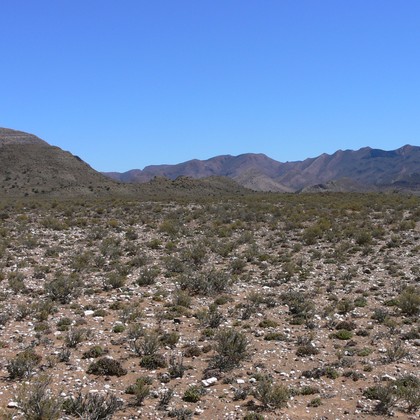
Arid scrub of the Nama and Succulent Karoo, renosterveld and drier fynbos, often in ravines and on rocky slopes with scattered bushes, and around farmsteads, field edges and weedy road verges. It forages on the ground and in low plants for seeds of grasses and herbs, outside the breeding season in flocks that wander widely. The small cup nest is placed low in a bush.
Where the bird is most at home, classified by the vegetation units of southern Africa.


Range and movements
Endemic to the region: the Western and Northern Cape, the west and north of the Eastern Cape and the Karoo into the south-western Free State, as well as Lesotho and southern Namibia. The form leucolaemus replaces the nominate in the north of the Northern Cape (Namaqualand and Bushmanland) and in Namibia. Not found outside the region.
- Resident
- Summer visitor (c. Oct–Mar)
- Winter visitor (c. Apr–Sep)
- Passage (Mar–Apr, Oct–Nov)
- dark = core range, pale = thinly spread
How and when to look
Good sites are Karoo National Park near Beaufort West, Tankwa Karoo National Park and Namaqualand; watch drinking places, where flocks come to drink together with other canaries. The species responds strongly to rain: after good rains large flocks can suddenly appear where it was absent before.
Conservation status
Not threatened. Fairly common, but numbers fluctuate strongly with rainfall. It was formerly trapped in numbers as a cagebird; overgrazing of the Karoo locally reduces the supply of seeds.
Scientific name
Serinus alario | (Linnaeus, 1758)
Linnaeus described the species in 1758 as Emberiza alario; because it was later moved to another genus, the author and year stand in brackets. The genus Serinus was introduced in 1816 by Koch. Serinus is Neo-Latin for 'canary-yellow'. alario comes from the Latin alarius or alaris, 'of the wing', from ala, 'wing'; Linnaeus (1758) described the bird as having red wings (alis rubris). The specimen the first description was based on came from Cape of Good Hope.