All species › Passerines › Finches › Cape Canary
Cape Canary | Serinus canicollis
Grijsnekkanarie | Serín Dorsigrís
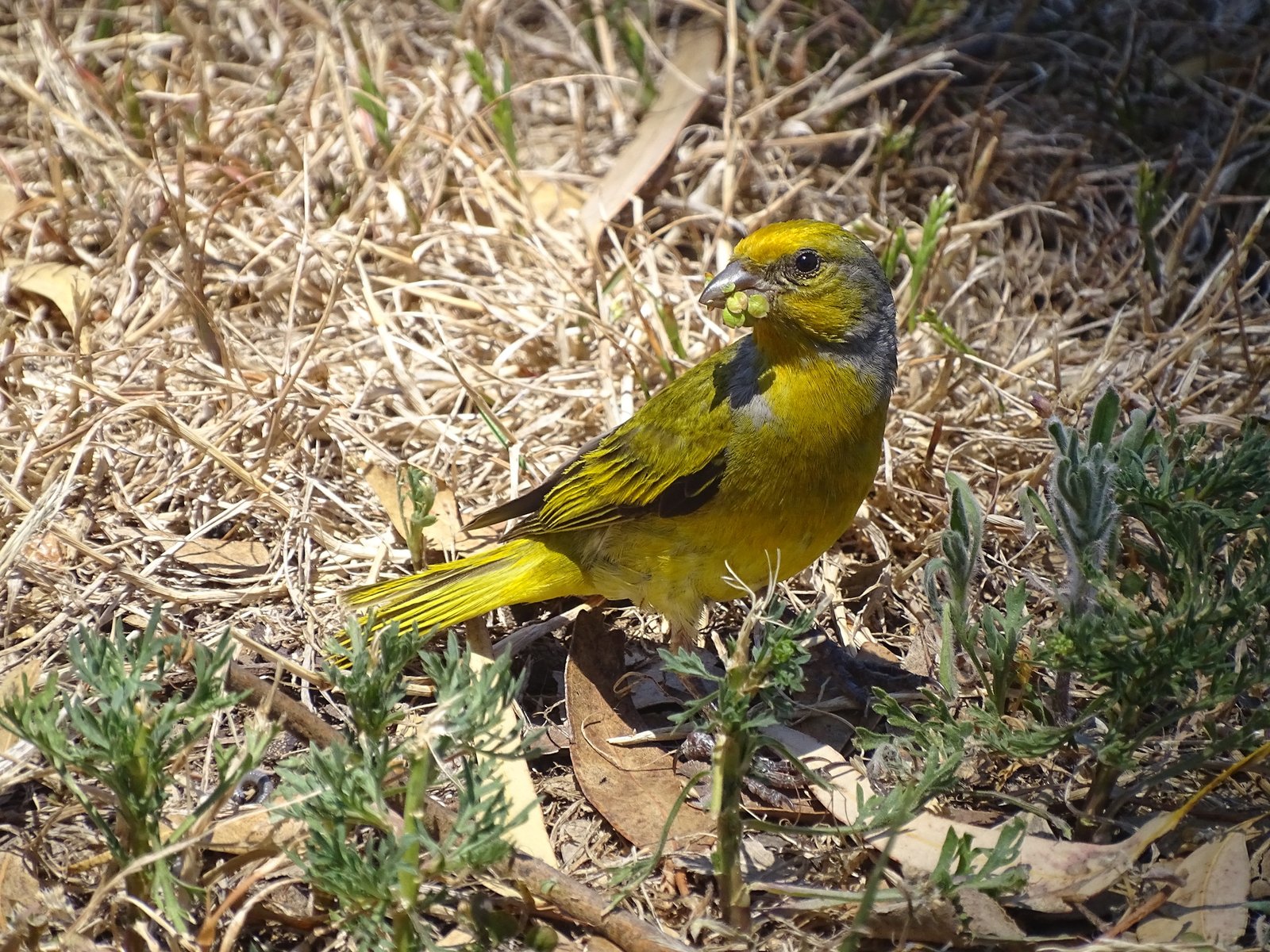
The Cape Canary is the common yellow canary of gardens, field edges and mountain slopes in the south and east of the region, with a varied song that includes mimicry of other species. The male is striking for its golden-yellow forehead and face against a plain blue-grey nape and neck sides.
Click a thumbnail to switch the photo above.
Voice
The song is a long, rolling and highly varied stream of clear whistles, trills and twitters, full and melodious, often from a treetop or in song flight; in the breeding season several males often sing together. The call is a soft, rising tchee-wee or a dry tcheep.
Recording: African Bioacoustics Community — CC BY-NC-SA 4.0 · shortened to the first 60 s, mono · xeno-canto
Identification
13 to 14 cm, with a fairly long, notched tail and a small, pinkish-grey conical bill. The male has a yellow-green to golden-yellow forehead, forecrown and face, a plain blue-grey hindcrown, nape and neck sides, and a yellow-green, faintly streaked mantle. The rump is yellow-green, the underparts bright yellow becoming whiter towards the undertail coverts. Wings and tail are blackish with green-yellow fringes. The female is duller, with a greener head, a less pronounced grey nape, a browner, more heavily streaked mantle and light streaking on the flanks. Juveniles are brownish green and streaked throughout.
Confusion species
Yellow-Fronted Canary (Crithagra mozambica) is smaller, with a yellow supercilium, a dark eye-stripe and moustachial stripe, a bright yellow rump and a grey-brown back. Yellow Canary (Crithagra flaviventris) lacks the grey nape and has a yellow supercilium and a dark moustachial stripe. Brimstone Canary (Crithagra sulphurata) is larger, with a heavy, bulbous bill and an all olive-green head. Yellow-Crowned Canary (Serinus flavivertex) of the highlands of Angola, Malawi and Zambia is very similar, but has less grey on the nape and two conspicuous yellow wingbars.
Habitat
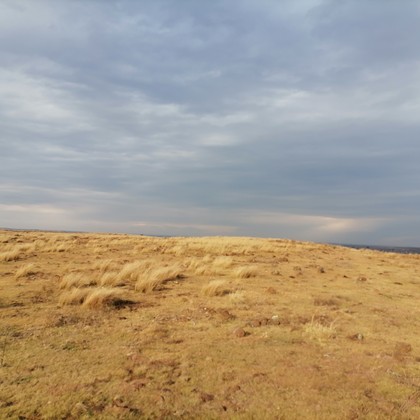
A wide range of semi-open landscapes with bushes and trees: fynbos, montane grassland with scrub and forest edges, highveld grassland with tree lines, plantations, orchards, field edges, parks and gardens. It forages in groups on the ground and in weeds for seeds, buds and small insects. Outside the breeding season it forms flocks, sometimes of hundreds of birds.
Where the bird is most at home, classified by the vegetation units of southern Africa.


Range and movements
South Africa in the Western and Eastern Cape, the southern Northern Cape, the Free State, KwaZulu-Natal, Gauteng, Mpumalanga and the highlands of Limpopo, as well as all of Lesotho and Eswatini; also in the eastern highlands of Zimbabwe and adjacent Mozambique. Absent from the arid west, Botswana and Namibia. Introduced to Réunion and Mauritius.
- Resident
- Winter visitor (c. Apr–Sep)
- dark = core range, pale = thinly spread
How and when to look
In the Cape, on the Highveld and in the Drakensberg one of the commonest canaries, often seen right at the accommodation. With yellow canaries, check for the grey nape, often visible as a grey wash even in females, and for the absence of face stripes. Its rich song is one of the constant background sounds of fynbos and of Cape Town's gardens.
Conservation status
Not threatened. Common and widespread, benefiting from gardens, plantations and field edges. It was formerly trapped in large numbers as a songbird and cagebird.
Scientific name
Serinus canicollis | (Swainson, 1838)
Swainson described the species in 1838 as Crithagra canicollis; because it was later moved to another genus, the author and year stand in brackets. The genus Serinus was introduced in 1816 by Koch. Serinus is Neo-Latin for 'canary-yellow'. canicollis comes from the Latin canus, 'grey', and collum, 'neck' — for the grey nape and sides of the neck. The specimen the first description was based on came from Cape of Good Hope.