All species › Passerines › Finches › Yellow-Crowned Canary
Yellow-Crowned Canary | Serinus flavivertex
Geelkruinkanarie | Serín Coronigualdo
The Yellow-Crowned Canary is a green-and-yellow canary of the African highlands that reaches the region only at its edges: on the plateau of west-central Angola and in the highlands of northern Malawi and north-eastern Zambia. It is closely related to the Cape Canary and was formerly lumped with it.
Voice
The song is a lively, varied warble of clear whistles and trills, similar to that of Cape Canary but in shorter phrases. The call is a soft tsiew or swee, also given in flight.
Recording: Lars Lachmann — CC BY-NC-SA 4.0 · converted to mono · xeno-canto
Identification
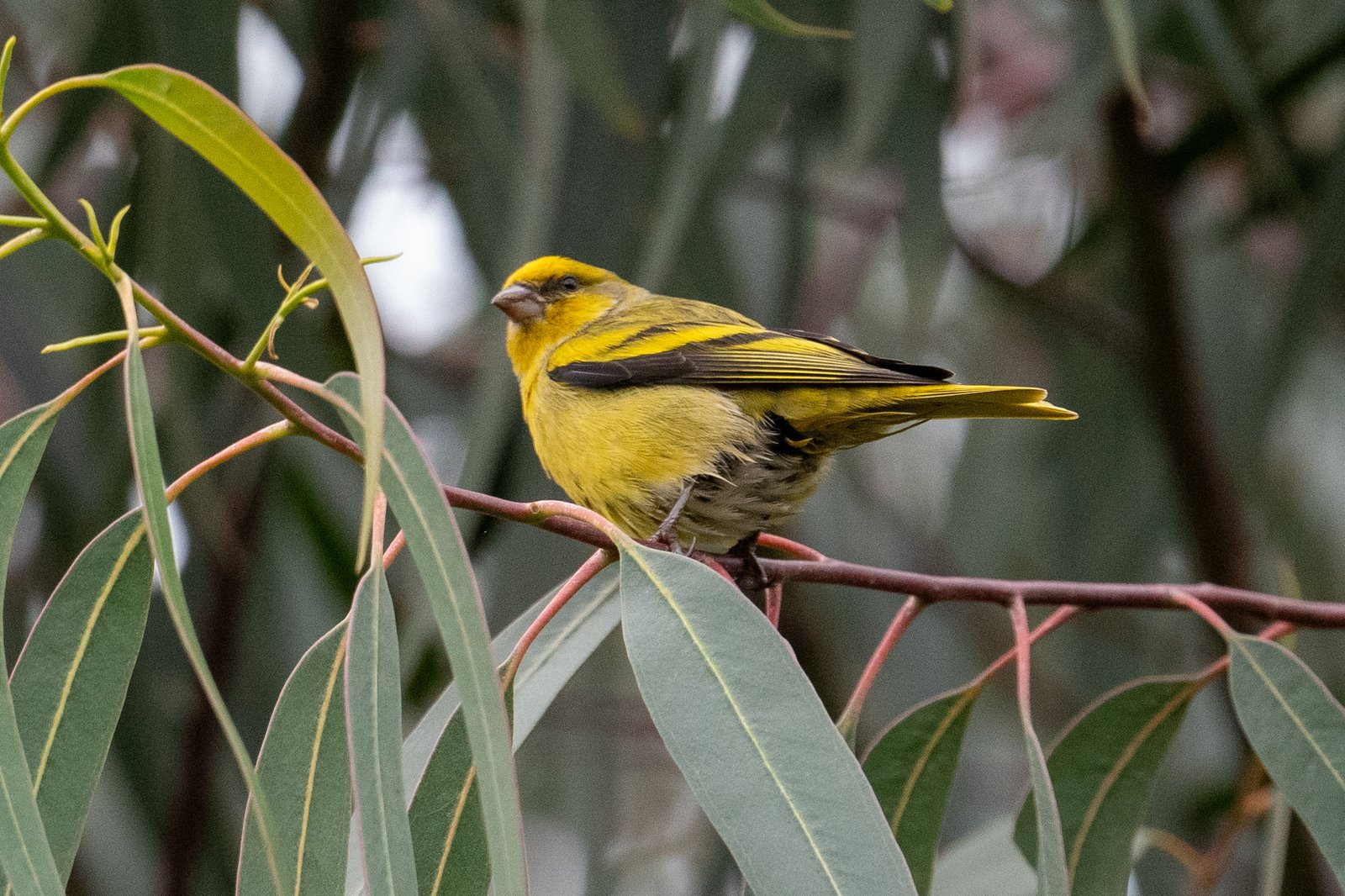
12 to 13 cm, with a short, notched tail and a small, grey to horn-coloured conical bill. The male has a bright yellow forehead and forecrown, a grey-green hindcrown and nape, and an olive-green, dark-streaked mantle with a yellow-green rump. Face and underparts are yellow. The blackish wings show two distinct yellow wingbars and broad yellow fringes to the flight feathers; the tail is black with yellow edges. The female is duller and greener, with less yellow on the crown and fine streaking on breast and flanks. Juveniles are browner and heavily streaked.
Confusion species
Cape Canary (Serinus canicollis) does not occur in the same places; it has a more clearly blue-grey nape and neck sides and lacks the conspicuous yellow wingbars. Yellow-Fronted Canary (Crithagra mozambica) is smaller, with a dark moustachial stripe and a yellow supercilium on a grey-brown head. Southern Citril (Crithagra hyposticta) has a longer, pointed bill and no yellow wingbars. Yellow-Browed Seedeater (Crithagra whytii) is brown with a long yellow supercilium.
Habitat
Montane grassland with scrub, edges of Afromontane forest, thickets and forest patches in the highlands, and in Angola also fields, gardens and village edges on the plateau, mostly above 1,500 m. It forages in pairs or groups on the ground and in weeds for seeds and buds, and outside the breeding season joins mixed flocks of canaries.
Where the bird is most at home, classified by the vegetation units of southern Africa.


Range and movements
In the region in two areas: the plateau of west-central Angola (Huambo, Huíla and Cuanza Sul, down to the escarpment in Namibe), home of the form huillensis, which is sometimes placed with Cape Canary, and the highlands of northern Malawi and north-eastern Zambia (Nyika Plateau, Mafinga Mountains). Beyond the region in the highlands of East Africa, from Tanzania through Rwanda, Burundi, eastern DR Congo, Uganda and Kenya to Ethiopia and South Sudan.
- Resident
- dark = core range, pale = thinly spread
How and when to look
On the Nyika Plateau it is one of the commonest birds of the grasslands and forest edges. In Angola it is most easily found around Huambo and on the plateau near Lubango. Watch for the broad yellow wingbars on flushed birds; where there is doubt with Cape Canary, range decides.
Conservation status
Not threatened. Common in the East African highlands and locally common on the Angolan plateau and on Nyika. Conversion of montane grassland to fields and plantations reduces its habitat locally, but the species adapts well to farmland.
Scientific name
Serinus flavivertex | (Blanford, 1869)
Blanford described the species in 1869 as Crithagra flavivertex; because it was later moved to another genus, the author and year stand in brackets. The genus Serinus was introduced in 1816 by Koch. Serinus is Neo-Latin for 'canary-yellow'. flavivertex comes from the Latin flavus, 'yellow', and vertex, 'crown' — for the yellow crown. The specimen the first description was based on came from Adigrat, Tigray, Ethiopia.