All species › Passerines › Finches › Eurasian Chaffinch
Eurasian Chaffinch | Fringilla coelebs
Vink | Pinzón Vulgar
The Eurasian Chaffinch is a European finch released on the Cape Peninsula around 1898, where it survives as a small, isolated population. It is the only Fringilla in the region: a slim, long-tailed finch with bold white wingbars and white outer tail feathers.

Voice
The song is a vigorous, descending rattle ending in a flourish, chip-chip-chip-cherry-cherry-chew-chewee-oo. The usual call is a clear pink; in flight a soft yoop. At the Cape both song and call stand out at once among the native bird sounds.
Recording: Romuald Mikusek — CC BY-NC-SA 4.0 · converted to mono · xeno-canto
Identification
14–16 cm, slimmer and longer-tailed than the native canaries. The male has a blue-grey crown and nape, a chestnut mantle, an olive-green rump and pinkish-orange cheeks and breast. Both sexes show a broad white shoulder patch, a second narrower white wingbar and much white in the outer tail. The female is dull grey-brown above and greyish buff below, with the same wing and tail pattern. The bill is a pointed cone, blue-grey in breeding males.
Confusion species
Cape Sparrow (Passer melanurus) and House Sparrow (Passer domesticus) are stockier, with a thicker bill and no white tail sides; Cape Sparrow also has a black-and-white head pattern. Cape Bunting (Emberiza capensis) has a striped head and rufous wings, without the double white wingbar. A female chaffinch is always identified by the two white wingbars and the white tail sides in flight.
Habitat
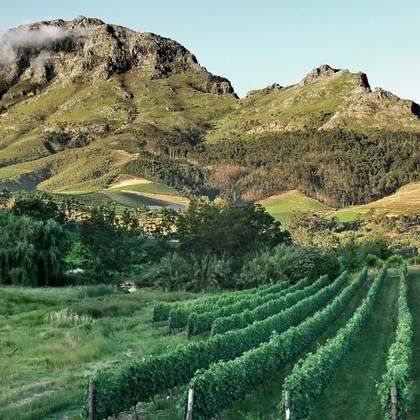
Wooded suburbs with oaks, pines and other exotic trees, parks, gardens, vineyards and the edges of pine and oak plantations on the lower slopes of Table Mountain. It feeds mainly on the ground for seeds and, when breeding, on insects in the canopy. The nest is a neat cup of moss and lichen in a tree fork.
Where the bird is most at home, classified by the vegetation units of southern Africa.

Range and movements
In the region only on the Cape Peninsula, mainly in the southern suburbs of Cape Town (Constantia, Newlands, Bishopscourt, Tokai) and locally around Hout Bay; the population is small, has always been local and has shrunk rather than spread since the twentieth century. Native to Europe, North Africa and western Asia, and also introduced to New Zealand.
- Resident
- Passage (Mar–Apr, Oct–Nov)
- dark = core range, pale = thinly spread
How and when to look
Search Kirstenbosch and the oak avenues of Constantia and Tokai, best in spring (August–November) when males sing. The loud rattle and the clear pink call betray the bird in the canopy. A chaffinch claimed elsewhere in the region is almost certainly an escaped cagebird or a misidentification.
Conservation status
Not threatened; globally one of the most numerous songbirds. In South Africa an introduced species of no conservation concern, with a small population that has not proved invasive and has not spread beyond the peninsula.
Scientific name
Fringilla coelebs | Linnaeus, 1758
Linnaeus described the species in 1758 and placed it straight away in the genus where it still stands. He introduced the genus Fringilla in that same work. Fringilla is the Latin word for 'finch'. coelebs is Latin for 'unmarried, single': in Sweden it was mainly the females that moved south in winter, leaving the males behind. The specimen the first description was based on came from Sweden.