All species › Passerines › Vangas and helmetshrikes › Retz's Helmetshrike
Retz's Helmetshrike | Prionops retzii
Retz' klauwier | Prionopo de Retz
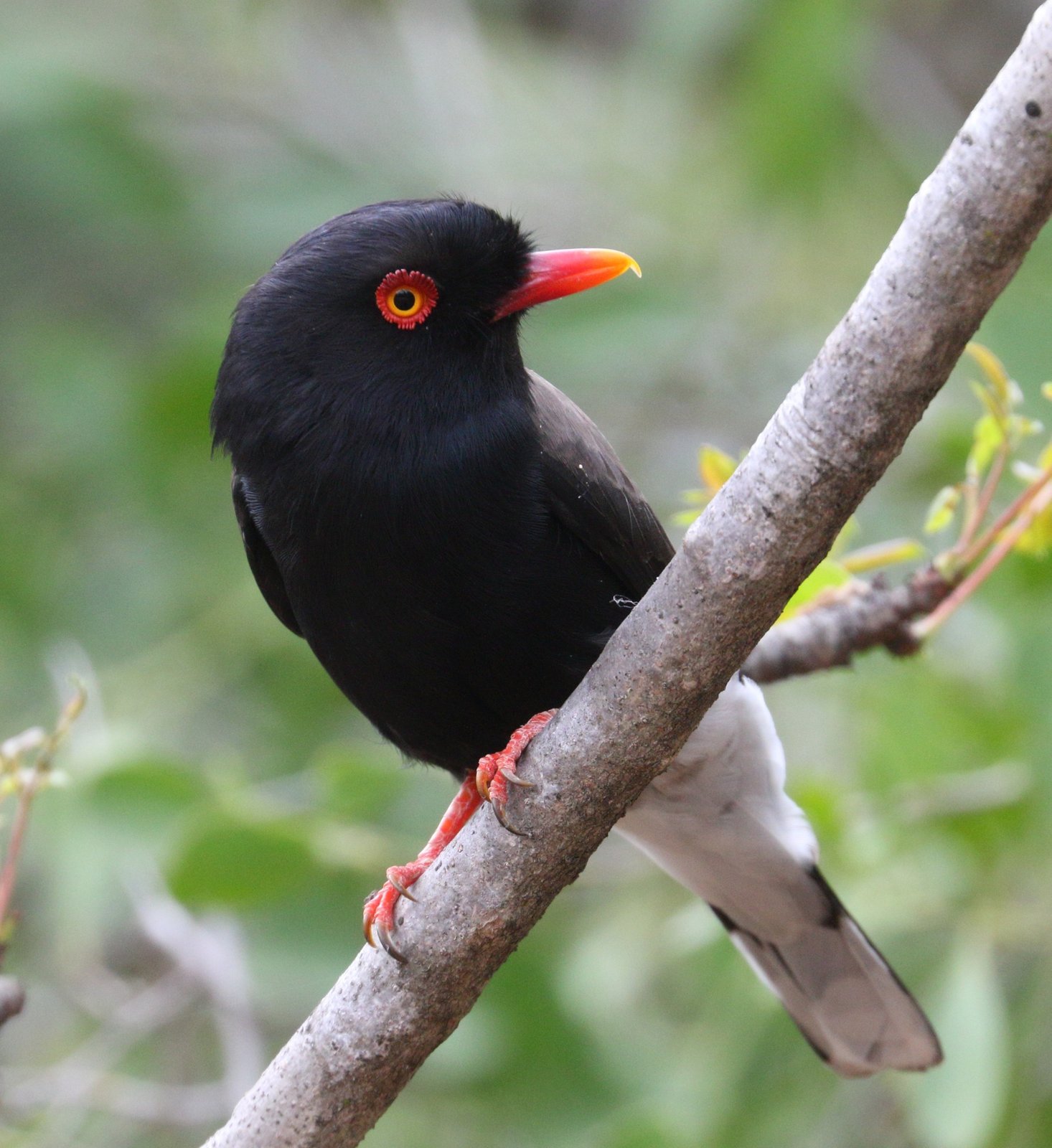
Retz's Helmetshrike is a sooty-black group-living bird with a red, yellow-tipped bill, a red eye-wattle and orange legs. Groups of four to ten birds move noisily through tall broadleaf and riverine woodland and breed cooperatively. The species is the main host of Thick-Billed Cuckoo, which lays its eggs in helmetshrike nests.
Voice
A continuous, harsh chattering from the whole group, with rolling and cackling calls such as chuk-chuk-chowee, kri-kri-kri and rasping notes, mixed with bill-snapping. The calls resemble those of White-Crested Helmetshrike but are somewhat lower and fuller.
Recording: Derek Solomon — CC BY-NC-SA 4.0 · converted to mono · xeno-canto
Identification
21–22 cm. Head, breast and belly are black with a bluish gloss; a short, bristly crest stands on the forehead. The back is dark greyish-brown and the wings are blackish-brown. The undertail coverts and lower belly are white, and the tail has broad white tips to the outer feathers that show well in flight. The bill is red with a yellow tip; the orange-yellow eye is surrounded by a bright red, scalloped wattle and the legs are orange-red. The sexes are alike. Juveniles are browner, lack the wattle and have a dark bill.
Confusion species
White-Crested Helmetshrike Prionops plumatus is black and white with a white crest and white underparts; the two species sometimes forage together. Gabela Helmetshrike Prionops gabela of the Angolan escarpment has a white belly and a grey-brown back, and does not occur in the same area. Fork-Tailed Drongo Dicrurus adsimilis and Southern Black Flycatcher Melaenornis pammelaina are all black, without a red bill or white tail tips, and do not live in noisy groups.
Habitat
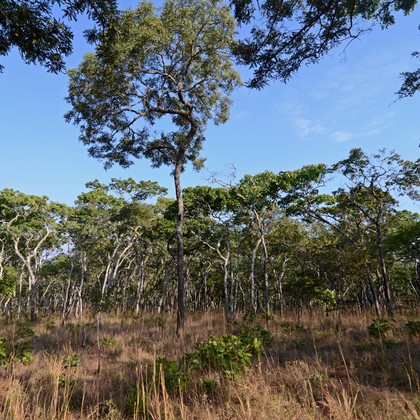
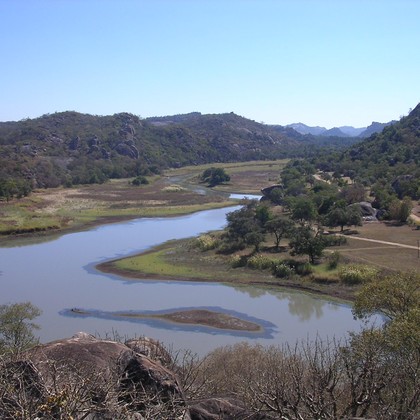
Tall broadleaf woodland: miombo and other broadleaf woodland with a closed canopy, riverine woodland with large trees, and the edges of dry evergreen and coastal forest. It forages higher in the trees than White-Crested Helmetshrike, mainly in the canopy, taking insects, caterpillars and other invertebrates.
Where the bird is most at home, classified by the vegetation units of southern Africa.

Range and movements
Angola, Zambia, Malawi, Mozambique and Zimbabwe (mainly the north, east and the low-lying lowveld), north-eastern Botswana and the Caprivi in Namibia. In South Africa in eastern Limpopo and Mpumalanga, including Kruger, and in northern KwaZulu-Natal; also in Eswatini. Beyond, from Kenya and Tanzania to southern DR Congo.
- Resident
- Summer visitor (c. Oct–Mar)
- Winter visitor (c. Apr–Sep)
- Passage (Mar–Apr, Oct–Nov)
- dark = core range, pale = thinly spread
How and when to look
Year-round; most reliable in riverine woodland in Kruger (for example along the Luvuvhu at Pafuri), at Mana Pools and in the miombo of Malawi and Zambia. Look for black birds with red bills following one another in a line from crown to crown. Where they breed, Thick-Billed Cuckoo may turn up.
Conservation status
Not threatened; locally fairly common, but rather scarce in the south of its range and dependent on large trees. Clearance of riverine woodland and miombo is the main threat; in protected areas the species is stable.
Scientific name
Prionops retzii | Wahlberg, 1856
Wahlberg described the species in 1856 and placed it straight away in the genus where it still stands. The genus Prionops was introduced in 1816 by Vieillot. Prionops comes from the Greek priōn, 'saw', and ōps, 'eye' — probably for the serrated eye-wattle or the stiff forehead feathers. retzii honours the Swedish professor Anders Adolf Retzius (1796–1860), comparative anatomist and anthropologist. The specimen the first description was based on came from Okavango River.