All species › Passerines › Vangas and helmetshrikes › Gabela Helmetshrike
Gabela Helmetshrike | Prionops gabela
Gabelaklauwier | Prionopo de Gabela
Gabela Helmetshrike is one of the rarest endemics of the Angolan escarpment: a helmetshrike with a black head and breast, a grey-brown back and a white belly, moving in small groups through the forest canopy around Gabela. It is closely related to Retz's Helmetshrike and was only described in 1957. Little is yet known about its behaviour and breeding biology.

Voice
Harsh chattering and rolling contact calls within the group, with bill-snapping, similar to those of Retz's Helmetshrike. The repertoire is poorly documented.
Recording: Ken Behrens — CC BY-NC-SA 4.0 · converted to mono · xeno-canto
Identification
19–20 cm. Head, throat and breast are black, with a short, bristly crest on the forehead. Back and scapulars are dark greyish-brown and the wings blackish-brown. The belly, flanks and undertail coverts are white, sharply demarcated from the black breast. The tail is blackish with white tips to the outer feathers. The bill is red with a yellow tip, a red wattle surrounds the eye and the legs are orange-red. The sexes are alike. Juveniles are duller and browner and lack the wattle.
Confusion species
Retz's Helmetshrike Prionops retzii is larger and black below as well, with only the undertail coverts white; it lives in the miombo of the interior rather than on the escarpment. White-Crested Helmetshrike Prionops plumatus has a white crest, a white collar and a white throat. Gabela Bushshrike Laniarius amboimensis, which lives in the same forest, has a chestnut crown and wholly white underparts, keeps to the undergrowth and has a black bill.
Habitat
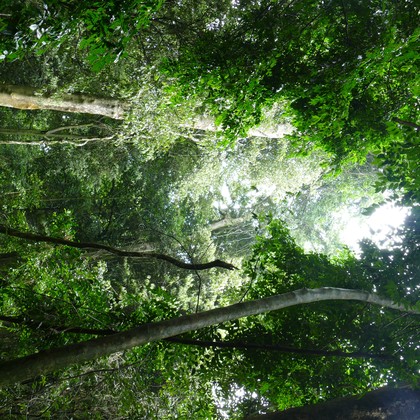
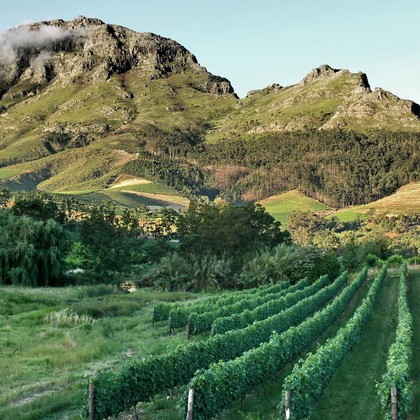
Moist semi-evergreen forest on the escarpment, roughly between 700 and 1300 m, including secondary forest and old coffee plantations where the tall shade trees have been retained. It forages in the canopy and middle storey, often in mixed foraging flocks.
Where the bird is most at home, classified by the vegetation units of southern Africa.
Range and movements
Endemic to western Angola: the Cuanza Sul escarpment, especially around Gabela, Kumbira, Conda and elsewhere in the old Amboim district. It does not occur outside Angola.
- Resident
- dark = core range, pale = thinly spread
How and when to look
Year-round. Kumbira Forest near Conda is the best-known site, together with Gabela Bushshrike, Monteiro's Bushshrike and other escarpment endemics. Watch the treetops for small groups passing with bill-snapping and chatter; the red bill and white belly are the best features in the half-light.
Conservation status
Endangered. The range is very small and the escarpment forest is disappearing fast through clearance for farming and charcoal and through felling of shade trees in abandoned coffee plantations. Because the species needs the tall trees, it is more sensitive to logging than the undergrowth birds. There is no formally protected area.
Scientific name
Prionops gabela | Rand, 1957
Rand described the species in 1957 and placed it straight away in the genus where it still stands. The genus Prionops was introduced in 1816 by Vieillot. Prionops comes from the Greek priōn, 'saw', and ōps, 'eye' — probably for the serrated eye-wattle or the stiff forehead feathers. gabela refers to Gabela, a town in western Angola where the species was discovered. The specimen the first description was based on came from 15 km south of Gabela, Angola.