All species › Pigeons and doves › Pigeons and doves › Ring-Necked Dove
Ring-Necked Dove | Streptopelia capicola
Kaapse tortel | Tórtola del Cabo
The Ring-Necked Dove is the pale grey dove with a black collar whose voice defines the soundscape of the bushveld throughout southern Africa. Its three-note call rings from every thorn tree from dawn until the heat of midday.
Voice
A rhythmic, three-note, endlessly repeated coo-COORR-coo stressed on the middle syllable, often rendered as work HAR-der. On landing, a rasping, growling krrrrr.
Recording: Walter Wallner — CC BY-NC-SA 4.0 · converted to mono · xeno-canto
Identification
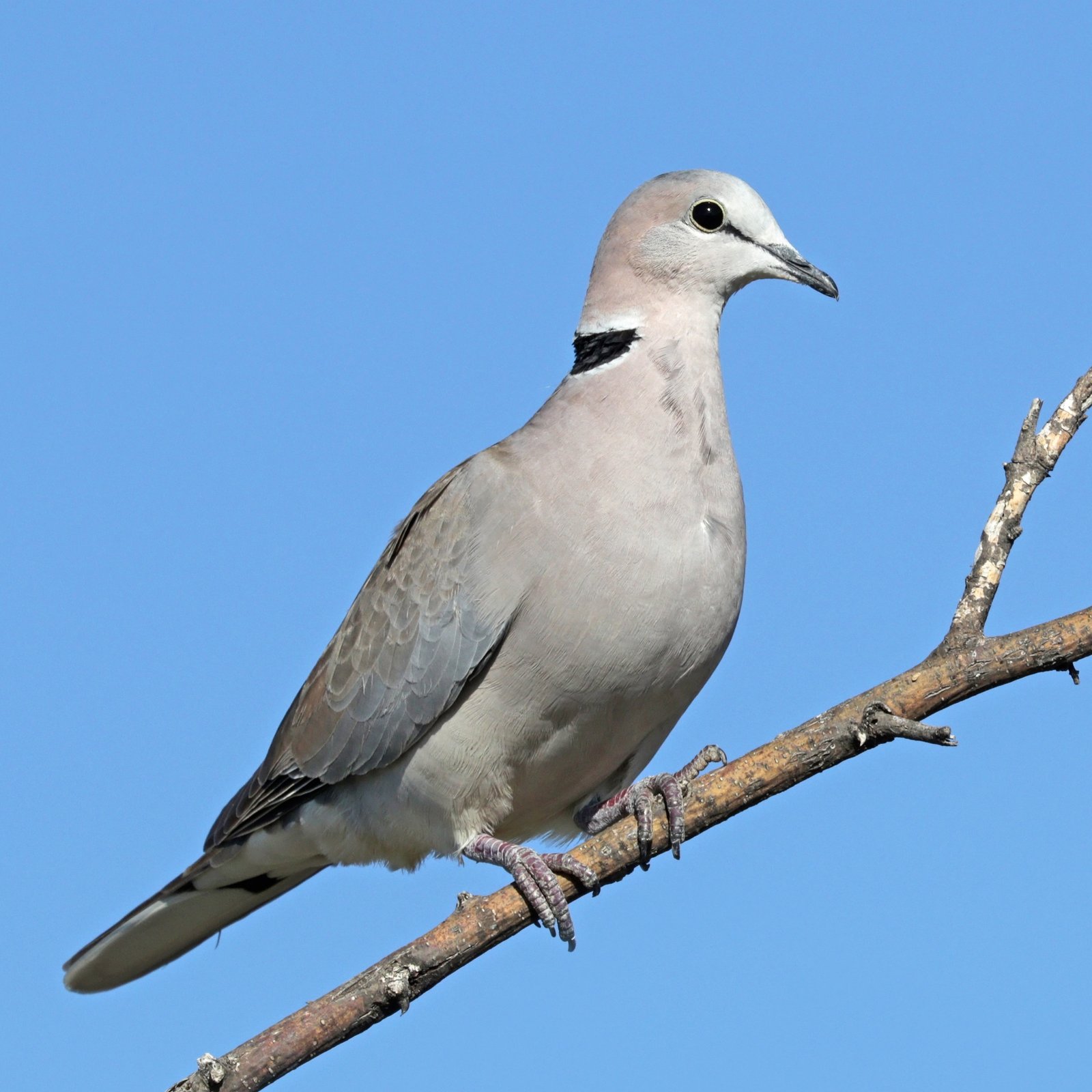
About 27 cm. The plumage is plain pale grey-brown, with a faint pink or lilac wash on head and breast, becoming paler to whitish on the belly. A narrow black collar crosses the hindneck, sometimes edged white above. The eye is dark, without an obvious red eye ring; the bill is black and the legs purplish red. The tail is grey-brown with broad white corners and white outer edges, conspicuous in flight. Birds in the west and the arid interior are paler than those in the east. The sexes are alike; juveniles largely lack the collar and show pale feather fringes.
Confusion species
Red-Eyed Dove (Streptopelia semitorquata) is larger and darker, with a pink head, pale forehead, dark red eye with a red eye ring, and a tail with a pale grey rather than white terminal band. Mourning Collared Dove (Streptopelia decipiens) has a grey head, a pale yellowish eye with a red eye ring and a whiter belly. Laughing Dove (Spilopelia senegalensis) lacks a collar and is rufous with a spotted breast.
Habitat
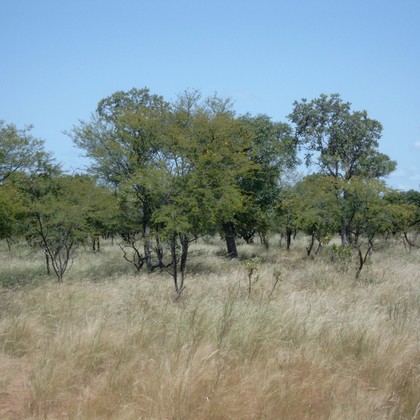
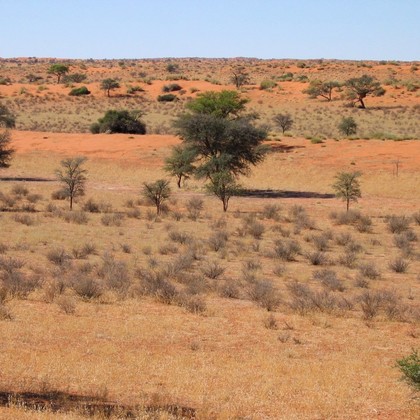
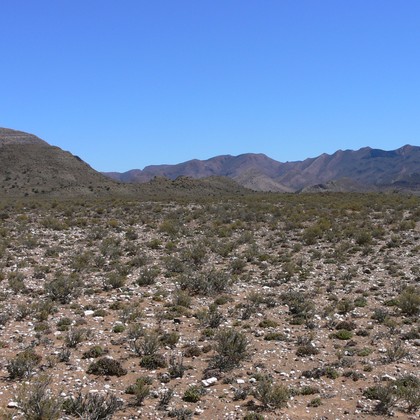
Almost any open to semi-open landscape with trees or bushes: acacia savanna, Kalahari thornveld, mopane and miombo woodland, Karoo scrub with trees along dry watercourses, farmland and gardens. It avoids only closed forest and treeless plains. It feeds on the ground on seeds and grain and is closely tied to drinking water.
Where the bird is most at home, classified by the vegetation units of southern Africa.
Range and movements
Common throughout the region, from the Western Cape and Lesotho to Namibia, Botswana, Zimbabwe, Mozambique, Zambia, Malawi and southern and central Angola; scarce in high mountains, continuous forest and the bare coastal desert. Beyond the region it extends north through East Africa to Ethiopia and Somalia, and into southern DR Congo.
- Resident
- Summer visitor (c. Oct–Mar)
- Winter visitor (c. Apr–Sep)
- Passage (Mar–Apr, Oct–Nov)
- dark = core range, pale = thinly spread
How and when to look
Wherever trees and water meet; at waterholes in Kalahari or mopane woodland hundreds arrive to drink in the late morning. Listen for the three-note call that forms the background of the bushveld. At such sites, compare carefully with Red-Eyed Dove and, in the north, Mourning Collared Dove. All year.
Conservation status
Not threatened and one of the most numerous birds in southern Africa. The species has benefited from artificial water points and agriculture. It is hunted locally, without noticeable effect on numbers.
Scientific name
Streptopelia capicola | (Sundevall, 1857)
Sundevall described the species in 1857 as Columbam vinaceam var. capicolam; because it was later moved to another genus, the author and year stand in brackets. The genus Streptopelia was introduced in 1855 by Bonaparte. Streptopelia is Greek, from streptos 'collar, twisted chain' and peleia 'dove', after the dark neck collar of these doves. capicola means 'Cape-dweller', from Cap and the Latin -cola, 'inhabitant' — for the origin of the first specimen. The specimen the first description was based on came from Rondebosch (Cape Town), South Africa.