All species › Pigeons and doves › Pigeons and doves › Red-Eyed Dove
Red-Eyed Dove | Streptopelia semitorquata
Roodoogtortel | Tórtola Ojirroja
The Red-Eyed Dove is the largest and darkest dove of southern Africa, a bird of riverine forest, parks and gardens with tall trees. The red eye ring and the black collar beneath a pink head are easy to see at close range.

Voice
A six-note rhythmic coo with a distinctive cadence, coo-coo, COO-coo-coo-coo, rendered as I am a Red-Eyed Dove. Also a soft growling krroorr and a plaintive kwaa on landing.
Recording: Richard White — CC BY-NC-SA 4.0 · shortened to the first 60 s, mono · xeno-canto
Identification
About 34 cm, bulky and dark. Head pinkish vinaceous with a pale grey forehead, breast deep pinkish wine red, belly greyer. A black collar crosses the hindneck. Mantle and wings are dark grey-brown, the primaries darker. The eye is dark orange-red and surrounded by a bare dark red eye ring. From below the tail is blackish at the base with a broad pale grey, not white, terminal band. The sexes are alike; juveniles are duller, with an incomplete collar and pale feather fringes.
Confusion species
Ring-Necked Dove (Streptopelia capicola) is smaller and much paler, with a dark eye lacking a red eye ring and white tail corners. Mourning Collared Dove (Streptopelia decipiens) has a pure grey head, a pale yellowish eye, a paler belly and white tail corners. Dusky Turtle Dove (Streptopelia lugens) in the highlands of Malawi and Zambia is darker, with rufous-scaled scapulars and a black patch on the neck side instead of a collar.
Habitat
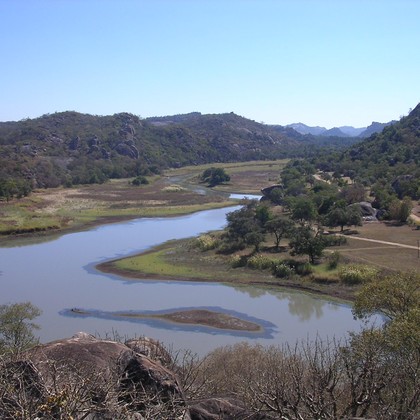
Riverine forest, forest edges, stands of tall trees in savanna, eucalyptus and poplar plantations, parks and gardens. It feeds on the ground, often in fields and gardens, on seeds, grain and fallen fruit, and rests in dense foliage. It needs water nearby.
Where the bird is most at home, classified by the vegetation units of southern Africa.


Range and movements
Common in the east and north of the region: eastern South Africa, Lesotho, Eswatini, Zimbabwe, Mozambique, Malawi, Zambia and Angola, and in northern Botswana and Namibia (Okavango, Chobe, Zambezi Region, Kunene). It has spread west along rivers and with planted trees into the Karoo and the Western Cape. Beyond the region it occurs across sub-Saharan Africa and in south-western Arabia.
- Resident
- Summer visitor (c. Oct–Mar)
- Winter visitor (c. Apr–Sep)
- Passage (Mar–Apr, Oct–Nov)
- dark = core range, pale = thinly spread
How and when to look
Along large rivers, in the rest camps of game reserves and in gardens with tall trees; the call is often heard before the bird is seen. At waterholes, use size, dark tone, the pale grey tail band and the red eye ring to separate it from Ring-Necked Dove. All year.
Conservation status
Not threatened and common. The species has benefited from tree planting, gardens and irrigation, and has expanded its range considerably in the south-west.
Scientific name
Streptopelia semitorquata | (Rüppell, 1837)
Rüppell described the species in 1837 as Columba semitorquata; because it was later moved to another genus, the author and year stand in brackets. The genus Streptopelia was introduced in 1855 by Bonaparte. Streptopelia is Greek, from streptos 'collar, twisted chain' and peleia 'dove', after the dark neck collar of these doves. semitorquata is Latin for 'half-collared' — for the black band on the hindneck. The specimen the first description was based on came from Taranta Mountains, Ethiopia.