All species › Pigeons and doves › Pigeons and doves › Mourning Collared Dove
Mourning Collared Dove | Streptopelia decipiens
Treurtortel | Tórtola Engañosa
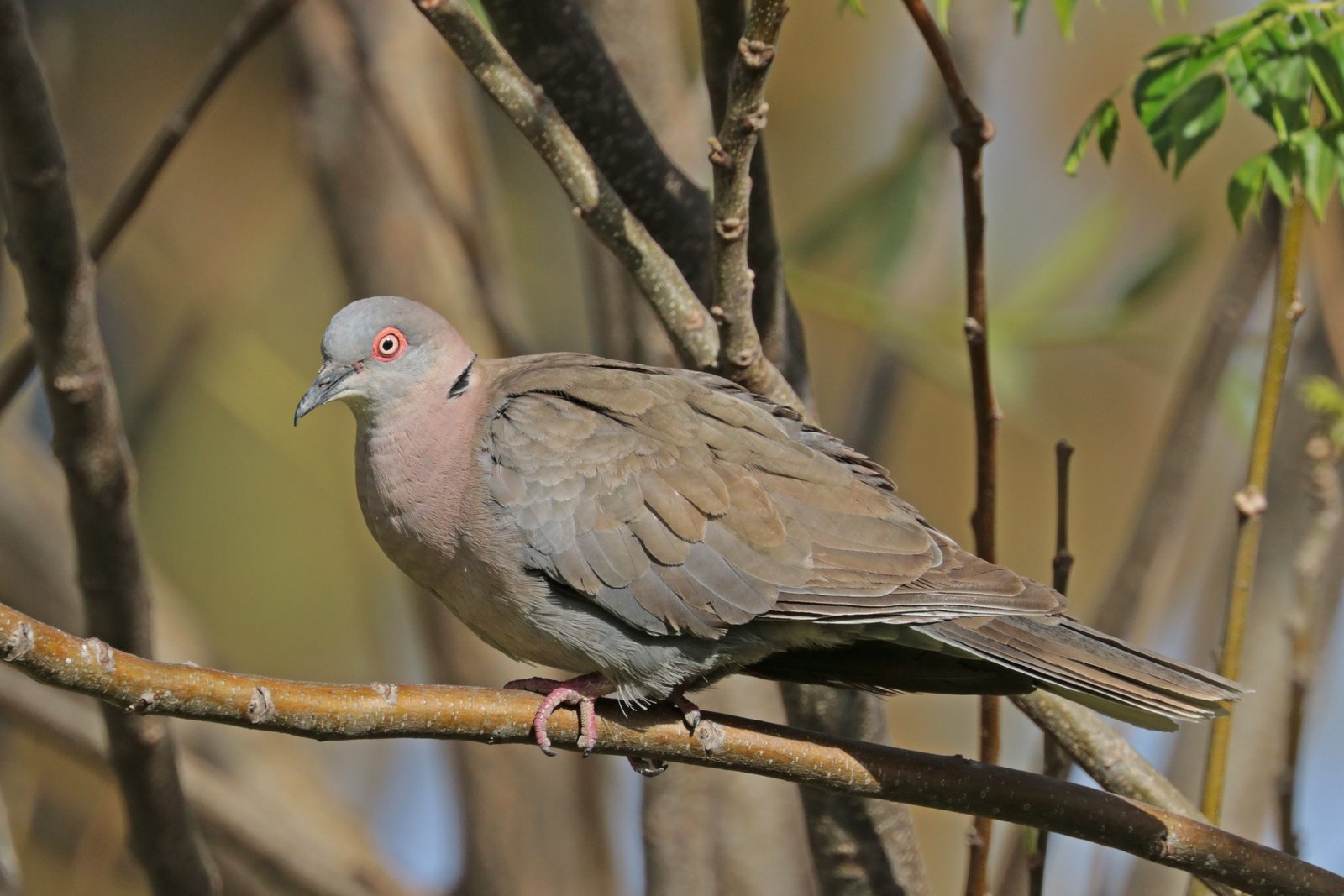
The Mourning Collared Dove is the grey-headed, pale-eyed dove of the great river valleys of northern southern Africa. It shares its habitat with Ring-necked and Red-Eyed Doves, so a good look at the head and eye is needed.
Voice
Very different from its relatives: a soft, falling, rolling krrrrrrr-oo, often followed by a two-note coo-KROO, and on landing a nasal, rolling arrrrr. The lack of a three- or six-note cadence is diagnostic.
Recording: Paul Lynch — CC BY-NC-SA 4.0 · converted to mono · xeno-canto
Identification
About 29 cm. Head and upper neck are clean pale grey, sharply contrasting with the pinkish vinaceous breast. A black collar, edged white above, crosses the hindneck. Upperparts are grey-brown, belly and undertail coverts paler to whitish. The eye is pale, yellow to orange-yellow, surrounded by a bare red eye ring, which gives the bird a staring look. The tail has a dark base and broad white corners. The sexes are alike; juveniles are browner, with an indistinct collar and pale feather fringes.
Confusion species
Ring-Necked Dove (Streptopelia capicola) has a grey-brown rather than clean grey head, a dark eye without a red eye ring, and a paler breast. Red-Eyed Dove (Streptopelia semitorquata) is larger and darker, with a pink head, a dark red eye and a pale grey rather than white tail band. The pale eye with a red ring in a grey head is the best feature.
Habitat
Riparian woodland and thicket in hot lowlands, especially with acacias, ana trees and jackalberries, and adjoining mopane woodland. Also around villages, rest camps and fields in river valleys. It feeds on the ground on seeds and drinks daily at the river.
Where the bird is most at home, classified by the vegetation units of southern Africa.


Range and movements
Within the region confined to the hot river valleys of the north: the Kunene and Zambezi Region in Namibia, the Okavango, Linyanti and Chobe in Botswana, the Zambezi, Kafue and Luangwa in Zambia, the Zambezi and Limpopo-Save valleys in Zimbabwe, the Zambezi and Save in Mozambique, the Shire Valley and Lake Malawi shores, southern Angola, and in South Africa only northern Kruger along the Limpopo and Luvuvhu. Beyond the region it ranges through the Sahel from Senegal to Ethiopia and Somalia, and south through East Africa.
- Resident
- Summer visitor (c. Oct–Mar)
- Winter visitor (c. Apr–Sep)
- Passage (Mar–Apr, Oct–Nov)
- dark = core range, pale = thinly spread
How and when to look
Pafuri in northern Kruger, the Okavango Delta and the Chobe riverfront at Kasane, and rest camps along the Zambezi. Listen for the rolling, almost purring call and look for the pale eye in a grey head. All year.
Conservation status
Not threatened and common over most of its range. In South Africa it is a scarce breeder owing to its small, isolated population. Loss of riverine woodland to clearing and water abstraction is a local threat.
Scientific name
Streptopelia decipiens | (Hartlaub & Finsch, 1870)
Hartlaub & Finsch described the species in 1870 as Turtur decipiens; because it was later moved to another genus, the author and year stand in brackets. The genus Streptopelia was introduced in 1855 by Bonaparte. Streptopelia is Greek, from streptos 'collar, twisted chain' and peleia 'dove', after the dark neck collar of these doves. decipiens is Latin for 'deceptive' — presumably because the species is easily confused with other collared doves. The specimen the first description was based on came from Dongola, Sudan.