All species › Pigeons and doves › Pigeons and doves › Laughing Dove
Laughing Dove | Spilopelia senegalensis
Palmtortel | Tórtola Senegalesa
The Laughing Dove is the small rufous dove of gardens, farmyards and dry savanna throughout southern Africa. Lacking a collar, with a pink head and a band of black spots across the breast, it is the tamest dove in the region.

Voice
A soft, laughing, rolling coo of five to seven notes that first rise and then fall, oo-coo-coo-COO-coo-oo. The wings clatter audibly on take-off.
Recording: African Bioacoustics Community — CC BY-NC-SA 4.0 · converted to mono · xeno-canto
Identification
About 25 cm, slim with a fairly long tail. Head and neck are pinkish vinaceous, without a black collar. The upper breast carries a broad gorget of rufous feathers with black, split spots. Mantle and scapulars are warm rufous brown, and the lesser and median coverts blue-grey, forming an obvious grey panel at rest and in flight. The belly is whitish. The tail is dark with broad white corners, easily seen on take-off. The eye is dark and the legs pinkish red. The sexes are nearly alike; juveniles are paler, lack clear breast spotting and have pale fringes to the coverts.
Confusion species
Ring-Necked Dove (Streptopelia capicola) is greyer and larger with a black collar on the hindneck. Red-Eyed Dove (Streptopelia semitorquata) is much larger and darker, with a collar and a red eye ring. Namaqua Dove (Oena capensis) is smaller with a very long pointed tail and rufous primaries in flight. Emerald-Spotted Wood Dove (Turtur chalcospilos) is compact and short-tailed with glossy green wing spots. The lack of a collar, the spotted breast gorget and the blue-grey wing panel make Laughing Dove unmistakable.
Habitat
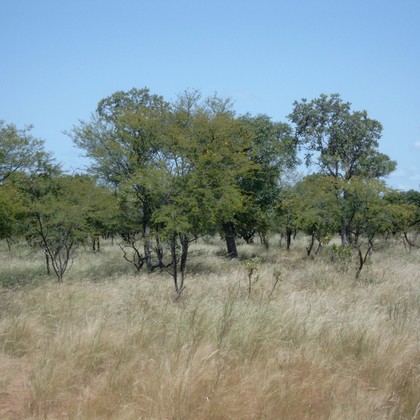
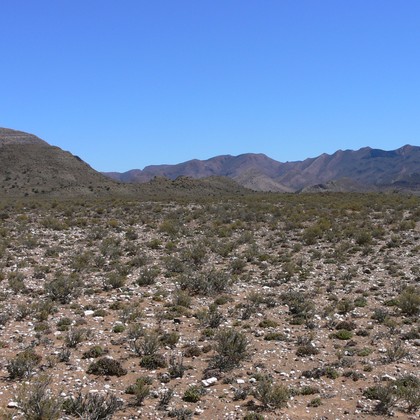
Dry savanna and thornveld, Karoo scrub, riverine woodland in arid areas, farmland, villages, gardens and town parks. It feeds on the ground on grass and weed seeds, spilt grain and small insects. It drinks daily and readily visits troughs and bird baths.
Where the bird is most at home, classified by the vegetation units of southern Africa.

Range and movements
Found over almost the whole region, from the Cape, Lesotho and Eswatini to Namibia, Botswana, Zimbabwe, Mozambique, Zambia, Malawi and Angola; scarcer in closed forest, high mountains and the bare Namib. Beyond the region it occurs across sub-Saharan and North Africa, and through Arabia and the Middle East to India; introduced to Western Australia.
- Resident
- Summer visitor (c. Oct–Mar)
- Winter visitor (c. Apr–Sep)
- Passage (Mar–Apr, Oct–Nov)
- dark = core range, pale = thinly spread
How and when to look
In practically every garden, campsite and waterhole in the region. Birds are so tame that the breast gorget and blue-grey wing panel can be studied at close range. On flushed birds, look for the white tail corners and the absence of a collar. All year.
Conservation status
Not threatened and common. The species has benefited greatly from gardens, agriculture and artificial water points, and is locally expanding. No targeted conservation measures are needed.
Scientific name
Spilopelia senegalensis | (Linnaeus, 1766)
Linnaeus described the species in 1766 as Columba senegalensis; because it was later moved to another genus, the author and year stand in brackets. The genus Spilopelia was introduced in 1873 by Sundevall. Spilopelia is Greek, from spilos 'spot' and peleia 'dove', after the speckled neck patch. senegalensis means 'from Senegal', the country the first described specimen came from. The specimen the first description was based on came from Senegal.