All species › Pigeons and doves › Pigeons and doves › Tambourine Dove
Tambourine Dove | Turtur tympanistria
Tamboerijnduif | Palomita Tamborilera
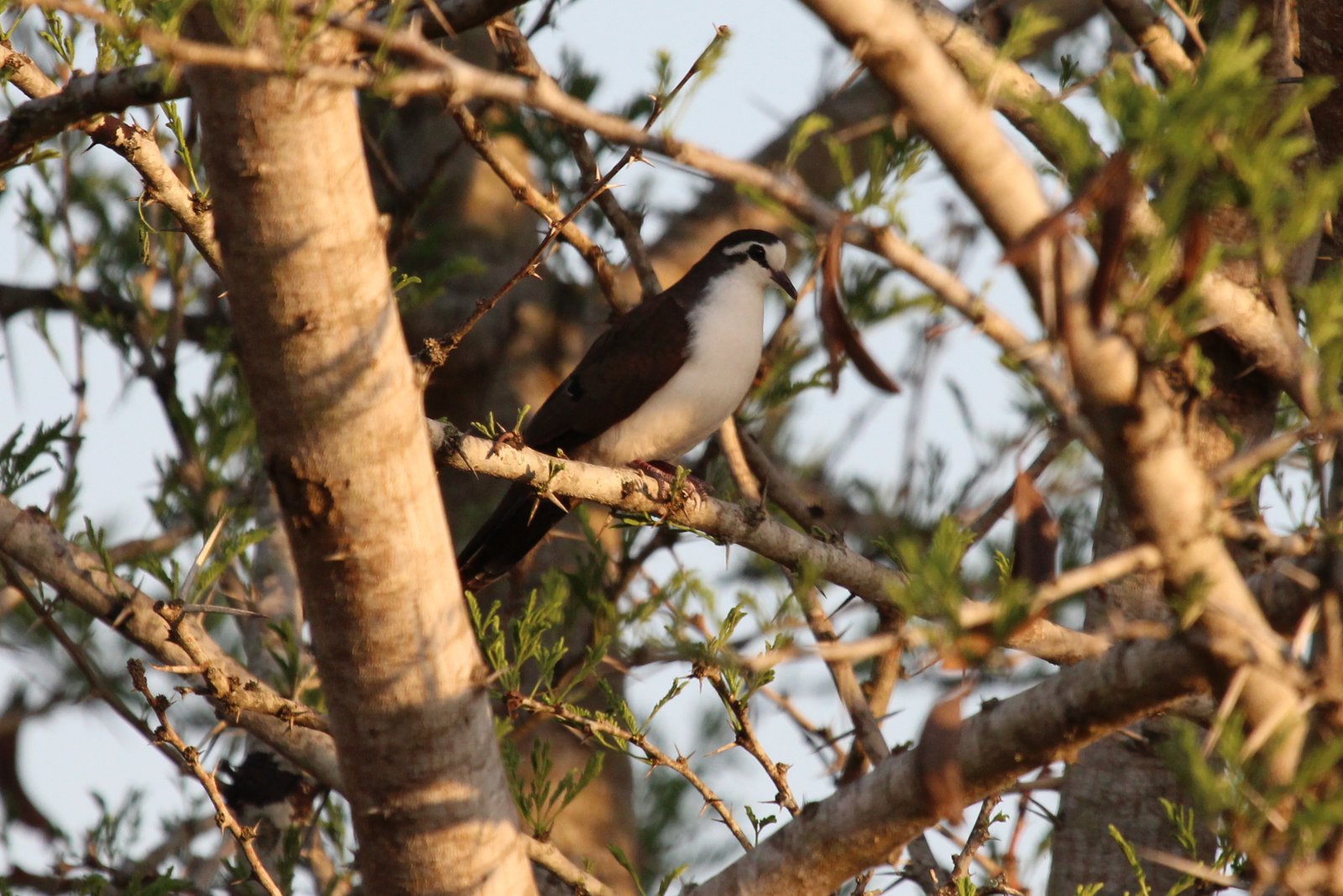
The Tambourine Dove is a small forest dove with snow-white underparts and a white face that shows up as a pale spot in the shade of the forest floor. It walks quietly over the leaf litter and, when disturbed, flies off fast and low.
Voice
A series of soft coos, doo… doo… doo-doo-doo-du-du-du-du, that accelerates but, unlike that of Emerald-Spotted Wood Dove, does not fall in pitch or fade away; it ends in a rapid, even roll. Also a short, husky coorr.
Recording: Budongo Conservation Field Station — CC BY-NC-SA 4.0 · converted to mono · xeno-canto
Identification
About 22 cm, stocky and short-tailed. The upperparts are dark olive-brown; the male's forehead, supercilium and underparts are pure white. There are a few glossy dark green to blue spots on the wing and two dark bands across the lower back, and the outer tail feathers are black. The bill is dark purplish, the legs purplish red. The female has greyer flanks and breast and less white on the face. In flight both sexes show rufous primaries. Juveniles are barred brown.
Confusion species
Emerald-Spotted Wood Dove (Turtur chalcospilos) and Blue-Spotted Wood Dove (Turtur afer) share the same build and rufous wings in flight, but have greyish-pink underparts and no white face. Lemon Dove (Aplopelia larvata) also lives on the forest floor but is larger, cinnamon below with a pale face, and lacks the rufous wing. A fleeting white belly darting away through the forest is almost always a Tambourine Dove.
Habitat
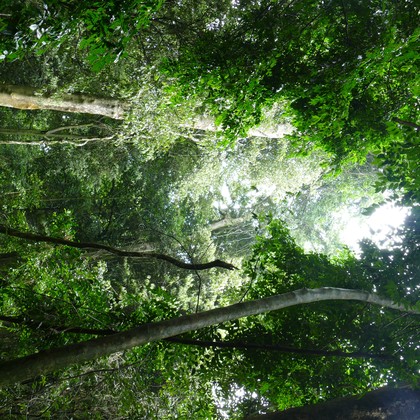
Coastal and lowland forest, riverine forest, dense thickets and forest edges, locally also montane forest and well-wooded gardens adjoining forest. It feeds on the forest floor and on paths on seeds, fallen fruit and small invertebrates.
Where the bird is most at home, classified by the vegetation units of southern Africa.

Range and movements
In South Africa in the eastern coastal forests from the Eastern Cape through KwaZulu-Natal to Mpumalanga and Limpopo, also in Eswatini, Mozambique, the Eastern Highlands and riverine forests of Zimbabwe, Malawi, northern and eastern Zambia, and northern Angola. Beyond the region from Senegal through West and Central Africa to Ethiopia, Kenya and Tanzania.
- Resident
- Summer visitor (c. Oct–Mar)
- Winter visitor (c. Apr–Sep)
- Passage (Mar–Apr, Oct–Nov)
- dark = core range, pale = thinly spread
How and when to look
Walk quietly along forest paths in coastal forest early in the morning, for example around St Lucia or in the forests of the Eastern Cape, and watch for a small white belly flushing ahead of you. The call gives the species away more often than the sight of it. All year.
Conservation status
Not threatened and fairly common in suitable forest. Locally sensitive to clearance of coastal forest and thicket, especially along the east coast of South Africa, but it persists in forest fragments and well-wooded gardens.
Scientific name
Turtur tympanistria | (Temminck, 1809)
Temminck described the species in 1809 as Columba Tympanistria; because it was later moved to another genus, the author and year stand in brackets. The genus Turtur was introduced in 1783 by Boddaert. Turtur is the Latin word for the turtle dove, an imitation of its soft purring call. tympanistria is Latin (from Greek) for 'female drummer' — for the series of calls that accelerates like a drumroll. The specimen the first description was based on came from South Africa (not further specified).