All species › Pigeons and doves › Pigeons and doves › Blue-Spotted Wood Dove
Blue-Spotted Wood Dove | Turtur afer
Staalvlekduif | Palomita Aliazul
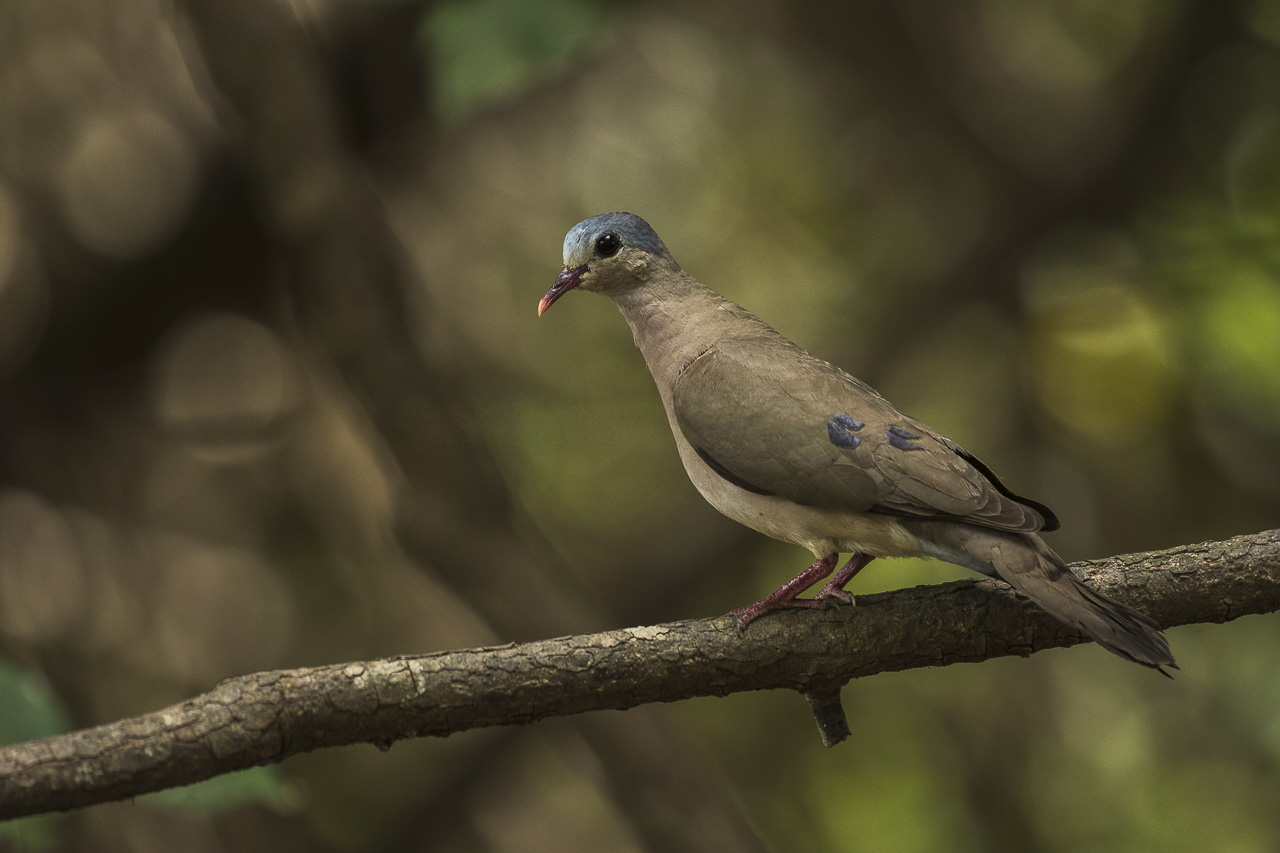
The Blue-Spotted Wood Dove is the northern counterpart of the Emerald-Spotted Wood Dove, a small ground dove of moist forest edges and thickets. Its best feature is the red bill with a yellow tip; the wing spots gleam steel blue rather than green.
Voice
A series of coos that accelerates and falls, doo… doo… doo-du-du-du-dududu, very like that of Emerald-Spotted Wood Dove but on average shorter, quicker to start and ending more abruptly. Reliably separated only with experience and good recordings.
Recording: Bernard BOUSQUET — CC BY-NC-SA 4.0 · converted to mono · xeno-canto
Identification
About 21 cm, stocky and short-tailed. The upperparts are warm grey-brown, the head greyer, the underparts pale vinaceous pink to pale buffy grey with a paler belly. The wing coverts carry five to seven glossy steel-blue to purplish-blue spots that look black in poor light. The bill is reddish purple with a yellow tip, the legs dull red. Two dark bands cross the lower back; the tail is grey with a black terminal band. In flight the primaries are rufous. The sexes are alike; juveniles are barred and have a duller bill.
Confusion species
Emerald-Spotted Wood Dove (Turtur chalcospilos) has green wing spots, a blackish bill, a paler grey head and a drier habitat; the gloss of the spots changes with the light, so bill colour is the most reliable feature. Tambourine Dove (Turtur tympanistria) has white underparts and a white face. Where both spotted Turtur doves occur together, Blue-spotted usually occupies the moister, denser parts.
Habitat
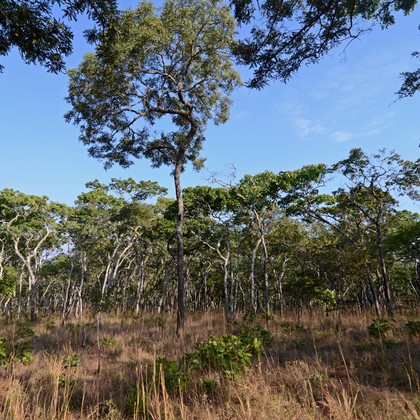
Moist forest edges, gallery and riverine forest, dense thicket along streams, clearings and gardens in forested areas, and the wetter parts of miombo. It feeds on the ground on seeds and fallen fruit, often on paths and in small fields.
Where the bird is most at home, classified by the vegetation units of southern Africa.

Range and movements
In the north of the region: almost all of Angola except the dry south-west, northern and western Zambia, Malawi, and northern and central Mozambique; scarce and local in eastern Zimbabwe. Absent from South Africa, Botswana and Namibia. Beyond the region from Senegal through West and Central Africa to Ethiopia and East Africa.
- Resident
- Summer visitor (c. Oct–Mar)
- Winter visitor (c. Apr–Sep)
- Passage (Mar–Apr, Oct–Nov)
- dark = core range, pale = thinly spread
How and when to look
In Zambia and Malawi, search forest edges along streams and gallery forest, where the species often feeds on paths. Look carefully at the bill: red with a yellow tip means Blue-spotted. Its overlap with Emerald-Spotted Wood Dove makes this species a good exercise in patient observation. All year.
Conservation status
Not threatened and fairly common in the northern part of the region. The species tolerates disturbed forest edges and small-scale farming well. At the southern edge of its range it is scarce.
Scientific name
Turtur afer | (Linnaeus, 1766)
Linnaeus described the species in 1766 as Columba afra; because it was later moved to another genus, the author and year stand in brackets. The genus Turtur was introduced in 1783 by Boddaert. Turtur is the Latin word for the turtle dove, an imitation of its soft purring call. afer is Latin for 'African'. The specimen the first description was based on came from Senegal.