All species › Pigeons and doves › Pigeons and doves › Emerald-Spotted Wood Dove
Emerald-Spotted Wood Dove | Turtur chalcospilos
Smaragdvlekduif | Palomita Aliverde
The Emerald-Spotted Wood Dove is the small ground dove of savanna woodland, heard more often than seen. Its mournful, descending song is one of the most characteristic sounds of the African bushveld.

Voice
A series of soft, hollow coos, doo… doo… doo-doo du-du-du-dudududu, that accelerates, drops in pitch and fades away like a bouncing ball. Heard all year, even in the heat of the day.
Recording: African Bioacoustics Community — CC BY-NC-SA 4.0 · converted to mono · xeno-canto
Identification
About 20 cm, stocky and short-tailed. Crown and hindneck are pale grey, the upperparts grey-brown, throat and breast pale vinaceous pink, the belly pale. The wing coverts bear a few glossy emerald-green spots that look black in shade. The bill is blackish with a purple base, the legs dull red. Two dark bands cross the lower back; the tail is grey with a black terminal band. In flight the rufous primaries are conspicuous. The sexes are alike; juveniles are barred brown and buff.
Confusion species
Blue-Spotted Wood Dove (Turtur afer) has steel-blue wing spots and a red bill with a yellow tip, and lives in moister forest in the north. Tambourine Dove (Turtur tympanistria) has white underparts and a white face. Namaqua Dove (Oena capensis) also has rufous wings, but a long pointed tail.
Habitat
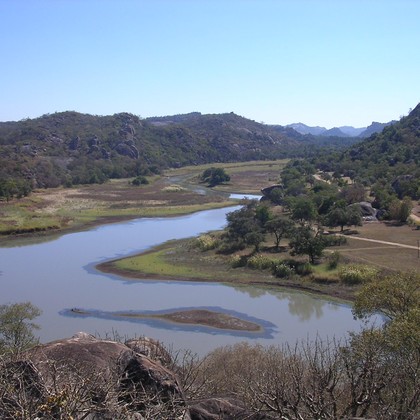
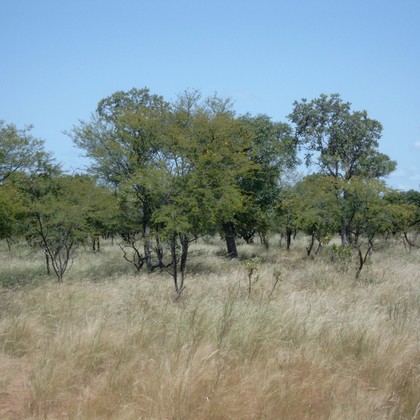
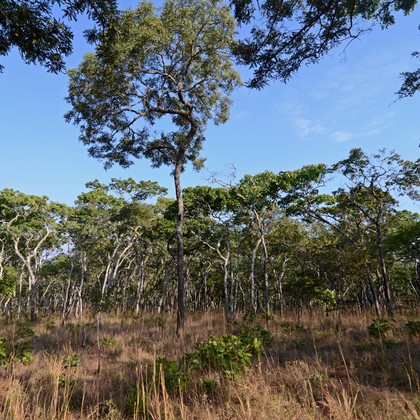
Dry and moist savanna woodland, thornveld, mopane, miombo and riverine vegetation, usually with dense undergrowth and open patches. It feeds singly or in pairs on bare ground on seeds, often on sand roads and paths, and when disturbed flies off fast and low to land again in the bushes further on.
Where the bird is most at home, classified by the vegetation units of southern Africa.
Range and movements
Widespread in the eastern and northern parts of the region: in South Africa from the Eastern Cape through KwaZulu-Natal to Mpumalanga, Limpopo and North West, also in Eswatini, all of Zimbabwe and Mozambique, northern and eastern Botswana, northern and north-eastern Namibia, Zambia, Malawi and most of Angola. Absent from the arid west, the Karoo and the south-western Cape. Beyond the region in East Africa north to Somalia and Ethiopia.
- Resident
- Summer visitor (c. Oct–Mar)
- Winter visitor (c. Apr–Sep)
- Passage (Mar–Apr, Oct–Nov)
- dark = core range, pale = thinly spread
How and when to look
In any bushveld reserve, such as Kruger or Hwange: the song can be heard at every hour of the day, and birds flush from sand roads ahead of the car with a flash of rufous wings. At waterholes they come quietly to drink. All year.
Conservation status
Not threatened and one of the commonest doves of the bushveld. It has declined locally where woodland has been converted to cropland, but tolerates moderate disturbance well.
Scientific name
Turtur chalcospilos | (Wagler, 1827)
Wagler described the species in 1827 as Columba Chalcospilos; because it was later moved to another genus, the author and year stand in brackets. The genus Turtur was introduced in 1783 by Boddaert. Turtur is the Latin word for the turtle dove, an imitation of its soft purring call. chalcospilos comes from the Greek chalkos, 'bronze', and spilos, 'spot' — for the metallic spots on the wing. The specimen the first description was based on came from Eastern Cape, South Africa.