All species › Pigeons and doves › Pigeons and doves › Namaqua Dove
Namaqua Dove | Oena capensis
Maskerduif | Tortolita Rabilarga
The Namaqua Dove is the smallest dove in the region, no larger than a sparrow in the body but with a long, graduated tail. The male wears a black mask from forehead to breast; in flight the rufous primaries stand out.

Voice
A soft, deep and mournful two-part coo, kuh-hoooo, the second note drawn out and slightly swelling, repeated with long pauses; hard to locate and, despite its low pitch, audible at some distance.
Recording: Stanislas Wroza — CC BY-NC-SA 4.0 · converted to mono · xeno-canto
Identification
About 27 cm, more than half of it tail. The upperparts are grey-brown, the underparts paler with a white belly. The male has a black face, throat and central breast, and a red bill with a yellow tip. The female lacks the black mask and has a dark bill. There are a few glossy blue-purple spots on the wing and two dark bands across the lower back. The long tail is graduated, with black edges. In flight both sexes show rufous primaries and underwings. Juveniles are barred brown and buff.
Confusion species
Emerald-Spotted Wood Dove (Turtur chalcospilos) also has rufous primaries, but is stocky and short-tailed and lives in denser woodland. Ring-Necked Dove (Streptopelia capicola) and Laughing Dove (Spilopelia senegalensis) are much larger and lack rufous wings. The long pointed tail and fast, direct flight low over the ground make the species recognisable even without the mask.
Habitat
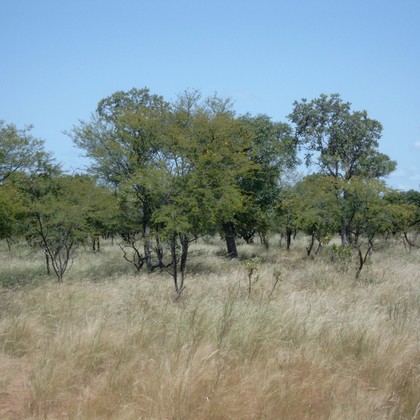
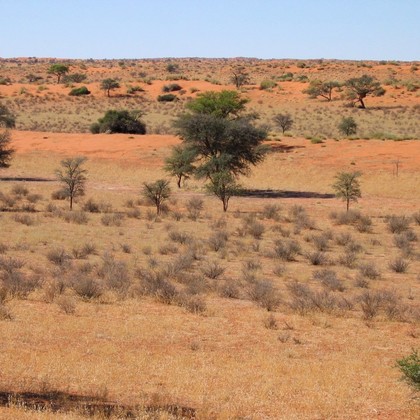
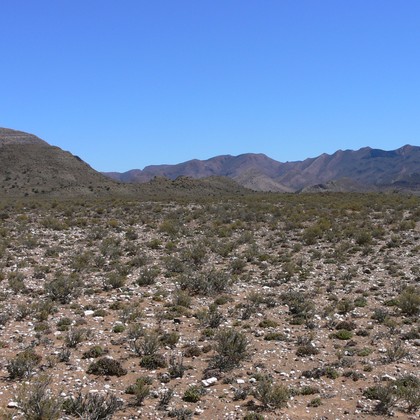
Dry savanna, thornveld, Karoo scrub and semi-desert with open ground, also field margins, fallow land and farmyards. It feeds on bare ground on small seeds of grasses and herbs and drinks regularly. It wanders nomadically with the rains and then turns up in large numbers.
Where the bird is most at home, classified by the vegetation units of southern Africa.
Range and movements
Widespread in the drier western and central parts: almost all of Namibia and Botswana, the interior of South Africa (scarce on the wet east coast and in the south-western Cape), Zimbabwe, southern Mozambique and the south and west of Zambia and Angola; in Malawi mainly in the Shire Valley and along the lake. Beyond the region across the dry parts of sub-Saharan Africa, on Madagascar, and in Arabia and Israel.
- Resident
- Summer visitor (c. Oct–Mar)
- Winter visitor (c. Apr–Sep)
- Passage (Mar–Apr, Oct–Nov)
- dark = core range, pale = thinly spread
How and when to look
Drive slowly along sand roads in thornveld and Karoo: birds flush low ahead of the car on rufous wings and land again on the ground further on. At Kalahari waterholes they come to drink in numbers in the morning. All year, but locally very variable.
Conservation status
Not threatened and very common. The species benefits from the opening up of scrub and from cultivation, and has extended its range over the last century, including southwards and northwards into the Sahel.
Scientific name
Oena capensis | (Linnaeus, 1766)
Linnaeus described the species in 1766 as Columba capensis; because it was later moved to another genus, the author and year stand in brackets. The genus Oena was introduced in 1837 by Swainson. Oena is Greek, from oinas 'pigeon'. capensis denotes the Cape of Good Hope, where the type material came from. The specimen the first description was based on came from the Cape of Good Hope.