All species › Falcons › Falcons › Rock Kestrel
Rock Kestrel | Falco rupicolus
Rotsvalk | Cernícalo Africano
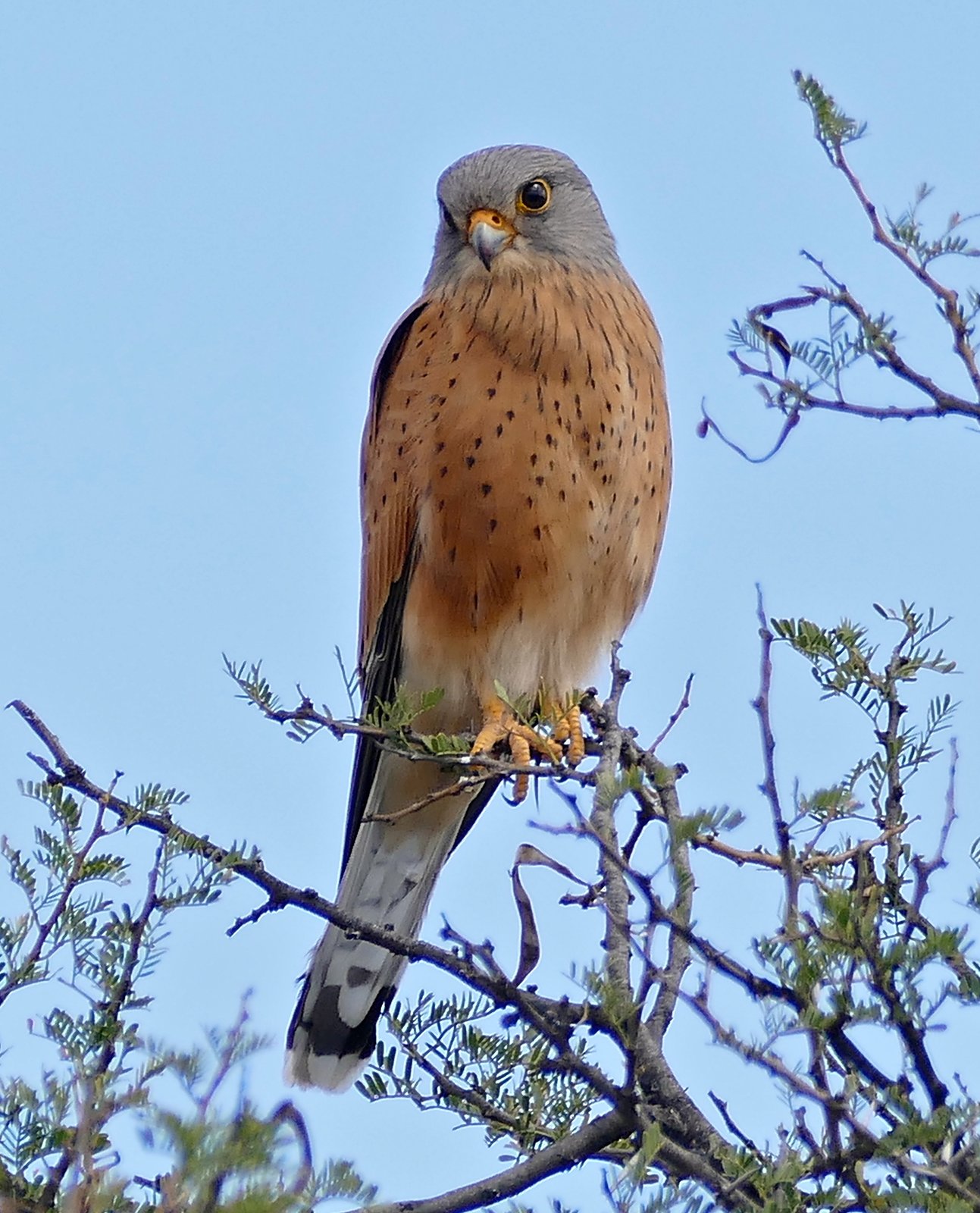
The Rock Kestrel is the common kestrel of southern Africa, a resident of mountains, cliffs and open country. It was long treated as a subspecies of Common Kestrel, but it is darker and redder, with a grey head in both sexes.
Voice
A high, rapidly repeated kee-kee-kee-kee and a high, trilling keerrr, mainly around the nest on a cliff.
Recording: African Bioacoustics Community — CC BY-NC-SA 4.0 · converted to mono · xeno-canto
Identification
About 31 cm. Head and neck are blue-grey, with a narrow dark moustachial stripe. The mantle and wing coverts are warm rufous with small black spots, the flight feathers dark. The tail is blue-grey with narrow bars and a broad black subterminal band with a white tip. The underparts are deep rufous with black drop-shaped spots. The female closely resembles the male but often has a slightly browner-tinged head and a barred tail. The iris is dark, cere and legs yellow. Juveniles are browner, with a streaked head and a rufous, barred tail.
Confusion species
Greater Kestrel (Falco rupicoloides) is paler, with barred upperparts, a pale iris and no grey head. Common Kestrel (Falco tinnunculus), a scarce Palearctic visitor, is paler below; the female has a brown streaked head and a barred brown tail. Lesser Kestrel (Falco naumanni) is smaller and slimmer, lives in flocks, and the male has an unspotted mantle and a grey wing panel.
Habitat
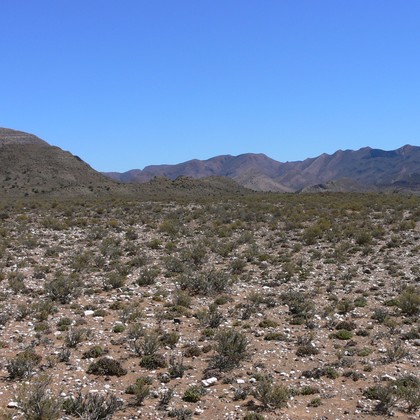
Mountains, gorges, rocky hills, cliffs and open grassland, Karoo and fynbos; also in urban areas, where it breeds on tall buildings. It hunts largely by hovering over slopes and grassy plains, or from a perch, taking rodents, lizards, large insects and small birds. It breeds on a ledge or in a niche in a cliff face, at times in an old crow's nest.
Where the bird is most at home, classified by the vegetation units of southern Africa.


Range and movements
Across almost the whole region: South Africa, Lesotho, Eswatini, Namibia, eastern and southern Botswana, Zimbabwe, western Mozambique and its highlands, southern Malawi, southern Zambia and southern and western Angola. Most numerous in mountainous and rocky country; scarce on the flat Kalahari sandveld and in densely wooded areas. Further north to southern DR Congo and Tanzania.
- Resident
- Summer visitor (c. Oct–Mar)
- Winter visitor (c. Apr–Sep)
- Passage (Mar–Apr, Oct–Nov)
- dark = core range, pale = thinly spread
How and when to look
In any mountain country of the region, from the Drakensberg to the Cape ranges and the granite hills of Zimbabwe, the bird can be seen hovering over a slope or perched on a boulder. A kestrel with a grey head and a heavily spotted rufous breast in the austral winter is almost certainly a Rock Kestrel.
Conservation status
Not assessed separately by the IUCN; it is included in Common Kestrel (Falco tinnunculus, Least Concern). Common; it benefits locally from buildings and pylons, while pesticides and poisoned bait are a risk in places.
Scientific name
Falco rupicolus | Daudin, 1800
Daudin described the species in 1800 and placed it straight away in the genus where it still stands. The genus Falco was introduced in 1758 by Linnaeus. Falco is the Latin word for 'falcon', possibly related to falx, 'sickle', for the curved shape of the claws or wings. rupicolus is Latin for 'rock-dweller', from rupes, 'rock', and colere, 'to inhabit'. The specimen the first description was based on came from Cape of Good Hope.