All species › Passerines › Cisticolas › Rock-Loving Cisticola
Rock-Loving Cisticola | Cisticola aberrans
Langstaartgraszanger | Cistícola Perezoso
The Rock-Loving Cisticola is a cisticola of rocky, wooded hillsides that often shows itself on a boulder with its long tail cocked at an angle. It moves slowly and potters about among the rocks, which earned it the name Lazy Cisticola in older literature. Its song and calls are monotonous but distinctive.

Voice
The song, from a boulder or bush, is a series of drawn-out, nasal whistles, tweeee… tweeee, or a slowly repeated chew. Calls are a plaintive, falling cheeeee and a harsh, grating cher-cher when disturbed, often given by both birds of a pair. There is no song flight.
Recording: Tim Cockcroft — CC BY-NC-SA 4.0 · converted to mono · xeno-canto
Identification
14–16 cm, with a long, broad tail that is often cocked and swung loosely from side to side. The upperparts are plain warm brown to grey-brown without streaking; the crown is rufous, the pale buff supercilium fairly distinct and the lores dark. The underparts are pale buff to ochre, warmer on flanks and undertail coverts. The tail has a black subterminal band and pale tips, well visible from below. The bill is fairly short and dark, the legs pink. The sexes are alike and breeding and non-breeding plumages hardly differ. Juveniles are more rufous. Posture and tail action suggest a prinia rather than a cisticola.
Confusion species
Tawny-Flanked Prinia Prinia subflava has a similar long, cocked tail but is slimmer and greyer above, with a yellowish belly and a longer white supercilium; it lives in rank growth, not on rocks. Neddicky Cisticola fulvicapilla often shares the same wooded slopes but is smaller, with a shorter tail lacking a bold black band and a plain rufous head without a supercilium. Grey-Backed Cisticola Cisticola subruficapilla of the west has a streaked grey back and lives in fynbos and Karoo scrub. Rattling Cisticola Cisticola chiniana has a streaked back and a shorter tail. In Angola the species is replaced by Huambo Cisticola Cisticola bailunduensis. The combination of an unstreaked brown back, long tail, rocks and sluggish behaviour is diagnostic.
Habitat
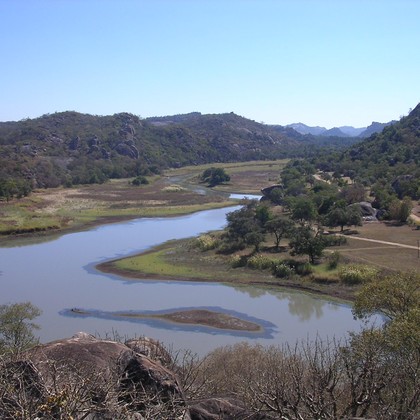
Rocky hillsides and kopjes with scattered trees, bushes and tufts of tall grass, granite and sandstone ridges in bushveld and the rocky edges of wooded ravines. Usually in pairs, low among the rocks; it forages for insects in the grass and on the rocks.
Where the bird is most at home, classified by the vegetation units of southern Africa.

Range and movements
In the east of the region: in South Africa from Limpopo and Mpumalanga through Gauteng and North West to KwaZulu-Natal and the Eastern Cape, also in Eswatini and south-eastern Botswana; in Zimbabwe on the rocky hills of the central watershed, the east and the south; in Mozambique mainly in the west and north; in Malawi on hills and mountain slopes, and in Zambia mainly in the east and north. Beyond the region in East Africa to Kenya and in a broad belt across the savannas of Central and West Africa.
- Resident
- Summer visitor (c. Oct–Mar)
- Winter visitor (c. Apr–Sep)
- Passage (Mar–Apr, Oct–Nov)
- dark = core range, pale = thinly spread
How and when to look
All year; search rocky, wooded slopes, for example in the Magaliesberg, the Matobo Hills and the Nyanga mountains. Listen for the nasal whistles and then scan the boulders: the bird often sits in the open, tail cocked, and allows a quiet approach. The sluggish behaviour and lack of a song flight set it apart from most other cisticolas.
Conservation status
Not threatened. Common on suitable rocky slopes and little affected by disturbance, since such slopes are seldom cultivated. Species limits are in flux: the northern forms are treated as a separate species in some lists, and the Angolan population has been split as Huambo Cisticola.
Scientific name
Cisticola aberrans | (Smith, 1843)
Smith described the species in 1843 as Drymoica aberrans; because it was later moved to another genus, the author and year stand in brackets. The genus Cisticola was introduced in 1829 by Kaup. Cisticola combines the Ancient Greek kisthos 'rock-rose' with the Latin colere 'to dwell'. aberrans is Latin for 'deviating, aberrant', from aberrare, 'to wander'. The specimen the first description was based on came from near Durban, KwaZulu-Natal.