All species › Parrots › Old World parakeets › Rose-Ringed Parakeet
Rose-Ringed Parakeet | Psittacula krameri
Halsbandparkiet | Cotorra de Kramer
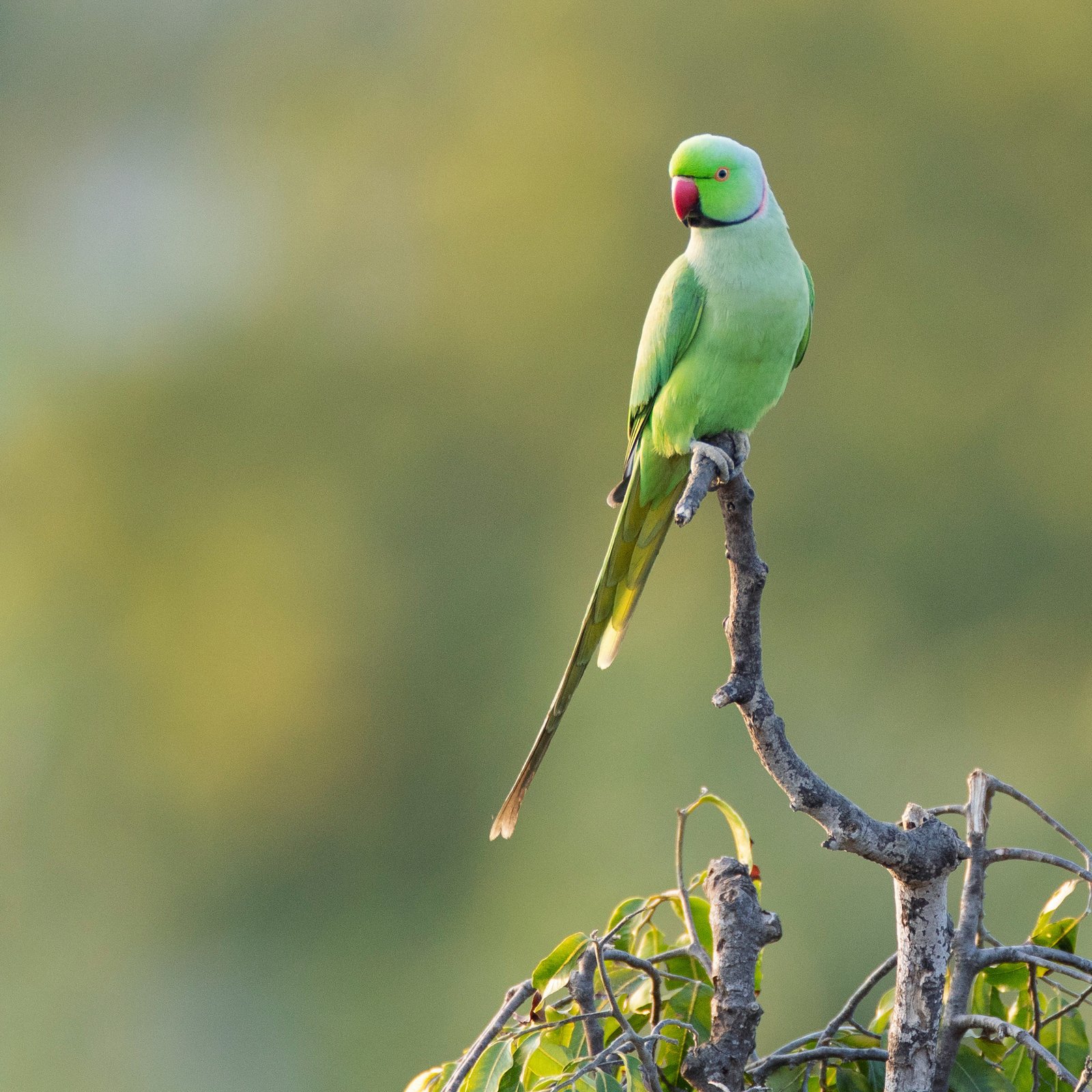
The Rose-Ringed Parakeet is a slender, bright green parakeet with a long, tapering tail and a red bill. It is not native to southern Africa: the birds here descend from escaped and released cage birds of Asian origin, and in a few cities they have formed small, self-sustaining populations.
Voice
A high, piercing kee-ak or kreee-kreee, often repeated in quick series in flight. Flocks are noisy at communal roosts, especially shortly before sunset.
Recording: Sam Hambly — CC BY-NC-SA 4.0 · converted to mono · xeno-canto
Identification
37–43 cm, more than half of it tail. Plumage yellowish-green, slightly bluer on the hindcrown and central tail feathers. The bill is deep red with a dark lower mandible. The male has a narrow black throat stripe continuing back as a thin band, bordered above by a pink nape ring. Females and juveniles lack both bands and are plain green, sometimes with a faint green collar. Flight is fast and direct on rapid shallow beats; the long tail and swept wings give an arrow-shaped outline.
Confusion species
There is no other wild long-tailed parakeet in the region. The native parrots, such as Meyer's Parrot (Poicephalus meyeri) and Brown-Headed Parrot (Poicephalus cryptoxanthus), are stocky and short-tailed. Escaped Alexandrine Parakeets (Psittacula eupatria) are larger, with a heavier bill and a maroon shoulder patch. Colour mutants from the cage-bird trade (yellow, blue) regularly turn up among green birds.
Habitat
Parks, gardens, avenues of exotic trees and fruit orchards in urban areas. It eats seeds, fruit, flowers and nectar, and visits bird tables. It nests in holes in old trees, often old woodpecker or barbet holes, thereby taking nest sites that native cavity nesters need.
Where the bird is most at home, classified by the vegetation units of southern Africa.


Range and movements
In South Africa established in and around Durban, and in smaller numbers in Johannesburg and Pretoria; single birds and small groups elsewhere, including around Cape Town. Elsewhere in the region only as an escaped cage bird. The native range spans the Sahel belt of Africa and the Indian subcontinent; feral populations live across much of Europe, the Middle East and East Asia.
- Resident
- Winter visitor (c. Apr–Sep)
- dark = core range, pale = thinly spread
How and when to look
Easiest to see at communal roost trees in town during the last hour before sunset, when small flocks arrive calling loudly. With green birds, check the tail length and red bill to separate them from escaped lovebirds and other parakeets.
Conservation status
Not threatened globally. In southern Africa an alien with a small but growing population. It competes with native cavity nesters for nest sites and can damage fruit crops; experience in Europe and elsewhere shows how quickly such populations can expand.
Scientific name
Psittacula krameri | (Scopoli, 1769)
Scopoli described the species in 1769 and placed it straight away in the genus where it still stands. The genus Psittacula was introduced in 1800 by Cuvier, GLCFD. Psittacula is Latin, a diminutive of psittacus 'parrot', so 'little parrot'. krameri honours the physician and naturalist Wilhelm Heinrich Kramer (died 1765). The specimen the first description was based on came from Senegal.