All species › Passerines › Tits › Rufous-Bellied Tit
Rufous-Bellied Tit | Melaniparus rufiventris
Roestbuikmees | Carbonero Ventrirrufo
Rufous-Bellied Tit is the miombo tit with a black head and a rufous belly, unmistakable once seen well. In the east of the region live paler forms with a cinnamon belly, which have often been treated as a separate species.

Voice
Harsh and rattling, chrr-chrr, often with a high lead-in, tsi-tsi-cher, and a series of clear, repeated whistles, chitti-chitti-chitti or pee-choo pee-choo, reminiscent of Southern Black Tit.
Recording: Niall Perrins — CC BY-NC-SA 4.0 · shortened to the first 60 s, mono · xeno-canto
Identification
15 cm. Head, throat and breast black, back grey, wings black with broad white edges to coverts and flight feathers, tail black with white edges. Belly, flanks and undertail coverts warm rufous. Adults of the western forms have a striking creamy-yellow iris; juveniles are dark-eyed. The eastern forms pallidiventris and stenotopicus have a pale cinnamon to buff belly and usually a dark eye. The sexes are alike, the female slightly duller.
Confusion species
Southern Black Tit Melaniparus niger is entirely black, with no rufous. Miombo Tit Melaniparus griseiventris has white cheeks and a greyish-white belly. White-Winged Black Tit Melaniparus leucomelas is black with a white wing patch. In poor light or from below Rufous-Bellied Tit looks dark; wait for a side view of the belly and flank.
Habitat
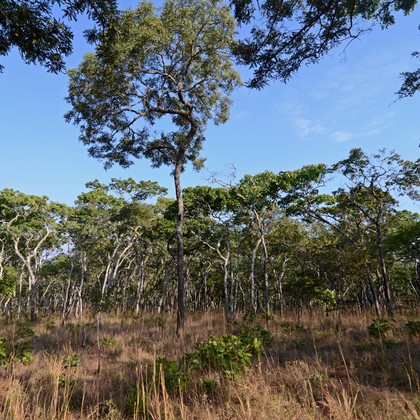
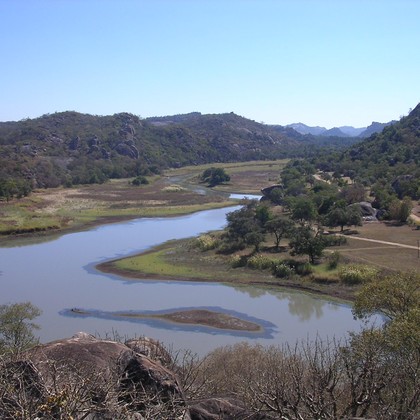
Miombo and other broadleaved woodland, in the west also Kalahari sand woodland with Baikiaea and Burkea. It forages in the canopy and on branches, almost always in pairs or small groups in mixed bird parties. Nests in a tree hole.
Where the bird is most at home, classified by the vegetation units of southern Africa.
Range and movements
Within the region in central and eastern Angola, almost all of Zambia, north-eastern Namibia (Kavango and Zambezi Region), extreme northern Botswana, Malawi, northern and central Mozambique and northern Zimbabwe. Beyond, in southern Congo-Brazzaville, southern DR Congo and southern Tanzania.
- Resident
- dark = core range, pale = thinly spread
How and when to look
Year-round, best in the dry season when mixed parties move through miombo. First locate the party by the harsh rattle and check every tit; the rufous belly and, in western birds, the pale eye are decisive.
Conservation status
Not threatened; widespread and locally common in miombo, and listed by the IUCN under the older name Parus rufiventris. Conversion of miombo to farmland and charcoal production do reduce its habitat.
Scientific name
Melaniparus rufiventris | (Bocage, 1877)
Bocage described the species in 1877 as Parus rufiventris; because it was later moved to another genus, the author and year stand in brackets. The genus Melaniparus was introduced in 1850 by Bonaparte. Melaniparus combines the Greek melas, 'black', with Parus, Latin for 'tit' — for the largely black plumage of many species. rufiventris is Latin for 'red-bellied', from rufus, 'red', and venter, 'belly' — for the rufous belly. The specimen the first description was based on came from Caconda, Angola.