All species › Passerines › Tits › Southern Black Tit
Southern Black Tit | Melaniparus niger
Roetmees | Carbonero Negro
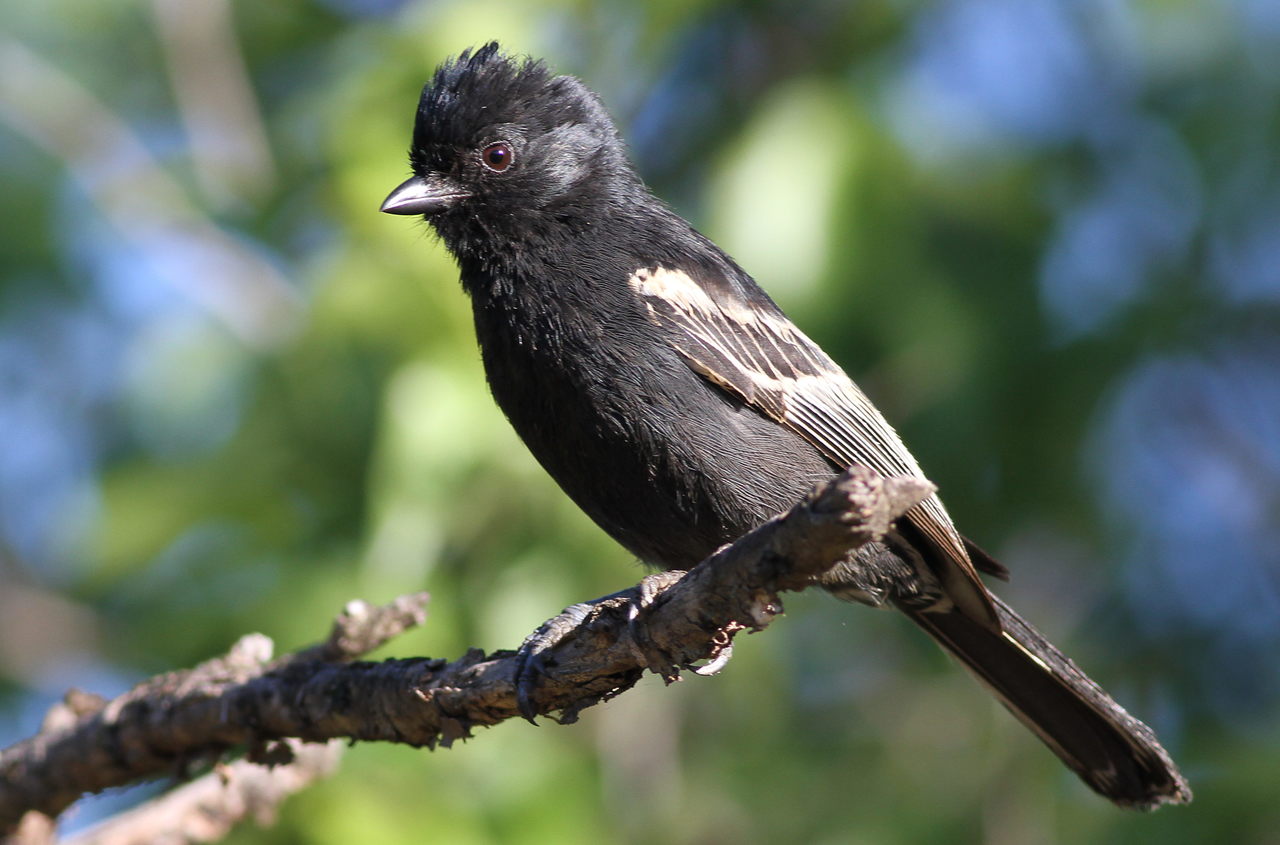
Southern Black Tit is the black tit of the eastern woodlands: a noisy, glossy black bird with plenty of white in the wing that joins mixed bird parties in pairs or small family groups. It is the commonest and most widespread black tit in the region.
Voice
Noisy. A rattling, harsh chrr-chrr-chrr, often preceded by a high tsi: tsi-chrr-chrr. The song is a series of clear, repeated whistles, pee-choo pee-choo or chee-wee chee-wee, varying by area and individual.
Recording: Lynette Rudman — CC BY-NC-SA 4.0 · converted to mono · xeno-canto
Identification
16 cm. The male is glossy blue-black, with broad white edges to the wing coverts and secondaries that together form a white wing panel, white edges to the outer tail feathers and black undertail coverts scalloped with white. The female is duller and greyer, especially on the belly and flanks, with the same wing pattern. Iris dark; bill black and fairly stout. Juveniles are brownish black with yellowish fringes to the wing feathers.
Confusion species
Carp's Tit Melaniparus carpi of north-western Namibia and south-western Angola is smaller, with a larger white wing panel and black undertail coverts without white scalloping; the two meet only in northern Namibia. White-Winged Black Tit Melaniparus leucomelas in Angola and northern Zambia likewise has plain black undertail coverts and a broad white wing panel. Miombo Tit Melaniparus griseiventris is grey with a black cap. Southern Black Flycatcher Melaenornis pammelaina and Fork-Tailed Drongo Dicrurus adsimilis are all black with no white in the wing.
Habitat
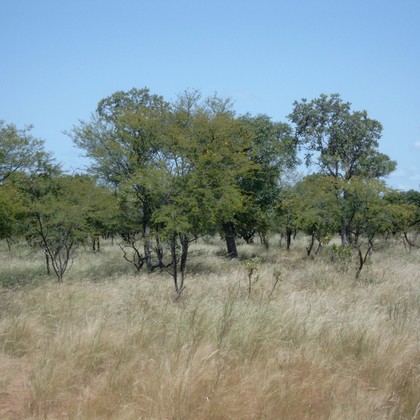
Broadleaved and mixed woodland, miombo, acacia savanna with large trees, riverine forest, forest edge and large gardens and parks with old trees. It forages on trunks, branches and in the canopy for insects and their larvae, prising them from under bark or hammering them open held under the foot against a branch. Nests in a tree hole.
Where the bird is most at home, classified by the vegetation units of southern Africa.


Range and movements
Within the region in eastern South Africa (from the Eastern Cape through KwaZulu-Natal to Mpumalanga, Gauteng, North West and Limpopo), Eswatini, Mozambique, Zimbabwe, eastern and northern Botswana, north-eastern Namibia, southern and eastern Zambia and Malawi. Beyond, only into southern Tanzania and south-eastern DR Congo.
- Resident
- Winter visitor (c. Apr–Sep)
- Passage (Mar–Apr, Oct–Nov)
- dark = core range, pale = thinly spread
How and when to look
Year-round. The harsh, rattling call is often the first thing noticed in a mixed woodland bird party; the black tit is frequently the 'leader' that keeps a flock together. In Kruger and the woodlands of Limpopo and Zimbabwe the species is common.
Conservation status
Not threatened; common and widespread, and at home in gardens and parks with old trees. The IUCN lists it under the older name Parus niger.
Scientific name
Melaniparus niger | (Vieillot, 1818)
Vieillot described the species in 1818 as Parus niger; because it was later moved to another genus, the author and year stand in brackets. The genus Melaniparus was introduced in 1850 by Bonaparte. Melaniparus combines the Greek melas, 'black', with Parus, Latin for 'tit' — for the largely black plumage of many species. niger is Latin for 'black' — for the largely black plumage. The specimen the first description was based on came from Sundays River, Eastern Cape, South Africa.