All species › Passerines › Tits › Carp's Tit
Carp's Tit | Melaniparus carpi
Carps mees | Carbonero de Carp
Carp's Tit is the black tit of arid north-western Namibia and south-western Angola, one of the few species wholly confined to the region. Formerly treated as a subspecies of White-Winged Black Tit, it closely resembles Southern Black Tit but lives further west in drier country.

Voice
Similar to Southern Black Tit: a harsh, rattling tsi-chrr-chrr and clear, repeated whistles, pee-pee-chwee or chee-wee chee-wee. Range and habitat are more reliable than voice.
Recording: Gareth K. — CC BY-NC-SA 4.0 · converted to mono · xeno-canto
Identification
14 cm. The male is glossy black with a large white patch on the wing coverts and broad white edges to the secondaries and primaries, so the closed wing shows much white. The undertail coverts are black with no or very little white scalloping; the outer tail feathers have narrow white edges. The female is duller and greyer black, especially below. Bill black, iris dark. Smaller and slimmer than Southern Black Tit.
Confusion species
Southern Black Tit Melaniparus niger is larger, with clearly white-scalloped undertail coverts and less white in the wing; in Namibia it occurs only in the north-east and barely meets Carp's Tit. White-Winged Black Tit Melaniparus leucomelas occurs only much further north and east in Angola, in miombo. Southern Black Flycatcher Melaenornis pammelaina and Fork-Tailed Drongo Dicrurus adsimilis lack white in the wing.
Habitat
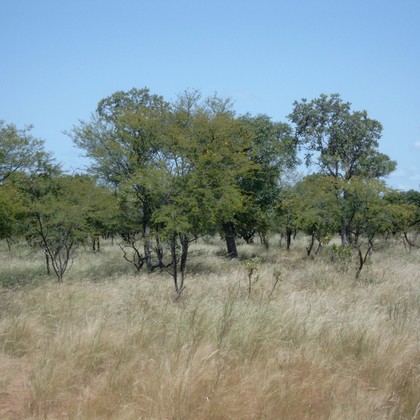
Dry woodland and thornveld with larger trees: mopane woodland, acacia savanna, wooded rocky hills and the trees along dry watercourses. It forages in pairs or small groups on trunks and branches for insects and their larvae. Nests in a tree hole.
Where the bird is most at home, classified by the vegetation units of southern Africa.

Range and movements
Endemic to the region: in north-western Namibia, from the Kaokoveld and Damaraland east to Etosha, and in south-western Angola (Namibe, Huíla and Cunene).
- Resident
- Summer visitor (c. Oct–Mar)
- Winter visitor (c. Apr–Sep)
- Passage (Mar–Apr, Oct–Nov)
- dark = core range, pale = thinly spread
How and when to look
Year-round. The rest camps in Etosha, such as Halali and Okaukuejo, and the mopane of the Kaokoveld are the best places; listen for the harsh call in a mixed bird party. East of Etosha any black tit is more likely to be Southern Black Tit; check the undertail.
Conservation status
Not threatened; fairly common within its small range, much of which is sparsely populated. No large-scale threats are known.
Scientific name
Melaniparus carpi | (Macdonald & Hall, 1957)
Macdonald & Hall described the species in 1957 as Parus niger carpi; because it was later moved to another genus, the author and year stand in brackets. The genus Melaniparus was introduced in 1850 by Bonaparte. Melaniparus combines the Greek melas, 'black', with Parus, Latin for 'tit' — for the largely black plumage of many species. carpi honours Bernhard Carp (1901–1966), a Dutch-born South African businessman and naturalist who sponsored zoological expeditions to South West Africa. The specimen the first description was based on came from Warmquelle, Kaokoveld, Namibia.