All species › Passerines › Tits › Dusky Tit
Dusky Tit | Melaniparus funereus
Gabonmees | Carbonero Cenizo
Dusky Tit is a dark, sooty-grey tit of the Central African rainforest that moves in parties through the upper storeys. In the region it reaches only northern Angola, where it is rare and poorly known.

Voice
Noisy: a harsh, buzzy chattering and rattling series, and a distinctive dree di-di-di, alongside clear whistles. Parties are usually heard before they are seen.
Recording: GABRIEL LEITE — CC BY-NC-SA 4.0 · converted to mono · xeno-canto
Identification
14–15 cm. The male is wholly dark slate-grey to sooty black, with no white in wing or tail and a slightly glossy head. The female is paler and greyer, especially below. Adults have a red iris, a striking feature for a tit; juveniles are dark-eyed and browner. Bill black, fairly short and stout.
Confusion species
White-Winged Black Tit Melaniparus leucomelas has a large white wing patch and lives in miombo and open woodland, not rainforest. Square-Tailed Drongo Dicrurus ludwigii and Fork-Tailed Drongo Dicrurus adsimilis are glossy black with a red eye, but have a long tail, forked in Fork-Tailed Drongo, and hunt from a perch. Black Cuckooshrike Campephaga flava is larger and longer-tailed.
Habitat
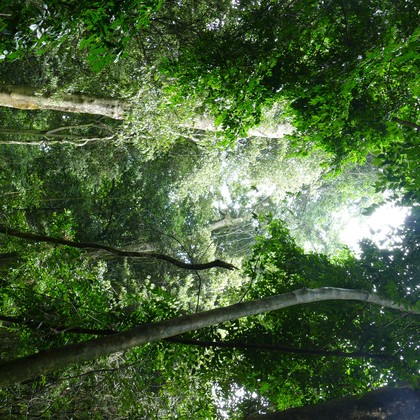
Lowland rainforest and gallery forest, especially the upper storeys and forest edge, also old plantations and clearings on the forest margin. It moves in parties, often with mixed bird parties, through the canopy and feeds on insects and larvae.
Where the bird is most at home, classified by the vegetation units of southern Africa.

Range and movements
Within the region only in northern Angola, in the northern forest belt; rare and little documented. Beyond, widespread in the West and Central African forest zone, from Sierra Leone to the Congo basin, South Sudan, Uganda and western Kenya.
How and when to look
Year-round. A rare species for the region; any record in Angola is worth documenting. Listen at forest edges for harsh, buzzy party calls high in the trees and look for the red eye.
Conservation status
Not threatened; widespread globally. In Angola the species is scarce, and the northern forest belt is subject to logging and conversion to farmland.
Scientific name
Melaniparus funereus | Verreaux & Verreaux, 1855
Verreaux & Verreaux described the species in 1855 and placed it straight away in the genus where it still stands. The genus Melaniparus was introduced in 1850 by Bonaparte. Melaniparus combines the Greek melas, 'black', with Parus, Latin for 'tit' — for the largely black plumage of many species. funereus is Latin for 'funereal' — for the dull, sooty-black plumage. The specimen the first description was based on came from Gabon.