All species › Passerines › Chats and flycatchers › Rufous-Tailed Scrub Robin
Rufous-Tailed Scrub Robin | Cercotrichas galactotes
Rosse waaierstaart | Alzacola Rojizo
The Rufous-Tailed Scrub Robin is a pale, sandy scrub robin with a bright rufous tail that breeds around the Mediterranean, in the Sahel and in the Middle East. It winters in the Sahel and East Africa south to Kenya and Tanzania; in southern Africa it is an exceptional vagrant.

Voice
Rather silent outside the breeding season. The call is a hard, dry tchak or tek and a high, rattling chrrr. The song on the breeding grounds is a clear, varied series of lark-like phrases, often given in song flight.
Recording: Stanislas Wroza — CC BY-NC-SA 4.0 · converted to mono · xeno-canto
Identification
A slender, long-legged scrub robin of 15 to 16 cm. The upperparts are warm sandy-brown to grey-brown, and the rump and long tail bright rufous; the tail feathers have a black band before the white tip, obvious when the bird cocks and fans its tail. The head shows a long pale supercilium and a dark eye-stripe. The underparts are plain creamy-white to pale sandy, without streaks. The flight feathers have pale edges. The sexes are alike.
Confusion species
Kalahari Scrub Robin (Cercotrichas paena) is the main pitfall: also sandy with a rufous tail with a black subterminal band and white tips, but greyer above, with a more distinct black malar stripe and a greyish breast. So always check the colour contrast between back and tail and the head pattern. White-Browed Scrub Robin (Cercotrichas leucophrys) has a streaked breast and white wing bars. Karoo Scrub Robin (Tychaedon coryphoeus) has a grey-brown tail.
Habitat
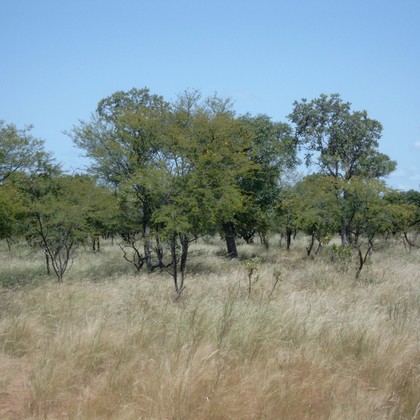
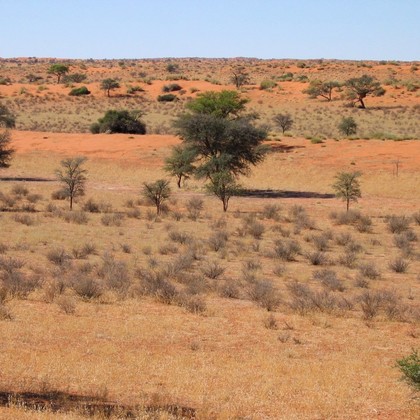
In the wintering range dry, open thornveld, scrub with bare ground, field margins and dry riverbeds. Forages on the ground, running a short way with the tail cocked and picking up insects.
Where the bird is most at home, classified by the vegetation units of southern Africa.
Range and movements
An exceptional vagrant to southern Africa, with only a handful of accepted records; apart from these the species has not been reliably recorded in the region. The breeding range extends from southern Europe and North Africa through the Sahel and the Middle East to Central Asia; African birds (minor) are sometimes treated as a separate species. The wintering areas lie in the Sahel and East Africa, south to Kenya and Tanzania.
How and when to look
Any report in southern Africa needs photographs and a careful comparison with Kalahari Scrub Robin. Look for the rufous tail contrasting strongly with the sandy-brown back, the long pale supercilium and the unstreaked pale underparts. Submit the sighting to the national rarities committee.
Conservation status
Not threatened. The global population is large, but in Europe the species has declined steeply in recent decades because of agricultural intensification and the loss of dry scrub, especially in Spain and Portugal.
Scientific name
Cercotrichas galactotes | (Temminck, 1820)
Temminck described the species in 1820 as Sylvia galactotes; because it was later moved to another genus, the author and year stand in brackets. The genus Cercotrichas was introduced in 1831 by Boie. Cercotrichas is Greek, from kerkos 'tail' and trikhas 'thrush'. galactotes means 'milk-like', from Greek gala 'milk'. The specimen the first description was based on came from Algeciras, southern Spain.