All species › Tubenoses › Petrels and shearwaters › Sargasso Shearwater
Sargasso Shearwater | Puffinus lherminieri
Sargassopijlstormvogel | Pardela de Sargazo
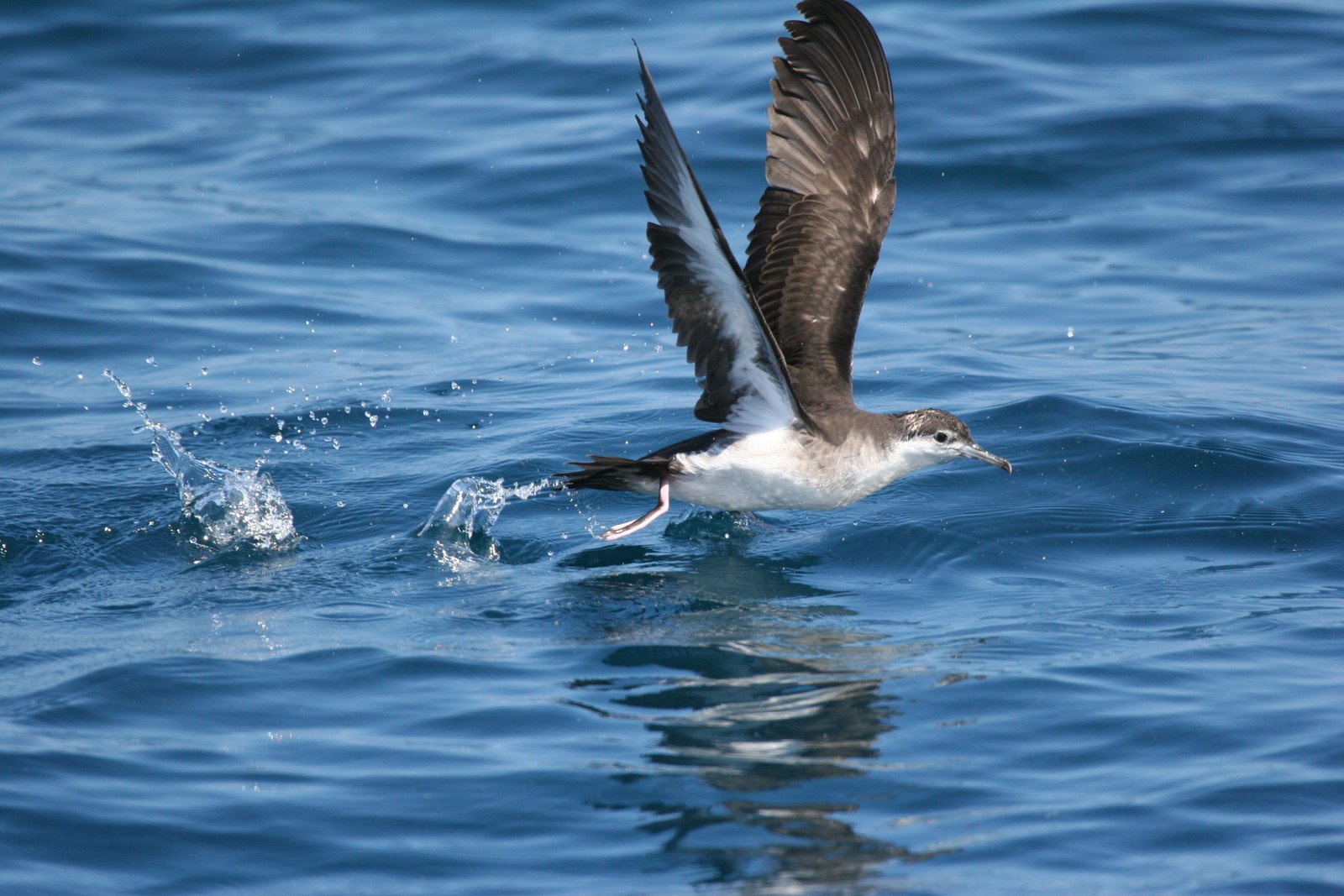
The Sargasso Shearwater is a small, dark brown and white shearwater of the Caribbean and western Atlantic. It used to form part of a broad Audubon's Shearwater that also included the birds of the western Indian Ocean; these are now kept separate as Tropical Shearwater. There is no certain record from southern Africa.
Voice
Silent at sea. At the colonies a plaintive, twittering pimm-pimm-pimm-oo and groans from rock crevices at night.
Recording: William Mackin — CC BY-NC-SA 4.0 · converted to mono · xeno-canto
Identification
Small, 30 to 33 cm, with short, broad wings and a relatively long tail. The upperparts are dark chocolate brown and the underparts white. The dark cap extends below the eye and continues into a dark patch at the side of the breast. The undertail coverts are dark. The underwing is white with a broad dark trailing edge and tip. The bill is dark and the legs pink with a dark outer side. It flies low over the water with fast, fluttering beats and short glides.
Confusion species
Tropical Shearwater (Puffinus bailloni) is almost impossible to separate in the field and is the only form of this group that occurs regularly in the Indian Ocean. Manx Shearwater (Puffinus puffinus) is larger, blacker above and has white undertail coverts. Little Shearwater (Puffinus assimilis) is more compact, with white around the eye and white undertail coverts.
Habitat
Warm tropical sea, often far offshore and near floating sargassum weed, where it picks small fish, squid and crustaceans from the surface or makes shallow dives. It breeds in rock crevices and burrows on small islands.
Where the bird is most at home, classified by the vegetation units of southern Africa.
Range and movements
No bird has been established with certainty in the region. Older reports of Audubon's Shearwater from Mozambique and KwaZulu-Natal derive from the old, broad species concept and almost certainly refer to Tropical Shearwater. Sargasso Shearwater in the narrow sense breeds in the Caribbean, the Bahamas and off Brazil, and ranges in the western Atlantic north to the Gulf Stream.
- Passage (Mar–Apr, Oct–Nov)
- dark = core range, pale = thinly spread
How and when to look
A small brown-and-white shearwater with dark undertail coverts off the east coast is almost certainly a Tropical Shearwater. A possible Sargasso Shearwater, for example off Angola or the west coast, can only be accepted with good photographs and a careful comparison of measurements and plumage.
Conservation status
Not threatened, although the population is modest and has declined in parts of the Caribbean through predation by rats and cats, disturbance of breeding islands and light pollution.
Scientific name
Puffinus lherminieri | Lesson, 1839
Lesson described the species in 1839 and placed it straight away in the genus where it still stands. The genus Puffinus was introduced in 1760 by Brisson. Puffinus comes from English puffin and its variants, the name for the cured nestling of the shearwater, once a delicacy. lherminieri honours the French naturalist Félix Louis L'Herminier (1779–1833), who worked on Guadeloupe and collected birds there. The specimen the first description was based on came from Antilles (Saint Barthélemy, Guadeloupe).