All species › Tubenoses › Petrels and shearwaters › Little Shearwater
Little Shearwater | Puffinus assimilis
Kleine pijlstormvogel | Pardela Chica
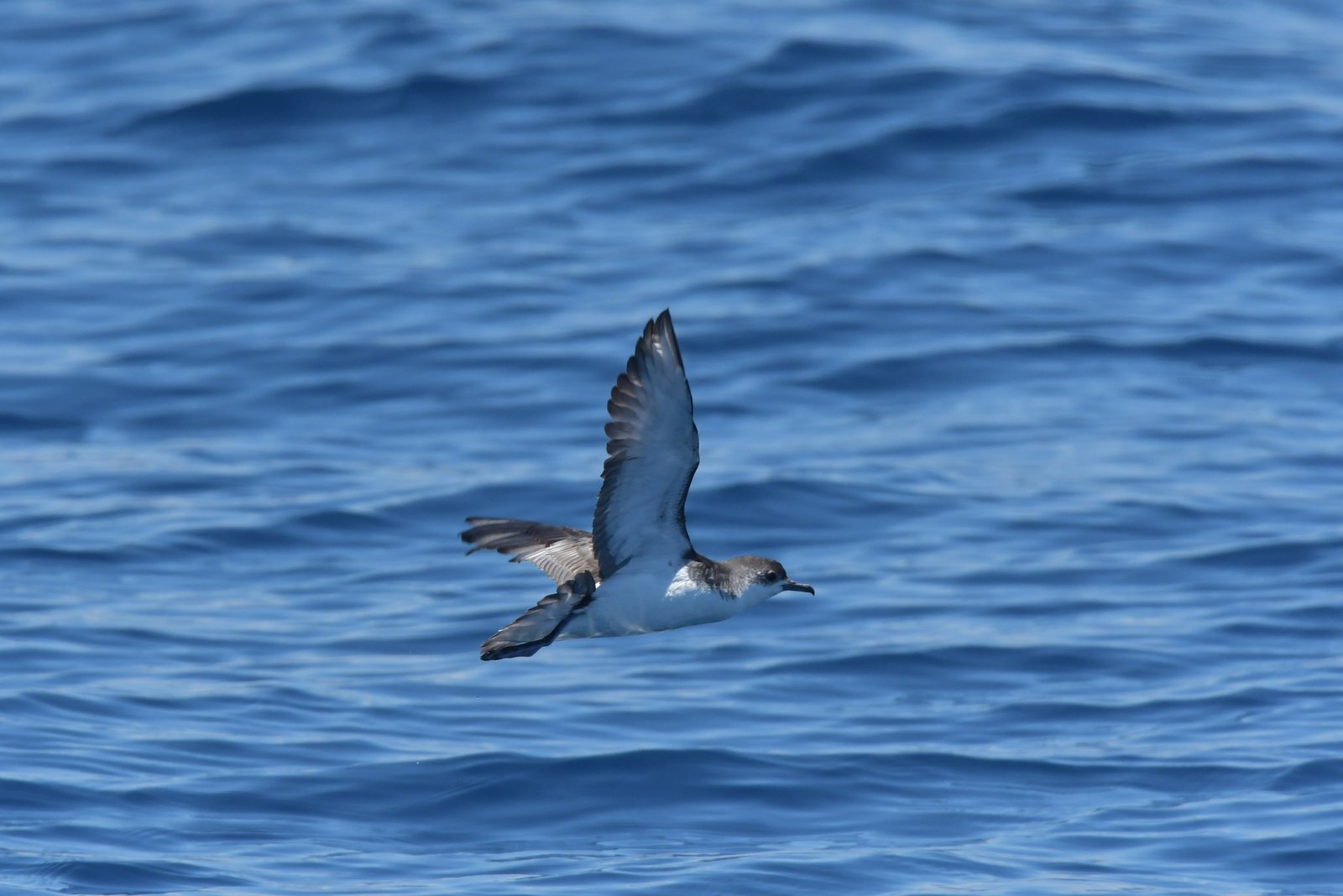
The Little Shearwater is the smallest shearwater of the region: a compact, crisply black-and-white bird that flies low over the waves on fast, whirring beats. Birds reaching southern Africa belong to the subantarctic form elegans, which breeds on Tristan da Cunha and Gough and is treated by some authors as a separate species.
Voice
Silent at sea. At the colonies a high, rhythmic, cooing and cackling call from the burrows at night.
Recording: David Boyle — CC BY-NC-SA 4.0 · shortened to the first 60 s, mono · xeno-canto
Identification
Small, 25 to 30 cm, with short, fairly broad and rounded wings. The upperparts are slate-grey to blackish with a blue-grey tinge in fresh plumage. The dark cap ends above or just at the eye, so that the face looks white and open, with the eye in the white or on the border. The underparts, undertail coverts and underwing are pure white, the underwing with a narrow dark margin. The short bill is dark and the legs blue-grey to pink. Sexes alike. It flies with bursts of fast, shallow beats and short glides, and often dives briefly.
Confusion species
Manx Shearwater (Puffinus puffinus) is larger and longer-winged, with a cap reaching below the eye, and flies with longer glides. Tropical Shearwater (Puffinus bailloni) is browner above and has dark undertail coverts; it occurs mainly off the east coast. Common Diving Petrel (Pelecanoides urinatrix) is smaller still, with a whirring flight without glides and a very short, stubby bill.
Habitat
Cool to temperate seas, often over the edge of the continental shelf and at fronts between water masses. It dives often and deeply for its size and hunts small fish, squid and krill. It rarely follows ships. It breeds in burrows on grassy islands.
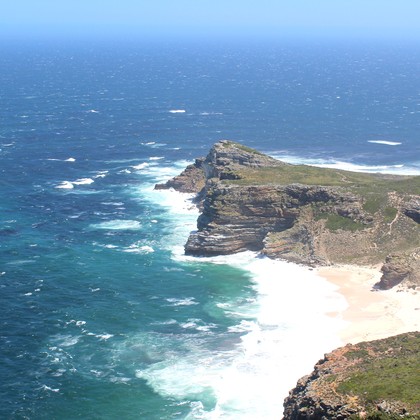
Where the bird is most at home, classified by the vegetation units of southern Africa.
Range and movements
A scarce visitor off the Western Cape and the Agulhas Bank, mainly in the austral winter; rare off Namibia and the Eastern Cape. The form elegans breeds on Tristan da Cunha, Gough, Amsterdam and Saint-Paul, the Chatham Islands and the Antipodes; other forms breed in Western Australia, on Lord Howe and Norfolk Islands and around New Zealand.
- Passage (Mar–Apr, Oct–Nov)
- dark = core range, pale = thinly spread
How and when to look
The chance is greatest on winter pelagic trips from Cape Town, far offshore over deeper water. Look for a small, fast black-and-white bird with a white face that whirrs low over the waves and suddenly disappears underwater. It is easily overlooked among the more numerous prions and storm petrels.
Conservation status
Not threatened. On some breeding islands introduced rats, cats and mice have caused severe damage; after predator eradication colonies are recovering locally.
Scientific name
Puffinus assimilis | Gould, 1838
Gould described the species in 1838 and placed it straight away in the genus where it still stands. The genus Puffinus was introduced in 1760 by Brisson. Puffinus comes from English puffin and its variants, the name for the cured nestling of the shearwater, once a delicacy. assimilis is Latin for 'similar' — for its close resemblance to related small black-and-white shearwaters. The specimen the first description was based on came from Norfolk Island.